Review of Bamboozled (2000) by Stephen W — 01 Aug 2010
A Film to Watch Once.
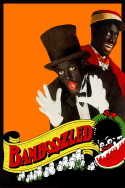
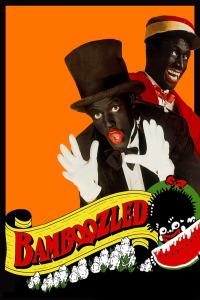
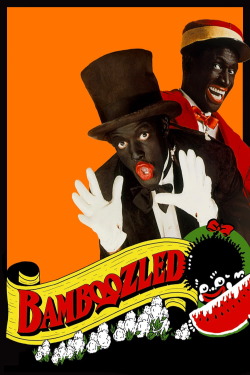
As it happens, I am able to compare my opinion of this film, at least in part, with the President of the United States. I am able to do this because of Roger Ebert for two reasons. One, he wrote the opinion to which I will be comparing mine. Two, the person who discussed Roger's opinion with him then shared the story in the comments to Roger's blog. So this becomes the only movie I know anything about Obama's opinion of, which has all sorts of sociopolitical ramifications I kind of don't want to go into. I do know, however, that I agree with both of them and not the person who brought the story to Roger's attention. Roger said, in his original review, that Spike Lee's big problem was the use of blackface. Once blackface was brought into the situation, that's what the story becomes about. There are a lot of legitimate, and perhaps a few illegitimate, points to be made here, and certainly the image of the two men's putting on the burnt cork is evocative and powerful, especially in the scene where you can tell that the two men are thinking very different thoughts. But it is still, when you get right down to it, made more about the blackface than, well, what's behind it.
Pierre Delacroix (Damon Wayans, acting for once) is a network executive who might as well wear a label in the office saying "hired because he was black." He is educated, intelligent, and eminently qualified for his job. He is also cut out of any real authority, to the extent that his assistant, Sloan Hopkins (Jada Pinkett Smith), isn't told about important meetings. His boss, Thomas Dunwitty (Michael Rapaport), wants him to come up with ideas that are "more black." He comes up with a satire, an honest-to-Gods minstrel show starring street dancer Manray (Savion Glover), whose name he changes to Mantan, and Womack (Tommy Davidson), whose name he changes to Sleep'n Eat. "Dela" comes up with what he thinks will be the most offensive concept possible, one so insanely racist and over-the-top that it will point out how ridiculous the concept of a "black show" is. Only, of course, there is no idea so ridiculous that someone won't run with it. Womack starts out being horrified by the whole thing, but he goes along with it because Manray thinks it will make them rich and famous, and he's tired of being homeless. Dela is willing to ride on the show's success, but Sloan isn't so fond of it, and her brother's group, Mau Mau, is growing violent. And suddenly, blackface has become cool, hip, and fun again in modern society--in the New Millennium, as it's so persistently called.
It's painful to watch, and Lee wants it to be. I have a book where a character chortles with glee at the idea of her satire, only for it to fall flat when the person it's intended to lambaste takes it seriously. Similarly, it's all but inevitable that some idiot will take "A Modest Proposal" seriously if you study it in a class. Thus the change in expression on Dela's face as the executives make it plain they're planning to put the thing on the air, as the audience goes from stunned horror to raucous laughter, is familiar. At that, he has to tone a few things down; an early suggestion is that they put white people into blackface, which is about the only think Dela is able to shoot down. Both Womack and Sloan are aware pretty much from the beginning that the whole thing is sick. Sloan even puts together a compilation of blackface scenes from older media, and when she gives Dela an old cast iron piggy bank showing a stereotypical black person, and Dela is actually pleased, because he collects that sort of thing. The jokes are so racist that the stunned response of that first audience may well be the most genuine. The white executives and writers come up with ideas rooted so far back in American history that I think most people forget them until they're brought up in the kind of footage Sloan tracks down.
Of course, Lee doesn't let modern racism slide, either, and he suggests that perhaps there are black people responsible for perpetuating certain negative images. We're not just talking Dela's having developed the idea in the first place, either. The Mau Maus, for example, remove the "c" from "black," taking it as a sign of the White Man's oppression. They also take for themselves new names, all with "blak" as part of them. Sloan's brother (Mos Def) now calls himself Big Blak Afrika (again with the conspiracy of the letter C!), and I cannot but assume that he thinks of Africa as a single entity just as much as the average white person. Lee mocks modern performers who have become acceptable to white society, perhaps forgetting that his good friend Denzel is probably among the most "safe" black actors in the industry, for all he played Malcolm X nearly twenty years ago. Dela was born Peerless Dothan, and he has taken for himself a "whiter" name, probably so that it's easier to get by in white-dominated society. Perhaps most importantly, there is the plain fact that an awful lot of black people go along with the whole thing. Yeah, there are all kinds of people sitting out in that audience wearing blackface, but they got a whole group of black people to play outrageous stereotypes--while themselves wearing blackface.
But once again, we must come down to how Lee simplifies racial issues. In the making-of, he talks about how all these images of blackface and so forth show how much hate there was for "his people." Which might be satisfying to Lee, but which ignores an awful lot of, um, reality. As we've discussed before, Al Jolson both wore blackface and fought for equality for his black friends in the industry. And yeah. Yeah, a lot of people did, and do, hate black people. A lot of people do think those stereotypes are real. Those images influenced a lot of people. Not in positive ways. I don't want to deny Spike Lee's experiences. It's just that he tends to delve very deeply into the aspect he wants to of what he's looking at. It's true that, even today, a "black" name is less likely to get a callback for a job interview than a "white" name, even with identical resumes. (Literally identical. Studies have been done.) However, I don't think Lee considers how black experience ties in with that of other ethnic groups, the idea that a lot of Jewish performers had to change their names to get by in white society, too. And, of course, let us not forget that there is really only one white character in the movie, and he is as much a cheap stereotype as the ones Lee deplores when they're black.
This review of Bamboozled (2000) was written by Stephen W on 01 Aug 2010.
Bamboozled has generally received positive reviews.
Was this review helpful?