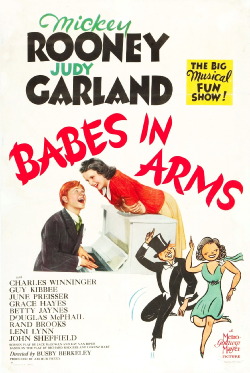
Review of Babes in Arms (1939) by Edith N — 27 Dec 2009
It Even Out-Grossed Judy Garland's Other Movie That Year!
The problem, as always, with topical humour is that it rapidly becomes dated humour. A restored sequence in this movie, which had been trimmed after Roosevelt's death, features him solving the world's problems . . . through dance! Which is, to the modern eye, a little disconcerting on several levels, not least being that, by the time the film was released in the US, Germany had invaded Poland. Also, you know, FDR by that point not so much about the dancing. Before 1921, possibly. But even leaving that aside, which was easy for audiences to do for a long time, Mickey Rooney does three impersonations over the course of the film. Clark Gable, well, yes; Clark Gable was in one of the best-known films of the year. But who these days (other than me) knows Lionel Barrymore as anything more than old Mr. Potter, nemesis of George Bailey? And who knows Eddie Cantor at all? And, of course, there is blackface. Lots and lots of blackface.
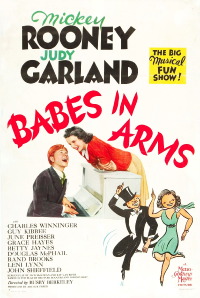
Mickey Moran (Mickey Rooney, taking a break from playing Andy Hardy) and Patsy Barton (Judy Garland, done with being Dorothy Gale) are showbiz kids. They were born and raised in vaudeville, that old-time starter of so many later radio and film careers. Only these kids are coming of age at the death of vaudeville, as the film really takes off in 1927, at the origin of talkies. The kids' parents go off to do a revival, and the threat is held over the kids that they're all going to end up in the system on a workfarm of some sort. Margaret Hamilton, also a refugee from Oz, is going to send them there. Mickey has sold a song to some Broadway bigshot for a hundred bucks, and he has the idea to save the family fortune by putting on a show in the barn. He recruits, and borrows over $200 from, former child movie star "Baby" Rosalie Essex (June Preisser). Her crush on Mickey threatens to come between him and his true love, Patsy.
Honestly, though, Margaret Hamilton kind of has a point. After all, there's a reason child performers are required to have on-set tutors now. Mickey Moran has dropped out of school, and no one much seems to have a problem with it. Except, again, Margaret Hamilton. Judge John Black (Guy Kibbee) seems to think show people are just the most adorable thing, even actually saying that they're like children, and only Margaret Hamilton is willing to stand up for the idea that the children's needs aren't being met. After all, the parents take off to Schenectady, from what I can tell leaving just the older kids in charge. Yes, all right, Mickey Rooney was nineteen at this point, but Judy Garland was seventeen, still a minor. And even taking into account Molly Moran (Betty Jaynes) and Don Brice (Douglas McPhail), there are an awful lot of kids just kind of running loose at that farm. They're said to skip school half the time, and they're pretty determined to follow their parents into show business even though it's quite plain that things aren't going so hot in the family trade. They really do need someone to look out for them, and while maybe Margaret Hamilton's solution isn't the best, it does seem like a better shot at a decent life than what they have.
It's funny, if you think about it, that one of the people looked down upon by the film is the child star--clearly based on Shirley Temple, who was roughly the same age as these kids--despite the fact that Mickey Rooney's first role was in 1926, Judy Garland's was in 1936, and Shirley Temple's was in 1932. It seems obvious to me that Baby Rosalie's parents were skimming from her salary, not an unknown practice, though it's supposed to be harder now. (I don't know how Dyllan's acting money is managed; I don't ask, because it's none of my business. I just assume he won't have trouble paying for film school next year.) Indeed, her father (Joseph Crehan) throws a fit because he thinks Mickey is taking advantage of her, though she sees it as staging the comeback Mickey Rooney so desperately wanted for all those years.
None of my friends seemed to have any idea what I was talking about when I referred to this as being the first movie wherein Mickey Rooney paired up with Judy Garland to put on a show in the barn. (And it is an honest-to-goodness barn, here, too, though they seem more to be using the barn as a backdrop, given events.) It's a genre dear to my heart as a concept, though I'm not sure how many movies I've ever actually seen in it. I don't even know how many there are to see. If the assumption that the first is the best is a reasonable one--given [i]Summer Stock[/i], with Gene Kelly instead of Mickey Rooney, I don't think it is, but anyway--the rest must be truly terrible. This one is a cute, harmless piece of fluff, especially placed in a context of its era, where it was okay to have a singing, dancing, Franklin and Eleanor. It hasn't aged well, but a lot of movies classic to their era don't. It's funny, though--for audiences of its era, better to cut the Roosevelts than the blackface. How times change!
This review of Babes in Arms (1939) was written by Edith N on 27 Dec 2009.
Babes in Arms has generally received positive reviews.
Was this review helpful?