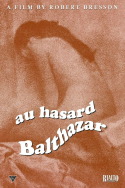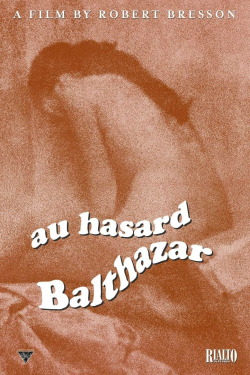
Review of Au Hasard Balthazar (1966) by Eric B — 22 Apr 2011
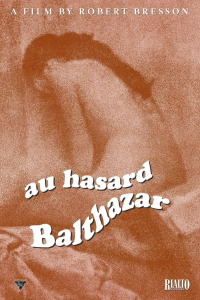
This was my second Robert Bresson film, and I sense that his style may be too gentle and pious to ever call him one of my pet directors. Still, "Au Hasard Balthazar" has a poetic eloquence that can't be denied.
Balthazar is a donkey who begins life as a cuddly foal, frolicking with children in the farmhouse straw. But he soon becomes harnessed as a mundane work animal, quietly enduring a procession of brutish owners and harsh duties. Yet he always retains a certain serene acceptance in his eyes -- an expression remarkably implied via editing alone. A scene where he exchanges "empathetic" looks with caged circus animals is especially poignant.
One of those initial children, Marie, is his most loving caretaker through the years, and she experiences a parallel fall from innocence and surrender to degradation. There are also suggestions that the nobly suffering Balthazar is a Christ figure, but overemphasizing this symbolism may be a mistake.
The film's main flaw is that its episodic structure means the characterizations are somewhat thin. In particular, a vicious youth named Gérard torments both Marie and Balthazar, but never makes his motivations understood. The nefarious Arnold is almost as inscrutable -- yes, he is a drunk, but does this fully explain his erratic abusiveness? Meanwhile, first-time actress Anna Wiazemsky (soon to become Mrs. Jean-Luc Godard) struggles to bring morose Marie to life, and spends much of the film woodenly standing like someone huddled at a graveside. Strangely, we identify more with the donkey than any of his human companions.
Unnecessary insertions of a Mercedes Benz and a transistor radio (playing contemporary French pop) serve to break the spell of what otherwise could have been a timeless story.
This review of Au Hasard Balthazar (1966) was written by Eric B on 22 Apr 2011.
Au Hasard Balthazar has generally received very positive reviews.
Was this review helpful?