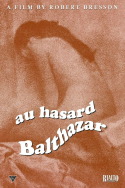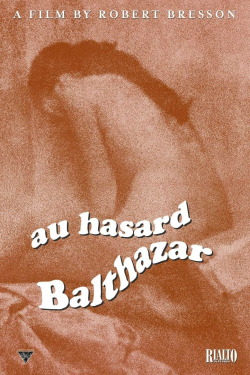
Review of Au Hasard Balthazar (1966) by Edith N — 28 Feb 2008
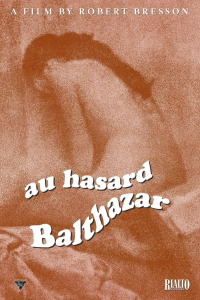
It's an odd thought, telling this story through the eyes of a donkey. Yes, all right, some of the story is his--the end, certainly, and I think the end sums up quite a lot of what we learn over the rest of the film. However, it's really the story of Marie (Anne Wiazemsky), Gerard (François Lafarge), and Jacques (Walter Green, if you can believe it). Marie's father (Philippe Asselin) and Arnold (Jean-Claude Guilbert) enter into it as well, but the real driving force of the story is the love triangle. However, the common thread running through the story is the passage of poor, gentle Balthazar from owner to owner.
He is born into a loving family; the children baptize him. Marie dotes on him, but he is sold to a cruel master (I have no idea). Eventually, he runs away and returns to Marie and her family. Perhaps they have to pay his previous master for him, but I don't know. Then, in time, he is sold to a baker (François Sullerot) and his wife (Marie-Claire Fremont), who employ wild, rebellious, [i]dangerous[/i] Jacques. Marie, as with so many young, foolish girls, is attracted to his Bad Boy nature. She rejects the kind and loving Gerard for him. Gerard, however, still loves her. Balthazar passes from owner to owner, ending up with the possibly-murderer Arnold. (If he is a murderer, he himself does not know it, having probably killed the person while in a drunken stupor.) When he leaves Arnold's service, he ends up back with Marie's family, and we can hope that he will find peace there.
Marie's mother eventually calls Balthazar a saint, and he surely has the patience of one. It should be noted that it often takes quite a lot of beating before he seems to notice it. Early in the film, Jacques hits Balthazar and kicks him, but the only thing that gets him moving is when Jacques ties burning paper to Balthazar's tail. Balthazar suffers through beatings, through overburdenings. He has no control over his life, of course, because he's a donkey. However, he is clearly the one with whom we are most intended to sympathize with. Marie is foolish. Jacques is dangerous. Gerard is over-trusting. The adults, all of them, fail to see what is going on. When Jacques receives a police summons, the baker's wife actually plans to smuggle him over the border rather than believe that he might deserve what happens to him.
The camera gives us the chance to form our own judgements of these people. There are few shots intended to impose Robert Bresson's view on us--no shots from above or below to make us see anyone a particular way; when the camera is filming from below, through Balthazar's legs or whatever, it is because that is the way to see what we need to see. The camera, like Balthazar himself, is an impartial observer on the follies of these people's lives.
Most of the men I know despair of women who choose the Bad Boy over the Nice Guy, and certainly Marie is guilty of that. Further, she assuredly pays for it in the end. There are a lot of women who find themselves in similar situations. Now, not all of them do, and not all women fall for the Bad Boy in the first place. However, we may see Marie's story all by itself as a morality play, even leaving out the wider implications of what happens with Balthazar.
This review of Au Hasard Balthazar (1966) was written by Edith N on 28 Feb 2008.
Au Hasard Balthazar has generally received very positive reviews.
Was this review helpful?