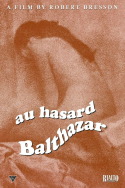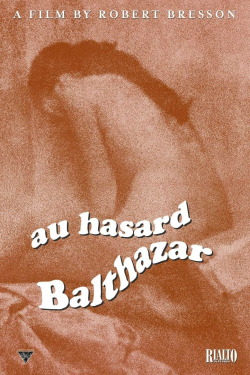
Review of Au Hasard Balthazar (1966) by Pascal V — 15 Jul 2011
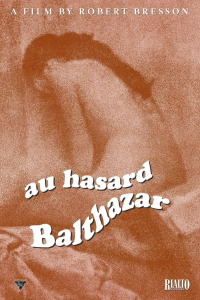
Robert Bresson's AU HASARD BALTHAZAR is a film whose purpose, throughout most of one's first viewing, is fairly unclear. The title character, a donkey, is relegated to the edges of the story for much of the film, taking center stage only intermittently. Instead, we see fragmented vignettes of events in and around the small village where he lives; Marie (Anne Wiazemsky), his first owner, falls in love with a young lout, Gerard (Francois Lafarge), eventually coming to grief; Arnold (Jean-Claude Guilbert), a pathetic drunk, is suspected of murder, and fears that he indeed committed horrific crimes while blacked out; Marie's father (Phillipe Asselin) is accused of shady business dealings, and the stress causes his health to break down; Marie, running from Gerard and his gang, takes refuge with an old, hardbitten farmer (Pierre Klossowski), whose interest in her is hardly pure.
Balthazar witnesses much of this, and is owned, or at least used, by all of these people in turn. He even has a stint in the circus, where he multiplies three-digit numbers to the amazement of the audience, but he soon becomes unmanageable and is sold again. Balthazar's owners are often hard on him, with only Marie being truly sympathetic to him; towards the end, after Marie has left (in what sense is not made clear), her mother (Nathalie Joyaut) makes little effort to prevent Gerard and his gang from using the old donkey in a smuggling operation.
This is, no surprise, a sad tale, but Bresson's spare style does not milk the material in any way; music is used sparingly (much of the music in the film is pop music played on Gerard's pocket radio), the visual style is straightforward in the extreme, and the pacing is quite deliberate. As such, the film was not quite the shattering emotional experience I had expected, but it honestly earns the emotions it does evoke.
We are aggravated, even amazed by Marie's blind devotion to Gerard: when she says, "He says, 'Come', I come, he says 'Do this', I do it...if he asked me to, I'd kill myself for him", it becomes painfully clear that this is an abusive relationship, a fact made clear also in the early scene when Gerard sneaks into her car and begins to grope her, and she makes little effort to dissuade him. We want Marie to realize what she is doing, and she indeed does so, but cannot resist a final confrontation with Gerard, an action which has disastrous consequences.
Our dislike for Gerard is well-earned as well. He is cruel to Balthazar, at one point tying newspaper to his tail and setting it on fire to get the donkey to move; he steals from his employers, he smuggles, and his actions toward Marie are despicable. Bresson shows us all of this simply and uncritically; we dislike Gerard as we would such a person were he real.
Bresson's script is carefully judged and simply written; the wandering plotting makes the film hard to follow at times (Arnold is dropped into the action with little explanation), but the events are generally intriguing enough to overcome this. His direction is equally simple; intelligent and unmanipulative. The film does feel a bit meandering at times, to be sure, and one does wonder just what the point of it all is, given the donkey's often fleeting presence.
It could be said that the film's goal is to show how life flows by when seen through the eyes of one who does not judge--in this case, Balthazar. People come and go, often without explanation; so it would be to Balthazar. The film's best moments, indeed, are those that focus on Balthazar himself. I don't know the name of the donkey Bresson used, but it's an endearing beast, and Balthazar's ultimate fate is quite moving.
Bresson's practice was to use non-professionals, and many of the performances are consequently pretty low-key. Wiazemsky's weakness of character as Marie is truly believable, and Lafarge's hooliganism equally so. Guilbert is intriguingly pathetic as Arnold, and Klossowski balances the farmer's lust and humanity (crabbed though it may be) well.
Ghislain Cloquet's cinematography is very fine, capturing the simple settings with an unflinching eye. It's not a flashy film in any way, but Cloquet gives a quiet painterliness to the images that is entirely suitable.
AU HASARD BALTHAZAR is a thought-provoking film, but for me, it falls just short of greatness. If the film had focused more on the donkey, it might have been better; after a while, one gets a little weary of these dour people and their tragic lives, and while they are sympathetic, Balthazar is more so. That the film brushes over most of Balthazar's youth is unfortunate as well; a more balanced look at the life of this creature would have really been fascinating.
But if it is not the masterpiece some have made it out to be (consider Jean-Luc Godard's assertion that it is "The world in an hour and a half"), it is still a powerful low-key drama about sad lives in a muted world.
This review of Au Hasard Balthazar (1966) was written by Pascal V on 15 Jul 2011.
Au Hasard Balthazar has generally received very positive reviews.
Was this review helpful?