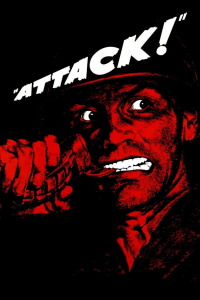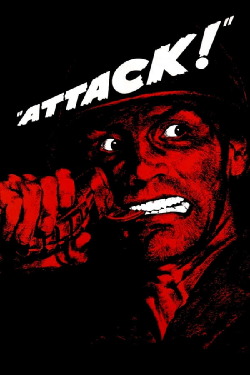
Review of Attack (1956) by Edith N — 28 Feb 2011
The Real and Secret Horrors.
One of the things that most people who know a little bit about the Civil War know about the Civil War is that General McClellan, who commanded the Army of the Potomac and was commander of the Union Army as a whole for a time, was easily fooled into believing he was outgunned. Robert E. Lee actually managed to fool him with logs painted black, the so-called "Quaker cannons." The Civil War was also riddled with political officers. Oh, McClellan wasn't one; he graduated second in his class at West Point. However, the mistakes made by McClellan and by those political appointees masquerading as soldiers are duplicated in this movie. As doubtless they have been duplicated in war over and over again through human history. They're simple failings, after all.
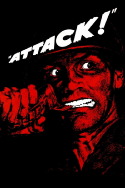
Lieutenant Joe Costa (Jack Palance) leads a small company of soldiers in the waning days of World War II. Some of his men were killed by orders issued by Captain Erskine Cooney (Eddie Albert). Cooney was in the National Guard before the War, and he is left in a position of command by Lieutenant Colonel Clyde Bartlett (Lee Marvin), who is hoping that Cooney's father, a judge, will aid him in his political ambitions when they get home. War heroes do so well on the campaign trail, after all. Unfortunately, he has the choice of bolstering Cooney's own military career or protecting the lives of his men, and everyone is pretty sure which choice he's made. The judge wants a son he can be proud of, and Bartlett will give him one over the bodies of a bunch of good men. Better men. And one day, Costa tells Cooney that if one more man of his dies because of one of Cooney's orders, Cooney will never return to the United States.
Cooney's failing isn't cowardice. Oh, he certainly is a coward, and I'll admit I spent the whole movie waiting for him to get shot. What else could his fate be in a gritty movie? His failing is that he doesn't care how many men die in order to boost his own personal career. He won't listen to Costa's advice about the situation they're probably entering, because he doesn't dare be wrong. He won't provide support when Costa's men are pinned down in the "little old house" he told them to shelter in because it might mean endangering himself. He has to come out of the war a hero. He's essentially promised his father that he will--and Bartlett has backed him up. It is only because his cowardice hurts his men that he isn't just ignored and scorned. He has killed better men than he, and that cannot be allowed to stand.
The military refused to cooperate in the making of this film. They don't have to, of course. Your Tax Dollars at Work doesn't have to include loan of tanks to MGM. However, most filmmakers submit scripts before production anyway, because if the military [i]will[/i] loan them tanks, that's a lot cheaper than renting them, which is what Robert Aldrich had to do. The military was deeply displeased by how the command structure was portrayed here and refused to be a part of it. There's only so much you can blame them, of course. Though I will say that the implication is that the Cooneys of the military get sorted out eventually. Not that the method Cooney is sorted out by is exactly one the Department of Defense exactly wants to condone, either. It's arguably a very moral movie, however, wherein courage triumphs. The bravery of one man overcomes the cowardice of another. And after all, they might have then hyped Eddie Albert's actual service record.
Now, of course, men die in war. That's what war is about. Realistically, several wars have been about sending your men climbing over the bodies of those who went before until you reached your goal, which was glory for King and Country, or whatever entity you were fighting for. Costa knows that. I mean, he'd have to. So it isn't entirely the deaths of his men. His men had a chance of dying no matter who was issuing the commands. No, the problem is that they are given foolish orders. In fact, someone higher up the chain of command would have been forced to take notice of Cooney sooner or later, because his cowardice also prevented his achieving the goals he was ordered to. He was to take the town, and he sent in forty guys and then withdrew when it turned out he needed more than that. Even McClellan got fired, remember, and Cooney was no McClellan. McClellan won sometimes.
This review of Attack (1956) was written by Edith N on 28 Feb 2011.
Attack has generally received positive reviews.
Was this review helpful?