Review of Appaloosa (2008) by Stefano L — 09 Jan 2011
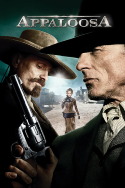
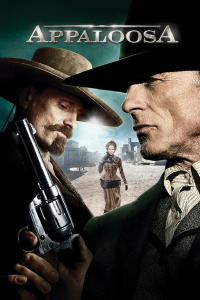
On the surface, Appaloosa appears to have a lot going for it. First off, Ed Harris and Viggo Mortensen have very good chemistry together and are quite believable as freelance 'peacekeepers' hired by the town of Appaloosa to reign in local bully Randall Bragg played by the very well-respected actor Jeremy Irons. Ed Harris's 'Cole' in particular reminds me of a laid-back but strong Gary Cooper from 'High Noon'. He's also got the swagger of Richard Widmark, with that violent disposition always on the verge of exploding to the surface. Viggo Mortensen's 'Hitch' is also a cool, likable character who's remarkably good with a gun.
For the first half of the movie, Harris and Mortensen maintain a cool demeanor in the face of Bragg and his group of menacing bad guys. The gunfight scenes are intentionally low-key and are well-done. But as things move along, there aren't really anymore startling revelations about these characters. What you see of the two principals in the first half, is basically what you get in the second half too. Cole and Hitch simply don't develop as characters. Yes, there's the running joke where Hitch is a better word-smith than Cole and is always helping him find the right words; and there's also a little bit of conflict when Rene Zellweger's "Allie' comes between them. But that's about it. More attention is paid to the 'logistics' of the film (as Ed Harris puts it during the DVD commentary) than the characters themselves.
Even worse is how the screenwriters handle the antagonist Bragg. He's supposed to be an erudite easterner who once worked with President Chester A. Arthur when he was in charge of the Port of New York's 'Custom House'. Somehow, the intellectual Bragg (who later quotes Emerson while in Cole's custody) has become the leader of a bunch of cut throats. We never learn what makes Bragg tick and eventually he loses his proactive stance and becomes Cole's prisoner on two occasions. Instead of building tension by having Bragg become more powerful, he's reduced to becoming a defanged prisoner being transported about in handcuffs.
Bragg's rehabilitation at the end of the film seems a bit hasty. We're told that President Arthur pardons him and before you know it, he's back in town, is able to purchase Appaloosa's main bar/hotel and suddenly is being feted by the very citizens who wanted him dead at the beginning of the film. Why these 'upstanding' citizens would suddenly forgive the man whose men murdered an innocent townsperson and raped and murdered his wife is not explained. But it does allow the screenwriters to allow Hitch to take Bragg out at the end since the bad guy must pay for his prior transgressions.
I'm not a great fan of Rene Zelwegger's acting abilities and I recognize that she is not the most attractive of Hollywood actresses. But does she really deserve the kind of reviews (replete with all kinds of misogynistic epithets) found here? In a movie such as this, it might not have been a bad idea to cast a woman who does not have 'model' looks. Do you really believe that the majority of women in the wild west were raving beauties? More likely most of them were plain like Zelwegger. Nonetheless, her part is not well-written either. Again, there's little character development. Allie's romance with Cole is more than a whirlwind romance—it basically happens in a virtual millisecond. Eventually we find out that Allie has a 'man' problem—she falls for just about any man she comes across, whether they be good, bad or ugly. In addition to that revelation, she also plays an unsteady piano and likes to flirt.
Appaloosa's strong suit is the cinematography. It's shot by a master craftsman, Dean Semler, who we're told worked on this picture for "next to nothing". And I have never seen better end credit shots in my life (dig those Indian head pennies!). A great amount of attention was paid to period detail in Appaloosa. The town looks like an 1882 town but it's too clean and doesn't feel lived-in.
Appaloosa has a similar plot to another recent western, "3:10 to Yuma". In both pictures, the lawmen transport a condemned prisoner who has a date on the gallows. As previously mentioned, the antagonist no longer can command his troops and the plot becomes a rather dull escape and capture potboiler. There are also a significant number of gaps in logic throughout the film. For example, when the Sheriff attempts to bring Bragg in at the beginning of the film, he only brings along two deputies and is easily shot down by the miscreants. No lawmen would walk into a situation where he could be cut down so easily. A posse of Federal troops accompanying the Sheriff would have been more believable. And how does the experienced lawman, Cole, allow his precious Allie to remain unprotected while he's busy transporting Bragg to justice? Don't you think he would have made provisions for her to hide somewhere or protected by some of his people while going about his business?
Check out Ed Harris's father in real life as the Judge who finds Bragg guilty. He's a hoot; one of the best characters in the film. But the same can't be said for the ineffectual townspeople who are unable to stand up against Bragg and his band of killers. It's become a cliché to have a bunch of cowering townspeople looking for salvation from lawmen for hire. In history, the townspeople were no pushovers. Take the case of Jesse James, who almost was killed by the outraged townspeople of Northfield, Minnesota after he robbed one of their banks.
Ed Harris is to be commended for making a beautiful, atmospheric film. But he should not have collaborated on the screenplay which required a more creative hand to improve a weak plot and provide more substantial character revelations.
Two and a half star with a little plus, out of four.
This review of Appaloosa (2008) was written by Stefano L on 09 Jan 2011.
Appaloosa has generally received positive reviews.
Was this review helpful?