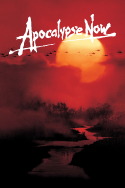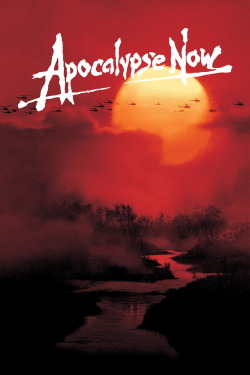
Review of Apocalypse Now (1979) by Cameron J — 21 Apr 2012
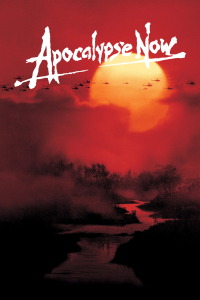
Now-a-days, poor ol' Martin Sheen is probably getting Vietnam War movie flashbacks, because the only thing crazier than Francis Ford Coppola's vision of this film and the Charlie in it is his own Charlie. Well, to be fair, Chuck might just be a little bonkers, because he recently visited the old family film collction, watched this little number, and now, he's gone a little bit fuzzy. Well, either that, or he checked out dad's copy of "Gettysburg", and by the end of that big, four hour mamma-jamma, he was burnt all kinds of out. Of course, then again, maybe I'm just instinctively making up excuses for Mr. Sheen, after all that he did for Alabama after that major tornado disaster. ...Oh no, I'm not going soft on him, because I'm so grateful, but because he now has a better idea of where to find me, and considering how crazy he is, I'm afraid to think of what he'd do to me. Well, that's another time and another day, but right now, I'm gonna have to clear my schedule for today, because it's "Apocalypse Now". No, that wasn't a cheesy, ridiculously long stretch of a joke about how I'm going to have to deal with the Apocalypse today, but rather, a cheesy, exaggerated joke about how this film will really take up my whole day, because I'm watching the "Redux" of this puppy, and that's going to take me a while, which isn't to say that I mind, because, make no mistake, this film is pretty awesome, no matter what version you're watching, and yet the day still doesn't go completely without a few hitches along the way.
As much as I'll forever and always respect Francis Ford Coppola for practically giving birth to certain major modern filmmaking sensibilities, he also, by extension, practically gave birth to too much slowness in the midst of new film quality. Well, kids, don't get too worried, because this film isn't even mildly as slow as something like "The Godfather", partially because it's sometimes a little too noisy for you to get hazy, though it does hit the occasional point in dry quietness. Still, what you have to worry about, more than dry dullness, is simply too much material and repetition that drag things out, especially in the "Redux", which I'll still praise quite a bit for giving the film more texture, depth, exposition and even entertainment value, usually within the midst of the excess material and repetition. However, while that added texture and depth might be enough to make the "Redux" superior to the original, it's too close of a call to tell, seeing as most of the extended version's improvements go balanced out by the excess material, because although that helps the film in many ways, there's no getting around the fact that certain aspects do, in fact, well outstay their welcome. Still, although that's especially an issue in the extended cut, dragging can also be found in the original cut, which is more of a problem than you would imagine, because the film starts out, as well as ends amazingly, yet in between that, it does nothing to up the oomph in order to cancel out the losing of steam in the midst of all of the dragging, leaving the film to fall of balance and fall rather flat on its potential of being full-on great. However, while the film does fall from grace, it never falls too far, and is never less than excellent. Sure, it stands to be tighter and, by extension, better, though it never would have stood as chance of being amazing in the first place, if it didn't have great components, and while those components don't do enough to keep the steam of the film constant enough to make the film, as a whole, amazing, they still really knock it out of the park and pull you in, shattering the limitations of its time, while still having enough dazzle to captivate you, no matter which generation you occupy.
From a technical standpoint, alone, the film played cards that few, if any other films were dishing out at the time, and cards that, even now, aren't played as sharply, notably when it came to sound design, something that this film has not gained enough attention for, because this stuff is close-to, if not decidedly groundbreaking. The very first bit of sound in the film, in which we hear quiet, ghost-like echoes of a helicopter has got to be among the most memorable, defining moments in cinematic sound design history, and yet, it doesn't end there, as the film continues to be boastful, sometimes to the point of being a little too noisy for its own good, but typically to deliver on sound style that's probably among the most clever and unique ever, as it marries both the realistic atmosphere and surrealistic aura with resonant, engaging and transcendant audibility that further amerliorates the film's themes, while placing the audience so far into this world that it makes it that much harder to resist. Still, the film not only catches you by the ears, but is also just as thorough in catching your eye through Vittorio Storaro's breathtaking cinematography, which bounces color and lighting in a way that made it look totally new at the time, as well as still beautiful by today's standards, as it gives the film a gritty glow that emphasizes both the brightness and bleakness of the environment in a surrealistic fashion, while the clever staging of the camera gave the film epic sweep and scope, as well as a kind of tight intimacy that placed you even deeper in the character's situation of being trapped in a broad environment, though just not broad enough to feel safe. That visual and audio glory certainly comes into play pretty phenomenally during the action sequences, which were, like the aforementioned cinematography and sound style that ices the action cake, inventive at the time and still stellar today, with concepts and staging that immersively lock you into the scenario, as well as blow you away with style, whether it be during any given frantic firefight, or that dizzying, air-tight air raid sequence. The film is a stylish one, yet really understands how to use that style to also supplement the substance, and boy is there plenty of substance here, and for that, there's no not thanking the performers, just about all of whom are great on that classic Coppola level that even rivals mordern acting abilities, with most every performance being memorable, charismatic and riveting, from Robert Duvall and Dennis Hopper as justly noted come-and-go, show-stealers, to our secondary leads, Frederic Forrest, Albert Hall and Laurence Fishburne, all of whom boast electric comradery and chemistry - that, I might add, goes immensely intensified in the "Redux" - that give this film humanity and livliness; and yet, when the deeper, darker stuff falls back into play, our beloved charmers break our hearts with emotional depth and presence that further sells us on how war can truly break anything. Still, the real standout in the lead cast is the head of the show, Martin Sheen, who drenches the Cpt. Ben Willard character in a shroud of mystery and anguish, gained from too much experience in a humanity-destroying environment, creating a compelling lead of both strength and vulnerability that Sheen powers with subtle, yet glowingly palpable, raw, emotional grit that finds itself turned into tense, good-against-evil chemistry when Sheen faces his fashionably late equal, Marlon Brando, who delivers on that presence of broken brilliance in a corrupt and powerful, yet still vulnerable, antagonistic force, making him one of those great, mysterious villains for the limited time that he's on. The onscreen performers authentically and emotionally deliver on powerful, compelling grit that draws you to the screen, and yet, the real star of this show is the powerhouse talent "behind" the camera: Francis Ford Coppola.
When the chaos goes quiet, Coppola nails that sobering sense of relief, as well some degree of tension - stemming from unawareness of what is to happen next - that can be found in a quiet warzone, but one that could blow up again at any moment. Of course, when that warzone finally does blow up, Coppola nails the pure, unrelenting atmosphere of tension, claustrophobia, sweep and freneticism during wartime, which, of course, helps make the intimidating uncertainty of quiet post-battle that much more tense, for now you have a taste of what could happen. Coppola really understands the tension of war, making the film immersive and making the the breaking of our characters that much more buyable and compelling, making this quite a powerful portrait on war's affect on man, or at least until with come to a twist in the tone towards the end that changes the film's message all but entirely, and makes the film more powerfully thought-provoking than ever. Throughout most of the film, Coppola seems to be painting the same-old-same-old portrait of how war can break a man, yet he, like all other great war film directors, takes a unique enough approach, and does it in the midst of such high-quality storytelling, that you don't really mind, and find yourself just as fascinated and touched by the portrait as always. However, where the film goes way off to its position as one of the most unique war films ever is its latter part, at which point, it shifts gears and twists its message to make a more audaciously provocative, universal statement that proclaims that, while war is a quick way to break a man, the fact of the matter is that humanity is breakable, and it doesn't so much have to be war that breaks man, as much as it can be some kind of influencing power or philosophy that shows the true darkness and fragility of humanity, and how it only makes us more animalistic, if even that. The film subtley, gracefully and hauntingly paints an audacious, realist portrait on how every human has his or her breaking point, and at that moment, are they simply broken threats to everyone else's humanity, or are they even human anymore, and for that matter, are they even wrong to break our humanity, seeing as its so corrupt? In the end, Coppola crafts more than just a powerful message on the horrors of war, but a provocative message on the faultiness of humanity, as a whole, and as the film draws to its chilling conclusion, set to Brando's echoing and hauntingly simple, yet definitive whisper of, "The horror... the horror...", just try to not walk away in awe, at both the weight of the film's themes, as well as the quality of the film, itself.
Overall, while the film is never less than excellent, it's kept from being full-on great by the fact that it falls too drastically in quality at a body plagued by some overbearing moments, as well as some excess material, slow spots, moderate repetition and dragging that serve as plagues throughout the film, though one's at their most intense during the body, which, even with its flaws, still remains of very high quality, boasting stellar visual and sound style, as well as sharp action, general entertainment value and across-the-board excellent acting to hold you over between the magnificent first few acts and glorious final act, which not only gives the film a thoroughly satisfying conclusion, but a heavily provocative and unique message, on the limitations of humanity, that Francis Ford Coppola presents as sharply as he does the rest of the film's haunting, effectively meditative aura that leaves "Apocalypse Now" to stand as a thrilling, haunting adventure through the minds and "hearts of darkness" of the men at war that leaves you numbed and intrigued.
3.5/5 - Solid.
This review of Apocalypse Now (1979) was written by Cameron J on 21 Apr 2012.
Apocalypse Now has generally received very positive reviews.
Was this review helpful?