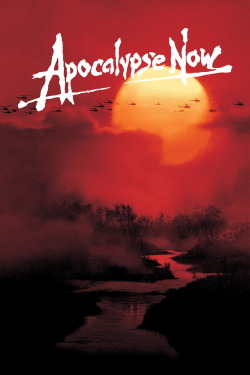
Review of Apocalypse Now (1979) by Tommy 'See The Treasure' S — 27 Jun 2014
*May be Spoilers*.
'The horror.. the horror!'.
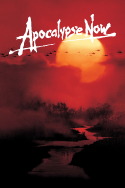
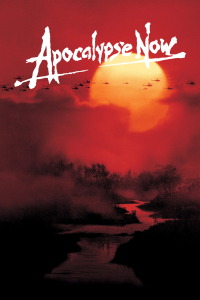
These are the final words spoken by Colonel Walter E.Kurtz(Marlyn Brando) but what exactly do they mean? The words resonate with eerie ambiguity. Do they indicate some final epiphany from Kurtz? Does he regret his vile actions? Or is he merely reinforcing his earlier decree: that in order to survive, man must either make friends or make enemies with horror. Francis Ford Coppola's Apocalypse Now, based on the classic novella, ''Heart of Darkness'' by Joseph Conrad, is a movie that deals with the horror of warfare and does so without simple prejudice or didactics. It goes to darker places than most war movies dare to go and it's no surprise that it's considered by many to be the greatest war movie of all-time.
While retaining the hallucinatory tone and dark themes of Conrad's classic novella, Copolla makes some adjustments to the story. The story is moved from Congo to Vietnam and Cambodia during the Vietnam war. Kurtz, portrayed in the novella as a deranged Ivory dealer, is now a rogue army officer who has committed horrendous acts of brutality and established himself as a Godlike figure to a worshipping tribe. Assigned with the task of assassinating Kurtz is the brilliant but disillusioned Captain Benjamin L.Willard(Martin Sheen). A wonderful parallel is drawn between these two characters and the lines between hero and villain are never clearly defined.
Before I continue I should note here that it is the extended redux version I am actually reviewing here, which includes around 30 minutes of extra footage. Critics and audiences alike have been divided in their reaction to this version, in particular to a lengthy scene where Willard and his crew meet a French plantation. This scene, despite reportedly costing hundreds of thousands of dollars, was actually cut from the final scene. Although the sequence adds a more political dimension to the movie it is not difficult to see why it was omitted. While I don't think there is anything particularly wrong with this scene, it does somewhat upset the rhythm and atmosphere of the story.
Some have likened this movie to Dante's ''Inferno'' and it's easy to see why. Willard and his crew's journey upriver to conquer the enigmatic and brutal Kurtz is akin to a slow fall into the deepest pits of hell, in which the moral codes of normal civilization no longer apply. Besides Willard, the crew themselves consist of mostly very young, irresponsible, and superficially cocksure young soldiers(Laurence Fishburn, Sam Bottoms and Frederic Forest) and a rigidly moral chief at the rudder(Albert Hall). None of them are permitted by Willard to know the mission objective but they suspect the worst. As the characters descend deeper and deeper into a nightmarish and hostile jungle, an atmosphere of obligatory madness festers. Meanwhile, Willard peruses through files of information on Kurtz, forming a morbid fascination with the man which hovers between admiration and terror.
Martin Sheen is terrific as Willard, showing the same sort of detached menace he showed us in Badlands. Sheen is a great actor who can hint at some inner madness with his singularly intense stare. Far from a pious war hero Willard is a somewhat dubious and ambiguous figure. We sense that he is not a million miles away from becoming something like the psychopathic murderer he is tracking down. Brando, despite limited screen time, gives a commanding and subtle performance as Kurtz. Like all the great villains of literature or cinema, Kurtz defies simplistic analysis. He is a manipulative and brutal man, but he is also intelligent, eloquent, and charming. The movie is laced with brilliant supporting performances from familiar faces. Robert Duvall contributes greatly with a scene-stealing cameo as a lieutenant(with a penchant for surfing) whose eccentric behaviour during an air strike raid suggests that he has completely lost his marbles. Dennis Hopper shows up as a fast-talking photojournalist who describes Kurtz as a 'great man'.
The movie is brilliantly shot and the scenes of battle are at once visceral and gruesome. Grand sweeping lateral tracking shots capture the war-torn environment and tend to evoke a sense of profound aimlessness. Despite their cruel and gory nature, these events are oddly thrilling and exhilarating to behold. The movie is bold enough to suggest that war can be thrilling as well as terrible, and that many of the young men who participate, do so with a perverse rush of pleasure. When the jaded and mentally unhinged crew finally arrive at Kurtz's horrific lair is one of the most memorable and eerie scenes I've ever seen. With bodies hung up in some sick pagan ritual and bones and severed heads scattered about as if in some macabre nightmare, we witness with uneasy clarity the full extent of the hideous crimes Kurtz has committed. This is a tremendous, visually spectacular and psychologically challenging war movie, and undoubtedly one of the greatest triumphs in the history of cinema.
This review of Apocalypse Now (1979) was written by Tommy 'See The Treasure' S on 27 Jun 2014.
Apocalypse Now has generally received very positive reviews.
Was this review helpful?