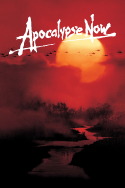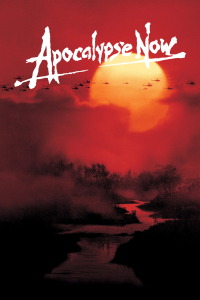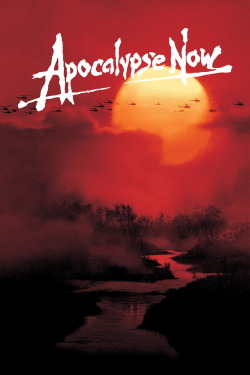
Review of Apocalypse Now (1979) by Moviemastereddy — 02 Apr 2016
In one of the scenes that have been added to Francis Ford Coppola's "Apocalypse Now," Captain Willard (Martin Sheen) smokes opium with a French widow (Aurore Clément) who lives in the crumbling imperial grandeur of her family's remote jungle rubber plantation. As Willard falls into a glassy-eyed stupor, and she slowly disrobes, the woman talks about her husband, a lost soldier in France's doomed colonial adventure, and about the essential dualism of human nature. "There are two of you," she says, "one that loves and one that kills.".
Variations on this theme surface from time to time over the three hours that make up "Apocalypse Now Redux," the expanded version of Mr. Coppola's 1979 film that opens today. The United States Army general who sends Willard upriver into Cambodia to find the mysterious Colonel Kurtz muses on the "conflict in every human heart between rational and irrational, good and evil.".
When Willard arrives at the tribal encampment that Kurtz rules like a mad deity incarnate, he encounters a manic American photographer, played by Dennis Hopper, who instructs him in the basics of "dialectic logic": "You either love someone or you hate them.".
The movie itself — shot over 16 months in the Philippines in circumstances by now as myth-shrouded as the story it tells — is similarly bifurcated, split between its immediate historical subject, the Vietnam War, and a grand, murky ambition to plumb the metaphysical heart of darkness. Whether it succeeds on either level has been a subject of debate at least since the film was unveiled at the Cannes Film Festival 22 years ago. Is "Apocalypse Now" a great Vietnam movie? Is it a worthy adaptation of "Heart of Darkness," the Joseph Conrad novella that is its putative source? Does its attempt to fuse 19th-century literature and 20th- century history hold together or fly apart at the seams?
Curiously, the passage of time has rendered these questions moot. Or to put it another way, "Apocalypse Now," in spite of its limited perspective on Vietnam, its churning, term- paperish exploration of Conrad and the near incoherence of its ending, is a great movie. It grows richer and stranger with each viewing, and the restoration of scenes left in the cutting room two decades ago has only added to its sublimity.
"Apocalypse Now Redux" arrives in this slack season to remind us of a lost era of visionary cinema, a time of creative self-confidence that frequently flirted with hubris, but also a time of risk taking and high seriousness. The artistic vision on display in "Apocalypse Now" — the divine madness that inspired Mr. Coppola to risk his health, his sanity, his fortune and the well-being of his cast, crew and family — is ultimately less impressive, and less important to the film's durable power, than the art itself.
And while the film may have been the apotheosis (and also the catastrophe) of American auteurism — the notion that a movie is above all the personal statement of its director — the achievement is not Mr. Coppola's alone. The script, which he wrote with John Milius, is a succession of vivid Dantesque vignettes that organize the absurdity, the cruelty and the hallucinatory randomness of jungle combat into a compact, episodic nightmare epic. With the exception of Michael Herr's uneven, self-consciously literary voice-over narration, the story is embedded, and embodied, in sounds and images: in Dean Tavoularis's production design, Vittorio Storaro's cinematography, Walter Murch's sound, and the voices and faces of its cast.
The current vogue for digitally enhanced, computer-generated special effects in live-action movies, and for jumpy, gestural editing, has lulled us into a pixelated, hyperactive slumber. "Apocalypse Now Redux" jolts us awake. The sequence in which Willard and his crew encounter a surfing-obsessed, Wagner-drunk air cavalry commander named Kilgore (Robert Duvall) could stand by itself as one of the best war movies ever, a rigorously choreographed spectacle of chaos and mayhem in which every line of dialogue is audible amid the gunfire and chopper blades.
To see the real helicopters swooping through actual space and exploding on the ground, to watch the villagers scrambling to avoid death from above is, in the summer of "Pearl Harbor," to feel a rush of nostalgia mixed in with terror and exhilaration. The old, cumbersome analog machinery, the handicraft of cutting and splicing what the camera has captured, impart a clarity and precision that the new technology has yet to match.
This review of Apocalypse Now (1979) was written by Moviemastereddy on 02 Apr 2016.
Apocalypse Now has generally received very positive reviews.
Was this review helpful?