Review of Another Thin Man (1939) by 'Amber L — 02 Aug 2013
Keeping Murder in the Family.
Someone actually observes in this movie that murders and pretty girls seem to follow Nick Charles (William Powell) wherever he goes. I actually have a perverse fondness for that kind of self-reference in detective fiction, especially when the detective either isn't a professional or else is and is still as likely as not to just sort of stumble over a body somewhere. The second sheriff on [i]Murder, She Wrote[/i] made the observation once, and the cops on [i]Detective Conan[/i] have made the observation repeatedly. I mean, it is a fair point, isn't it? The more so with [i]Detective Conan[/i], which is starting to reach the point where you wonder if anyone in Japan is left not dead, in prison, or a cop. [i]Murder, She Wrote[/i] lasted twelve seasons, which is a lot, but [i]Detective Conan[/i].
Has about seven hundred episodes. This is, what, the third [i]Thin Man[/i] movie? And most of them take place in big cities.
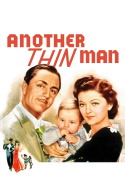
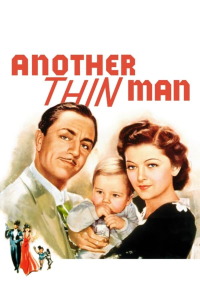
Nick and Nora (Myrna Loy) are home from San Francisco, back in New York. They have brought their baby, Nickie Junior (William A. Poulsen). They are called out to Long Island to see Colonel MacFay (C. Aubrey Smith), who had been a partner of Nora's father's and still has something to do with Nora's fortune. Naturally, the colonel is murdered. The first suspect is Phil Church (Sheldon Leonard), who says that, if he dreams someone's death three times, the person dies. Not, of course, that Phil himself kills them. But he dreamed the colonel's death three times, he says, and now, the colonel is dead. As usual, Nick ends up investigating the murder, whether he wants to or not. Nora, on the other hand, is enthusiastic about the idea of investigating the murder, and she's actually starting to get better at it. Not as good as Nick, but you know, that's the difference between a cop and an heiress. And the plot does tend to thicken.
One of the things I really like about these movies is the relationship between Nick and Nora. Okay, yes, they frequently pretend that they don't love each other--that they mostly just put up with each other. Nick pretends to have married Nora for her money, and it's hard to say why Nora married Nick, if you listen to them. On the other hand, a cop tries to make Nora jealous of Nick's past, and while she seems more curious than anything else, she spends the entire rest of the movie dropping the names the cop dropped to her, apparently in the hopes of getting Nick's side. When they run into each other in a nightclub, having gotten there independently while following two separate leads, he scares of a bevy of young men by asking if she's really supposed to be out of quarantine. Nora, gamely, goes along with it. After all, aside from the person who's got a lead for her, the only person she really wants to be with is Nick--though she's pretty confident she could have gotten the money to pay her informant from one of those men.
This movie also seems to spend less time insinuating that Nora is a completely unskilled investigator, which is possibly my least favourite running theme in the movies. Okay, yes, she misses her contact at the nightclub and ends up dancing with a gigolo, but she did get to the nightclub on her own in search of that tip. Which she turns out not to have needed, because the guy she was looking for just kind of came in on his own. Okay, it's while she's trying to extricate herself from that gigolo, but if she had just waited at that table a few more minutes, she wouldn't have needed to pay the informant at all. She's unskilled, but at least part of that is because Nick isn't willing to train her. This, I think, is because Nick really prefers being retired, but he keeps getting involved in these cases in spite of what he really wants. He's intrigued by them as puzzles, I think, and sometimes, he is investigating the deaths of people he knows and maybe even likes.
There's also the whole thing about Nick's bevy of underworld contacts. One of them, "Creeps" (Harry Bellaver), first tries to rob them, and when he finds out whose apartment it is, he decides instead to throw a birthday party for Little Nickie. And someone heard you couldn't get in without a kid, so he borrowed one from someone, because he wanted to go and didn't have a kid of his own. And so forth. I think the difference between that whole aspect of things and the way Nora is constantly shown to have no practical sense is that the movies are never mocking Nick. He is privately making fun of these people in his head, and it just so happens that they don't notice. Nora generally tends to, but one of the things I like about her is that she doesn't say anything. She is as unfailingly polite to people like "Creeps" as she is to the colonel or her own aunts and uncles. It is, I think, one of the things that Nick really likes about her, though he never says it--Nora has class.
This review of Another Thin Man (1939) was written by 'Amber L on 02 Aug 2013.
Another Thin Man has generally received positive reviews.
Was this review helpful?