Review of Annie Hall (1977) by Violet F — 11 Apr 2018
Sometimes, the most daring and influential works are the ones that age the worst. Techniques that were once fresh are copied so often they become blasé; the hype surrounding a landmark movie raises new audience's expectations too high; social progress renders certain characters or plotlines painfully insensitive. Annie Hall, I'm happy to report, avoids these pitfalls. Its influence is clearly seen in later rom-com classics like When Harry Met Sally - the subgenre of psychological New York romances owes a lot to Diane Keaton's vest.
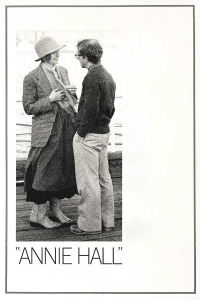
Released in 1977 to immediate critical acclaim and popular success, Annie Hall is among the most iconic Woody Allen films, filled with scenes and one-liners that have by now become a part of the American cultural consciousness. It's a work that, for all of its extraordinarily 1970s fashion, has stood up remarkably well to the tests of time - certainly better than many of Allen's other works (I'm looking at you, Manhattan). To speak personally, it's one of my all-time favorite films, largely due to its casual articulation of our anxieties about death, love, and much more.
At its core, the plot of Annie Hall can be summed up in very few words. Neurotic comedian Alvie Singer (a blatant stand-in for Woody Allen, as most characters he plays are) meets Annie Hall (Diane Keaton) over a tennis match. They quickly become romantically involved, and she moves in with him - but Alvie's insecurity leads to them breaking up. After the break-up, Alvie is depressed, and tries to get back together with Annie, to no avail. The End.
But, of course, Annie Hall is much more than that. It's a work that succeeds in the tricky balancing act between highly experimental filmmaking and charming, relatable characters. From beginning to end, Annie Hall is unconventional; not many movies have the main character break the 4th wall and directly tell the audience that life is "full of loneliness and misery and suffering and unhappiness, and it's all over much too quickly" - let alone in the first 25 seconds of the film.
Allen's background as a standup comedian is evident in the steady stream of witticisms throughout (upon Annie commenting how clean LA is in comparison to his beloved New York City: "That's because they don't throw their garbage away, they turn it into television shows.") The movie blends classic stand up jokes with Alvie's persistently nihilistic outlook; the final scene, in particular, uses this technique to extraordinary effect. Annie Hall is a work whose experimental storytelling is still innovative today - nonlinear structure, telepathic subtitles, briefly turning into a cartoon - but it's always in service of the greater message, rather than self-indulgent distractions.
Many people of my generation know of Woody Allen only as a creepy guy who married his adopted daughter, which is understandable - after all, he's a creepy guy who married his adopted daughter. But if you're able to separate the art from the artist, I'd highly recommend you give this one a watch.
This review of Annie Hall (1977) was written by Violet F on 11 Apr 2018.
Annie Hall has generally received very positive reviews.
Was this review helpful?