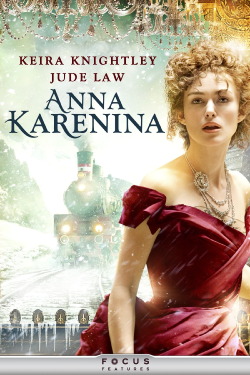
Review of Anna Karenina (2012) by Nathaniel S — 01 Jun 2013
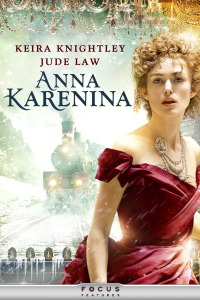
One of the most legendary novels in movie history gets another film adaptation, as Joe Wright adds his twist to the the tale. Anna Karenina has been made on the screen countless times over the past century and the role has been played by some of the greatest actresses of all time including Greta Garbo and Vivien Leigh.
Despite the numerous film adaptations, there has yet to be a definitive version of the film, mostly due to the challenging aspects of putting such a grand novel on the silver screen is such a challenge. This time around Joe Wright does his best to bring more style into the film, and it is that style that makes it stand out more than the other films. Does that mean that this film is certainly better; perhaps not. The film does carry numerous strengths not least of all the lead role played by enduring and vastly talented actress Keira Knightly (this is the third collaboration with Wright). Taking on a role made famous by Leigh and Garbo is not an easy task, but Knightly brings fresh air and a certain individuality to the role. With Knightly, Anna seems more lost and confused. Almost more childlike in her pursuit for true love. This time around we can feel sorry for all that has happened to Anna as she strives for something we all want.
The film does not stray far from the book, and all the characters behave exactly as we have come to suspect. Wright wisely decides not to take too many twists with the novel, and his interpretation of the film is what makes it among the most individualistic.
For all the praise that Knightly should receive, the co leads in the film are just as sharp. Jude Law is ideally cast as the wronged husband Karenin. Though his character is very still and lacks real vigor of Vronsky, he nevertheless pulls of the impressive feat of really showing us what he is feeling and thinking under that mask of emptiness. This is a man that truly loves his wife and in spite of all that she has done to him, he does not want to see her suffer. Little known actor Aaron Johnson should get recognition with this film. His performance as Vronsky is one of the higher points of the film. The playboy turned star crossed lover is believable. Although Vronsky is no the most likable character and through out the film reveals that he is weak, we also cannot help but feel a little pity for the man as he also is trying to find happiness in the comfort of true love.
The film centers around the idea of true love, and whether or not if there are boundaries that should not be crossed when finding that love. There is no secret that the film deals largely in infidelity. The question here is what is you are truly in love with another's spouse? What about divorce in an age where that is frowned upon? Can who live without the care of social standing.
When reviewing this I often think of Gone with the Wind, another film which deals with a character having to face the wrath of the public after doing what she thinks if right. The difference between Scarlett O'Hara and Anna Karenina is simple; O'Hara could care less what people think about her, and she is able to walk the streets of society and sneer at all the dirty looks and insults almost to a point where those insults actually entertain her. Karenina is not so fortunate in ignoring the hisses of society and she buckles under the pressure. Perhaps she might have endured it through the strength of her love. Here is where Vronksky must dig inside himself and help her through the initial rough patches. If it is true, and love can survive any obstacle, then we are not given that message here. Love takes a lot of strength and effort, but no character seems to be willing to put forth that effort for an extended period of time.
The use of religion and collectivism is a large aspect of the book, but the film does not focus too much on those philosophical aspects, which is a disappointment. The problem that we face with this film is the transitions. Wright makes the world one large stage, which is his way of saying that the characters lives are like one big stage show. Yes, the idea is creative, but it does not work. Sometimes it is confusing, and other times it is just to put on a spectacle. The art design and the effects are top notch. The dance scene can contend for the finest ballroom waltzes that I have ever seen on screen. Add that to a magnificent score and you have one beautiful look to the movie. The costume design is, as you would expect, top of the line.
So with great performances, a wonderful backdrop, and a good story, can't this film be considered a definitive version of the film. Overindulgence and not enough depth into the supporting characters brings this film down. We understand Karenina, but what about Levin or Kitty, who are among the most important characters in the novel. We are presented with forbidden love; a love that is wrong and will end in doom. Now what about true love that does not include coveting another spouse. Levin and Kitty represent immature love that eventually grows into something more; something pure and deep. This is real true love, but the film shy's away from it, and makes appear almost unimportant.
A good film for sure, and one that will make fans who love romance films leave satisfied, but those that are into the ideals of Tolstoy will leave a little annoyed and unappreciative.
This review of Anna Karenina (2012) was written by Nathaniel S on 01 Jun 2013.
Anna Karenina has generally received positive reviews.
Was this review helpful?