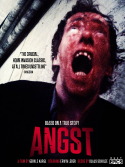
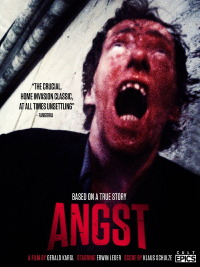
Review of Angst (1983) by Ivo W — 14 Sep 2014
The camera...
That camera is a protagonist. It is alive...
It moves like a mouse in closed spaces, like a kite through buildings and trees, like an observable stalker through the streets, like a mirror of human faces observed closely, and turns its head as quickly as a bird.
The score...
That score haunted my soul. It sounds like an omen of death.
Few films utilize a score so hauntingly. At first glance, it is deceptively simple, as the horror score consists of around 4 tones. But it terrifies you. It sounds like a choir echoing through a long, dark tunnel during midnight. Sounds like that make me feel powerless. It made the whole show more disturbing. This film embodies the word "disturbing" so beautifully. Actually, the power of the score does not rely on the film, and viceversa. both help each other.
And then we have views on violence.
Tangible monsters can be scary, but sometimes not as terrifying as the monsters of the mind. Those are harder to fight against. The protagonist embodies that anxiety. He is a prisoner of his own demands. The film is so honest and polished in its delivery, that it is almost obvious how Kargl never intended to bring exploitation to the table, but authentic horror without the need of a high body count, or screams. The more realistic it is, the more powerful the punch, and throughout, with the killer's voiceover, extreme disturbing close-ups, a camera that doesn't miss a detail, a realistic running time of events, a score that sucks your soul out, all technical accomplishments intentionally place you inside the killer's mind, and transforms your hands into his. The camera normally shies away from the intimate action of an assassination; here, you become the victim. You feel like drowning.
Another thing that serves as evidence for confirming that Kargl's scope wasn't intended as exploitative is the psychological character analysis approach used since the very beginning. The narrator IS the killer. That's a dangerous move for more reasons than you can count (ask Gaspar Noé, the biggest admirer of Angst), one of them being that you as a viewer have no choice but tolerating a rotten soul that kills out of pleasure, excitement and anxiety combined. And here's someting I don't remember seeing in the genre before: while we witness the violence and horror with such asphyxiating minimalism, the narration does not explain the killings in almost 100% of the occasions. Rather, it begins to reflect in the character's past. If you have enough energy and bravery to hear his anecdotes in case that you can get past the audiovisual stimuli of the horror portrayed, you realize that his stories were either much more tragic, or definitely more graphic and disturbing. It's deception after deception, all with bloody aftermaths, which he uses as a psychological justification of his current actions, as an attempt to rationalize his irrational impulses, which is already an oxymoron. That is simply one spectacular stunt, because if you want to escape from one story, then you have to switch to the other one (that being told or that being shown), so there is no visual or emotional escape. This state of being trapped mirror's the state of the killer as well. Indeed, if you observe carefully, the anecdotes he tells have parallelisms with what he is executing at the moment (the fat mother with the pig, the handicapped son with his stepfather, etc.). That is a very accurate and loyal definition of horror: not being able to escape.
How unfortunate it is that Kargl first appeared in the big screen with this extraordinary masterpiece and then left without a trace. However, Angst left an influential legacy behind in Austrian and German horror, and its reputation still lives in the minds of those who witnessed one of the most impactful psychological analyses in decades. If you liked this film, Buttgereit's Der Todesking (1990) is strongly recommended. Even fans of Henry: Portrait of a Serial Killer (1986), one horror show I respect well enough, should dare go to German-speaking horror territory from time to time.
97/100.
This review of Angst (1983) was written by Ivo W on 14 Sep 2014.
Angst has generally received positive reviews.
Was this review helpful?