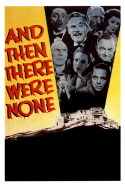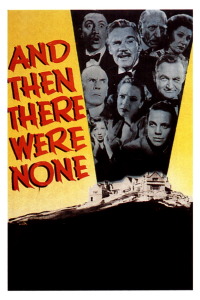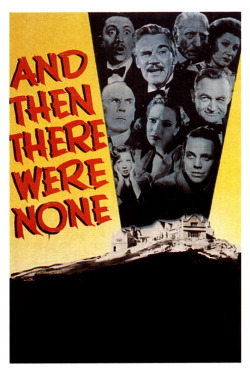
Review of And Then There Were None (1945) by Nelson R — 08 Jun 2018
And Then There Were None (1945) - - Rene Clair.
N. Rheem's synopsis.
Theme and summary - -.
And Then There Were None is a 1945 film adaptation of Agatha Christie's 1939 novel. Her book has been made and re-made into films numerous times by several film makers under several alternate titles i.e. Ten Little Indians. This author believes this 1945 version is the superior one to see.
This film is an interesting look at better quality English life circa end of World War 2. The student of history can gleen quite a bit about customs and norms from that time with watching and careful listening.
Eight invited house guests plus two hired house staffers are brought together onto an isolated island off the English coast. The house has been rented to a host unknown to any of the staffers or guests. Except for the staff, each person is there at the invitation of close friends of each guest. Prior to stepping foot onto the island none of the staff or invitees knows any of the other guests. Each invitee has been requested to attend a 'weekend' visit courtesy of their friends, the Owens.
The island is completely cut off from the British isles as there is no telephone connection, and the transportation boat only arrives by scheduled service two times each week. A single local electrical generator provides the power for house lighting. This becomes a significant weak link as the weekend progresses.
Their first evening they dine as a group of eight without their hosts who have delayed their departure for the island and remain in London. After dinner a recorded gramaphone record is played at 9:00PM announcing that each person has been accused of murder in one form or other. The gramaphone voice announces he is Mr. Owen, although none of the guests have ever met the man. Several guests deny the truth to the recorded accusations but one by one they all begin to die according to different circumstances.
The house staff is questioned regarding any other persons who could possibly be on the island, but firm insistence is stated that only the original ten persons seen and identified at the beginning are actually there. This lays the groundwork for a classic who-done-it murder mystery.
Over the course of the weekend their numbers are reduced until only two persons are left alive by Monday morning. This culminates in a surprise ending not at all unknowable when the facts are finally laid bare. The dialogue and sequence of events are all there for the astute student to surmise who the guilty party finally is revealed to be.
As one quest points out at the beginning, 'Two accidental deaths in 12 hours. I don't believe it.' The storyline parallels a song found on the piano and a small dinner table centerpiece of ten ceramic American Indian figures which are symbolically broken one at a time for each new death among the guests.
Rising tensions are amplified as more and more guests end up dead, and the scenes are increasingly shot in a house darkened by a failed electrical generator.
During one sequence, the guests are confined to the house interior due to rainfall. But even the rain raised the tensions further as they discuss the ramifications of the weather.
The director develops the personalities of each person very well. Each of their dialogues and actions are believable and bring a sense of stability to the storyline. Several quasi-friendships develop during the film progression which makes for some interesting alliances in trying to determine who is killing the guests. Several guests openly state who they trust and why for each set of circumstances. It becomes apparent that each person's attempt at cognitive reasoning to determine what is happening fails for a diverse set of reasons.
Overall this film is very well done, entertaining and watchable.
Filmic techniques - -.
Music is always a primary tool for setting tempo and emotions during a film such as this one. The musical direction staff and film editors did a first rate job of matching visual images with the spoken words and music background. An interesting montage occurs approximately half way through the film where one can imagine the thoughts of each guest without any dialogue, and only relying on the visual clips coupled with a piano sonata.
The films progresses quite quickly. The entire timeline of the film occurs during a three day period from Friday afternoon to the following Monday morning.
A billiard table is used as an analogic device to recall what has happened, and what could happen in the near future. As one guest observes, 'Nothing clears the mind like a game of precision.'.
Several humorous incidents were included to help break up the tensions, leading to the next rise in tensions, which keeps the viewer actively anticipating and on edge. This is a successful technique to help maintain a high level of anticipation for what will happen next.
The few well known actors included, Barry Fitzgerald, Walter Huston and June Duprez all play their parts very well. In fact all the actors are convincing in each respective role. (One of the dresses that June Duprez wears gives visual proof positive that quality fashion is always in style regardless of decade.).
This review of And Then There Were None (1945) was written by Nelson R on 08 Jun 2018.
And Then There Were None has generally received positive reviews.
Was this review helpful?