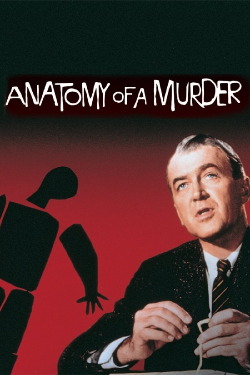
Review of Anatomy of a Murder (1959) by Mereie D — 03 Feb 2010
Admittedly, one needs a whole lotta stamina to digest this more-than-2.5-hour courtroom drama. At the same time, it never gets tiring or tedious, which must be regarded as a warranty seal for quality. I suppose that back in the fifties, the average movie watcher was not accustomed to being entertained by tough, thorough, deadly serious and highly realistic topics like these during his visits to the cinema.
In that sense, Anatomy of a Murder must have been something really special back then. It struck me that director Otto Preminger paid attention to virtually every detail in a court case one could possibly come up with.
There are not just the facts of the case themselves, but also the theatricals of the defending and the accusing parties, the emotional outbursts, the rhetorical tricks, the unexpected (and possibly unreliable) witnesses, the technicalities of the trade (discovering precedents, telling the jury to ignore certain things being said, which they are virtually incapable of), etc.
, etc. And all the time, there is also this nagging feeling lurking at the back of the viewerâ??s mind: was the rape accusation genuine or did Laura Manion (Lee Remick) make it all up, flirty as she is.
The final witness clears it all up for us. The only problem I had was with the ending, which was all too snappy for my taste. After the members of the jury have briefly stated their verdict, there is a cut to the final scene, which makes clear all is well as far as the defending lawyer and his associates are concerned, but is not too explicit on the situation of the accused and the relationship with his wife (or did I miss something?).
Perhaps this focus is meant to clarify that the protagonists of this film are not the accused and his wife, but the people who pleaded their case. It is true our sympathy lies mainly with Paul Biegler (James Stewart), who has a tough job cut out for him as a financially-tight country lawyer, confronted with bloodhounds like Assistant State Attorney General Claude Dancer (George C.
Scott) in a difficult enough case. The movie is devoid of artsy film techniques, which would indeed divert attention from a topic of which the facts themselves have enough body to construct a decent story.
The accompanying music by Duke Ellington was great, though. I felt it somehow did contribute something to the production.
This review of Anatomy of a Murder (1959) was written by Mereie D on 03 Feb 2010.
Anatomy of a Murder has generally received very positive reviews.
Was this review helpful?