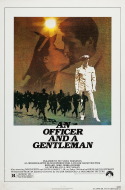
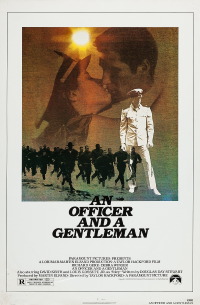
Review of An Officer and a Gentleman (1982) by Cameron J — 25 Nov 2012
"Love lift us up where we belong, where the eagles cry, on the mountain high!" So yeah, this film's theme song's lyrics aren't exactly written by Billy Joel, and yet, it's still one of your better '80s movie theme songs, so it would appear as though Joe Cocker didn't rather gratuitously growl his throat into dust... again, in vain, or at least not to everyone other than Don Simpson, who was so uncrazy about the super-hit song, which he didn't even expect to be a hit, that he tried to get the thing cut from this film to which he wasn't even attached. Ouch, that's pretty harsh, but hey, who would take Don Simpson's word when it comes to successful original music for a drama about Naval aviation? Granted, four years after this film came out, Simpson produced "Top Gun", whose soundtrack featured, like, 32 original songs and has a 9x Platinum certificate, but other than that, what does he know? Yeah, now that I think about it, if it wasn't for Simpson's not even attached to this film, the success of the "Top Gun" soundtrack's not coming until after this film and Taylor Hackford's having a history of both knowing quite a bit about music and being evidently extremely convincing (He got a 52-year-old Helen Mirren, who swore to never marry, to marry him; now that's impressive), Simpson might have stood a chance of getting this film's theme song cut, so we got pretty lucky, not necessarily because I'm all that crazy about "Up Where We Belong", but because I don't think something "Danger Zone" would fit all that much in this film, which definately isn't as action-packed as "Top Gun". Yeah, there's not a whole lot going on with this Naval aviation film, but hey, I reckon I'm not gonna complain too much, as this film remains a good one. Still, with that said, regardless of what Don Simpson might have you believe (if he wasn't dead), this film's song is the least of its worries.
The film isn't necessarily dull, or even really all that generally terribly bland in its slowness, yet there is indeed slowness, which will lapse quite often, yet not often enough, being prevalent enough for the film to go generally paceless and quite often blanded up, occasionally something fierce, thus resulting in atmospheric pacing problems that don't simply prove detrimental by their own right, but call more to attention story structure pacing problems. Douglas Day Stewart's screenplay has plenty of high points, but also has plenty of fat around the edges, not simply turning in too much material, but too much familiar material that sends the film in circles rather aimlessly, resulting in repetition of excess filler that slows down what momentum there is in the film and helps in granting the final product the over two-hour runtime that its story doesn't really warrant. Certainly, enough bite can be found within the story concept and directorial touches for the final product to come out as rewarding, but really, there just isn't a whole lot going on, with the more prominent military angle being compelling yet almost blandly minimalist, and the romance angle all but bringing things to a whiplash halt. At its absolute worst, the film is quite decent, yet about the only reason why the romantic attributes don't leave the film to collapse as underwhelming is because they're a touch underused, and even then, the relatively limited usage of the romance angle proves problematic by doing not too much more than create a sense of thematic unevenness upon the incorporation of the romance attribues that both throws you off quite a bit and further emphasizes just how lesser - nay - borderline expendable the romance angle is in comparison with the military angle. Again, the film is decent at worst, so I'd be lying if I said that I didn't enjoy any of the romantic subplots, yet the romantic angles are just so hardly compelling and necessary, with limited originality, hardly any sense of actual conflict and not really too much impact on the final product. Still, it's not like the story is, when at it's best, stellar or anything like that, for although the story's concept and execution is generally fairly sharp, there's not quite too much sting to any part of this tale, and with the slow aimlessness and excessive repetition bringing this more to light, the final product should, for all extents and purposes, underwhelm, which of course makes this film's success at true goodness all the more impressive. Don't get me wrong, the film escapes underwhelmingness by not much than a hair, yet the fact of the matter is that it makes its break into rewarding sharpness that stands prevalent enough to both leave you to walk away satisfied and recognize what value there is within the substance.
I wish I could say that the film's subject matters runs a deep as it should, yet many of the film's most potent story attributes have only so much weight to them, with certain other attributes, including a whole romantic theme angle, standing as borderline expendable filler, though no piece of this tale is less than enjoyable, and when the subject matter really picks up, while it doesn't quite lift up to where the eagles fly and Joe Cocker and Jennifer Warnes sing and, in the case of Cocker, growl, it all but takes off conceptually, alone. As for the execution of the worthy concepts, expect flaws, yet mostly for there to be quite a bit of inspiration, even in the writing department, for although Douglas Day Stewart's story structuring gets to be a bit bloated and even a tad uneven in its thematic shifts on occasions, Stewart's characterization and exposition layout is colorful and immensely charming, sparking much life into the character aspects that drive this film, while Taylor Hackford takes good care of the more atmospheric aspects, or at least when he needs to most. Hackford's atmosphere dries up all too often, thus creating the slowness that blands things up a bit, yet there is always enough juice in the air to keep charm alive and consistently engaging, and when Hackford really needs to deliver, well, he delivers, drawing intrigue and depth from the particularly dramatic moments, not to where a degree of predictability dissipates, yet certainly to where resonance accels and really brings the value of the subject matter to life. The final act kicks off with a tragedy that I bet you'll recognize behind an especially dramatic note that really does pierce with sharp emotional punctuation to the film's depth, which goes truly defined by particularly resonant moments such as those, yet isn't so lacking that the rest of the film finds itself unable to be kept alive as rewarding by other high points in writing and direction, as well as by high points in acting that never finds itself paralleled by low points. Certainly, due to the film's dramatic limitations, there are material limitations for our hefty cast of talents, yet each performer boasts piercing charisma that defines his or her character as distinctive and engagingly colorful, with Louis Gossett, Jr. particularly stealing the show whenever he hits the scene as the absurdly charming, dirtbaggishly take-no-bull drill instructor who we all love to hate and, at least in this film's case, walk away really remembering. Still, as charming as everyone is, there is indeed dramatic material that hits many people at one point or another, but perhaps hits leading man Richard Gere the hardest, and when that time comes, Gere delivers with emotional range that dances from grippingly broad to movingly subtle and goes into fleshing out the Zack Mayo character as more than just a colorful piece in the character department: a worthy lead. The film hardly soars, and never could, due to natural shortcomings, yet there is a fair deal of value to the subject matter that, when brought to life by the inspiration that powers the writing, direction and acting, makes all the difference and goes into making this film well worth watching.
When it's all said and done, slowness and repetition, as well as the uneven incorporation of the almost rather expendable and hardly compelling romantic attributes, emphasize the limitations within the bite of the subject matter and nearly brings this film to a state of underwhelmingness, yet ultimately finds its threats of undercutting the film's value fended off, as the film finds itself "lifted up to where it belongs" on the wings of quite a few high spots in the subject matter, fleshed out by the color within Douglas Day Stewart's charming writing and Taylor Hackford's sometimes resonant direction, and complimented by an abundance of distinctive charisma within the cast, from which Richard Gere stands out as a compelling lead and one of the reasons why "An Officer and a Gentleman" manages to cut through its shortcomings and ultaimtely stand as a rewarding watch.
3/5 - Good.
This review of An Officer and a Gentleman (1982) was written by Cameron J on 25 Nov 2012.
An Officer and a Gentleman has generally received positive reviews.
Was this review helpful?