Review of American Honey (2016) by Spangle — 03 May 2017
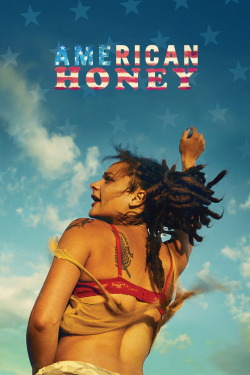
A hypnotic tone poem that explores the lost children of capitalism, seeking to make ends meet by any means necessary, American Honey is a Southern-set film that soaks up the essence of Antebellum life as well as the brutal poverty and isolation that goes hand-in-hand with life for many in the South and America. Telling the story of a group of lost souls that party, drink, smoke, and **** as they try and sell magazines throughout the midwest, American Honey brings kids together from all over the South and shows the division that exists in America between the rich and the poor. Wrapping you around its finger via its excellent soundtrack, unique camera work, and its essence as a film, American Honey is a harsh and truly exhausting film to watch for nearly three hours, but is an excellent slice of Americana and the underbelly of the nation from Brit Andrea Arnold.
The real highlight of this film is undoubtedly its music. Pulling from a wide range of inspirations from country to Bruce Springsteen to metal and especially to hip-hop, American Honey is a celebration of every corner of America. Though most of the characters hail from the south or midwest - Texas, South Dakota, Maryland, Florida, etc. - there are some from other states such as New Jersey and California. With its characters and music genres pulling from across the continental United States and reflecting popular music from various races and income levels, the film may largely focus on poverty and whites, but strives to encapsulate the American experience and influence that has on everyone who lives in the country. With gorgeous shots of the sun setting on the horizon or lens flares where the sun seems to blot out the whole image, Arnold captures the beauty of America wherever she goes. Beautifully maintained upper class homes, rugged oil fields, and open desert, are all given their due and show just how diverse the country in appearance, but one thing remains constant: how beautiful the land is no matter where you go. Through her camera finding this beauty and the diverse soundtrack, Arnold always sets the mood just right to be able to soak in this beauty and celebrate the nation's diversity wherever the group of kids travels.
In exploring this diversity though, the film really explores the divide between poor and rich that exists in America and also shows where they are the same. From pampered villages in rich sections of Kansas City to the poor backwoods of Rapid City, the film never shies away from showing the divide. For the former, the worst thing that happens is a daughter and her friends dancing provocatively to rap music in the backyard. For the latter, the mother is too drugged to even notice what her kids are doing. This divide between poor and rich is also shown by the traveling band of magazine sellers who freak out at the big buildings in Kansas City. For them, they have never seen anything like this with little-to-no big cities in the towns where they live. Yet, what is always common is how everybody is out for themselves and pitying those beneath them. People with Christian bumper stickers blow them off, oil workers pay for sex from the girls, and rich Texans try to exploit innocent girls by getting them liquored up. Nobody has their hands clean and that is, unfortunately, what really brings everybody together: selfishness. This selfishness is often derived out of pity where some people either respond to the feeling by offering a helping hand and buying the magazines. Or, they seek to just exploit the people and take advantage of their position as "superior". Yet, it is in the former that the film really finds its kind central heart. With characters such as lead Star (Sasha Lane), buying food for an impoverished family or taking care of kids that are not her's, the film shows what is possible when somebody feels not just pity, but empathy and offers a helping hand to those who are worse off than themselves.
Using unique camera work to capture everything, Arnold's occasionally hand-held camera in the van is really the highlight of this film. With music playing loudly in the back and constant extreme close-ups jumping from character-to-character, the film often feels like a home video. Casual, unfocused, and meandering, in this tone, American Honey seems to just be capturing events partaken in by real people at an actual point in time in American history. It is this unstructured approach that really makes the film feel its length and be mentally exhausting with very few plot threads that exist in this film to really weave it all together. The only thing left is the thematic considerations and beautiful camera work and, as a result, the film is one that really relies upon its tone to capture the imagination of the audience and provide the audience with the mental stimulation they require. In this endeavor, its hypnotic approach to filmmaking is mostly successful.
This review of American Honey (2016) was written by Spangle on 03 May 2017.
American Honey has generally received positive reviews.
Was this review helpful?