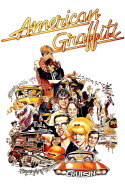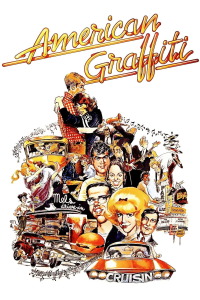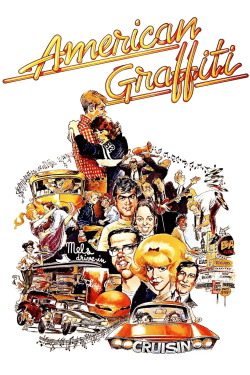
Review of American Graffiti (1973) by Brandon S — 20 May 2017
The first time I sat down and strapped into American Graffiti, I found my brow furrowing and my mind brewing. "It's like George Lucas just threw a couple of kids in some classic cars, drove around town, and shot, wrapped and edited whatever happened," I thought. "They're so far off script it's really beginning to show." As it turns out, that wasn't too far from the truth. With a tight shooting schedule and difficult edit, a production budget topping just $700,000 and a string of boys-will-be-boys antics courtesy of a young cast, American Graffiti was as unpredictable and unruly behind the scenes as the final cut of the film is on screen. But somewhere between the film's at-times pedestrian performances and stilted exchanges, the American Zoetrope co-founder's ode to early '60s cruiser culture takes on an invigorating life all its own. Boys struggle to become men, an oft-forgot era in American history springs to life, and indispensable songs from the likes of Buddy Holly, Chuck Berry and the Platters grab hold of the radio-savvy teenagers and propel them toward an uncertain future. Just don't go into Lucas' sophomore effort expecting a timeless classic.
American Graffiti tells the somewhat episodic, coming-of-age tale of four longtime friends and recent high school graduates - blonde bombshell-smitten Curt Henderson (Richard Dreyfuss, Close Encounters of the Third Kind), college-bound Steve Bolander (future Happy Days mainstay Ron Howard), stiff-lipped cruiser John Milner (Paul Le Mat, Melvin and Howard) and socially inept Terry "The Toad" Fields (Charles Martin Smith, The Untouchables) - who drive, dance and race their way to morning over the course of a single, life-changing night in Modesto, California. Set in 1962, sandwiched snuggly between the baby boom of the '50s and the social firestorm that would soon erupt as Lyndon Johnson began expanding the scope of the Vietnam War, Lucas' film exudes nostalgia and realism. While an unmistakable yearning for simpler times bleeds through nearly every scene, the director never allows nostalgia to consume him, nor does he don rose-colored glasses. (At least none that he leaves on for very long.) His third act represents a sobering, startlingly poignant commentary on the folly and short-sightedness of youth; so much so that it casts an all-too-revealing light on everything that proceeds it. Curt and his friends may be full of hope and youthful idealism, but the moment the boys face morality, uncertainty and looming adulthood - no matter how brief a glimpse each one of them may be afforded - whatever confidence they once possessed, whatever preconceived notions they might have clung to, are shaken.
Unfortunately, that same sense of purpose doesn't fuel the rest of the film. For the better part of ninety-minutes, Lucas hurries after his cast in a fit of cavalier spontaneity, shooting from the hip like an out-of-breath storm trooper. He not only takes what he's given, he doesn't bother asking them for anything more. (As Harrison Ford, Lucas' once and future gunslinger, explains it in the film's accompanying production documentary, shooting is the director's least favorite part of making a film.) The result is a string of hit-then-miss performances that showcase his young actors' inexperience more than anything else. Dreyfuss and Howard are the most invulnerable to Lucas' strange indifference, acting and reacting with the institutional ease of the natural talents they already were, but Le Mat, Smith, Ford, Cindy Williams and Mackenzie Phillips have a bit of trouble adapting to his directorial style. While their performances aren't bad by any means, or even average, they sometimes have the wide-eyed stare of actors unaccustomed to their surroundings. In some cases, the Lucas' slice-of-life beats work wonders: Smith's bike troubles, the burst of laughter that comes after Phillips is struck by a water balloon, and Le Mat, Ford and Bo Hopkins' drinking between takes. In other cases, such on-the-fly mishaps serve as all-too-jarring reminders that Lucas' Modesto teens are little more than pen-scribbled characters adrift in an at-times purposefully aimless narrative.
But just when it all begins to take a toll, the sweet smell of nostalgia wafts out of the doors of Mel's Drive-In. Though Lucas, to his credit, keeps a firm grasp on the wheel and his '70s wits about him, his innovative use of music and silence, all-encompassing sound design, and flawless selection of '50s and '60s rock-n-roll classics is the first of many things that help the film weather its more severe storms. It's really hard to despise American Graffiti, if only because the siren songs of some of the greatest musicians and artists of the era are weaved into the fabric of Lucas' distinctly American story. His approximation of 1960s Modesto, viewed through the lens of memories near and dear to his heart, can't be praised enough either. Everything from the cars to the diners and dives ring true, and his costuming, locations and set pieces only intensify the illusion and endear the film to anyone with affection for the time period, history or culture. Thunderbirds, sock hops, greasers, Impalas, real radio broadcast excerpts, there's even an appearance by legendary radio DJ Wolfman Jack himself. American Graffiti isn't George Lucas' finest hour, nor does it feature any career-defining performances from its cast members, many of whom would go on to do bigger and better things just a few years later. But it is a milestone in independent cinema, its director's canon and its actors' lives.
American Graffiti shares little in common with THX 1138 (other than American Zoetrope's independent know-how) and light years away from the original Star Wars trilogy. But it certainly has its charms and holds tremendous nostalgic sway over children of the '50s and teens of the '60s. The music and production design alone make it worth watching.
This review of American Graffiti (1973) was written by Brandon S on 20 May 2017.
American Graffiti has generally received very positive reviews.
Was this review helpful?