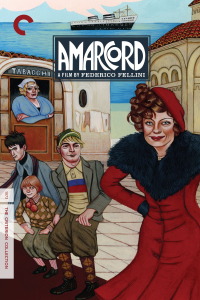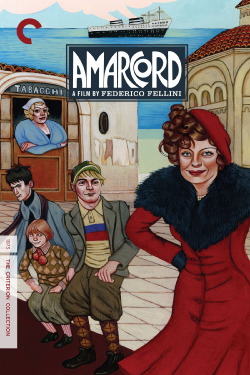
Review of Amarcord (1973) by Hans O — 03 Oct 2007
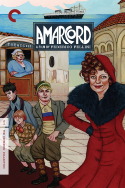
Nostalgia can give you a warm fuzzy feeling. Everything looks better with the passing of time. You can gloss over the nasty details and glorify the ones you wish to remember. Federico Fellini takes his brightly lit camera to the tune of cheerful circus music by Nino Rota back into his youth in a village on the Adriatic water front of Emilia.
Fellini insisted Amarcord (Emilian transliteration of â??I rememberâ??) was not strictly biographical. Perhaps. But the feeling of nostalgia is unmistakably authentic. It would be repeated with that other Oscar winning Italian movie of twenty years later, Cinema Paradiso.
Titta Biondi (Bruno Zanin) is a young teenage boy not yet coming to terms with his pubic virility. Judging by his other films, Titta suffers from that male illness that Fellini never recovered from, lust. Many of the adventures of Titta and his school-mates are a result of their groins thinking for them.
The town is collectively in lust with Gradisca (Magali Noël), the local hairdresser, not quite beautiful in the ordinary sense but more desirable in her fleshy, available way. Her nickname is a flirtation in and of itself, being essentially an invitation to partake from what she has to offer: â??would you like some?â?? But the poor girl, showered by attention of men of all post-pubic ages, is lonely and worried sheâ??ll be too old to marry and have children.
The boys also fantasize about the local tobacconist who has, quite literally as it turns out, large, asphyxiating breasts.
What to do but release tension in sessions of collective masturbation? Iâ??ve never been in one of those myself but judging by this film and Cinema Paradiso in the 30s and 40s they were all the craze in Italy among teenage boys.
Apart from the women, the film affectionately fondles other characters of the town: the half blind priest obsessed with stories whispered in the confessional of â?? youâ??ve guessed it â?? young boys jerking off; school teachers with sundry amusing proclivities, to alcohol, to tight skirts, to accurately labial pronunciation and to short men in black fascist uniforms; random village idiots; the blind accordionist who everyone makes fun of apparently not appreciating how stupendously and incongruently talented he actually is; the local lawyer who is a fountain of unwelcome trivial details about the townâ??s history, real or imagined; and, a slimmer version of 8½â??s La Saraghina, an insatiable nymphomaniac girl with legs wide open for anyone willing to dip in.
Since the story is told from Tittaâ??s point of view we get to know more intimately his family: his sex-crazed grandfather who tells stories of his own sex-crazed grandfather (Fellini comes from a long and strong blood-line it would seem); his fuzz-buzzing maternal uncle whose existence is limited to eating his sisterâ??s food and shagging German tourists at the local hotel; and his mentally insane paternal uncle who, true to form, climbs up trees screaming to the world â??I Want a Womanâ??.
Then thereâ??s Tittaâ??s father, Aurelio (Armando Brancia) who is especially interesting for apparently being the only anti-fascist in town. For Tittaâ??s childhood is in the early thirties. German Nazis are scary. Italian Fascists are absurdly comical. The scene where a mid-ranking but very short dignitary visits the town is replete with opportunities to poke fun at the mediocrity and the delusion of these self-important black shirts.
The arrival on the train is reminiscent of the arrival of Napoloni, the Dictator of Bacteria, in The Great Dictator. The comical touch of the troupe trotting from station to town square in quick march is all the more funny for being quite probably historically accurate. Equally so the ludicrous giant representation of Mussoliniâ??s growling face constructed moronically out of a floral sculpture.
Even so the glossing over may be a bit too generous with the Fascists here. The main characterâ??s father gets a good beating by the local thugs in one episode and the film seems only interested in the funny side of things. Since this is not young Tittaâ??s point of view (who as a boy may not have appreciated the real threat of the Fascists) but the memories of the time by a now presumably adult Titta (enjoying the benefit of post-war hindsight), the genuinely brutal side of the black shirts may have enjoyed a more sincere exposure in this film even at the risk of diluting somehow its gently humorous tone.
The telling of the film is framed by the arrival of spring going through a year long cycle of a sea-side resort town. Within that frame are individual, mostly unconnected episodes where we get to know the characters and in one case at least a plot arc for one of them.
The title is appropriate. The film is a loose collection of memories, stories to be told to grand-children when they grow older unless one is about as blunt as Tittaâ??s grandfather in which case one can tell their grand-children when sitting on their lap about how they almost died one day trying to suck on the biggest tits in town.
Not Felliniâ??s best but for that perhaps one of Felliniâ??s more accessible films. Eminently enjoyable.
This review of Amarcord (1973) was written by Hans O on 03 Oct 2007.
Amarcord has generally received very positive reviews.
Was this review helpful?