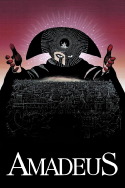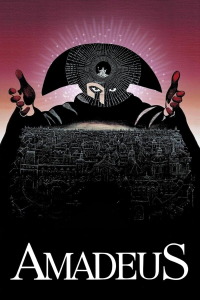
Review of Amadeus (1984) by Olivia P — 26 Dec 2010
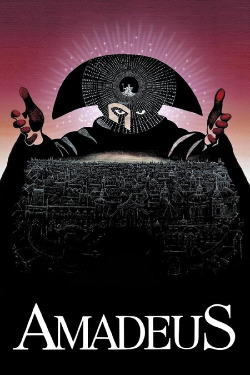
The name Amadeus means âloved by God.â? It was also Mozartâ(TM)s middle name, yes, and he is the subject matter, but the title of Milos Formanâ(TM)s masterpiece means far more than just a single part of Mozartâ(TM)s name.
The religious overtones of Amadeus is plainly spelled out by Antonio Salieri (F. Murray Abraham, in a brilliant, Oscar-winning performance), who, now aged and decrepit, is confined to an asylum after a suicide attempt, laments in an interview with a priest that God gave him a passion for music and an ear so keen to recognize that he had little talent.
On top of this, God favored a juvenile, vulgar âperforming monkey,â? a little prodigy named Wolfgang Amadeus Mozart (Tom Hulce). Mozart, who is first introduced to Salieri donning a pink-tinted wig, which identifies him as the very manifestation of a 1980s punk dropped into the 18th century.
Told through flashbacks in the interview, the audience discovers that Mozartâ(TM)s effortless churning out of the music of the heavens enrages the jealous Salieri, who, as official court composer to the emperor of Vienna, goes out of his way to ruin Mozart, yet secretly admire him.
Salieri, a true tragic figure, is absolutely distraught at his conflicting feelings. Bitterly, he turns his back on God. âFrom now on, we are enemies,â? he announces to a Christ-laden wooden crucifix, moments before he tosses it into the fire.
Bemoaning the fact that this God of mercy has turned out to be solely a God of torment until his final days, Salieri decides to commit the unthinkable: he will kill Mozart. The title of the film, Amadeus, as previously mentioned, does mean âloved by God,â? and, yes, as far as talent goes, Mozart was favored, probably more than anybody, but at what cost? In the weeks leading up to his death, he loses his wife and child, and spends his final hours with his only friend in the world: Salieri himself.
Perhaps the greatest portrait of an artist ever committed to film, Amadeus is a supremely moving masterpiece, and is an exquisite love letter to the effects, both positive and negative, of one of the all-time masters.
This review of Amadeus (1984) was written by Olivia P on 26 Dec 2010.
Amadeus has generally received very positive reviews.
Was this review helpful?