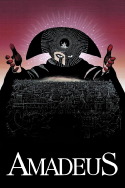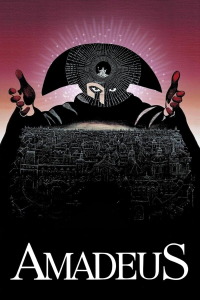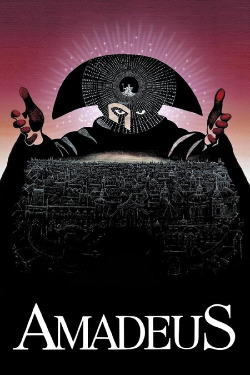
Review of Amadeus (1984) by Matt P — 21 Nov 2011
"Everything you've heard is true," is the motto from Peter Shaft's fascinating biopic of Wolfgang Amadeus Mozart. The film, based on the play, depicts the life and times of Mozart's stay in Vienna told through the narrative of Antonio Salieri (an Italian court composer), now living in a mental hospital.
It's clear from the very start of the film (with the eerie cries of "Mozart!") that Salieri is disturbed. After attempting suicide he is taken to a mentally ill hospital where he locks confines himself to a room closed in by decrepit ill-reputes. A priest arises through all this mess, ready to speak with Salieri and bring him to salvation. What follows is an eerie tale that unfolds like no other. Before going into his hatred for Mozart, Salieri plays a tune of his music for the priest to see if his familiarity of it will strike a good relationship. Unfortunately, the priest sadly shakes his head as Salieri crumples up into a dissatisfied and disgusting creature and begins the long the loathsome tale of how he killed Mozart.
Because the story is told from Galleries point of view we're expected to find Mozart the villain and Salieri the tragic hero. Well, that's not necessarily the case. Salieri gives us inside information that helps us to look at both sides and be more well-rounded with the story and characters. Neither Mozart or Salieri are the epitome of good and bad. Rather, misguided youths that grew up fast with wide ambitions not yet fulfilled. Mozart's father, a hot-tempered man with a strong desire to see his son succeed in his hometown, was by his side when he was a boy. He taught him to be the prodigy he was at 21 years old. Salieri on the other hand, never had an upstanding father figure, and looked to God to be his roll model. No one can really say whether or not God plays to our whims, but for Salieri, it's hard to think opposite. When he prays for a miracle to let him pursue music his father suddenly dies. His father, being the only one holding him back, would no longer shape him to be a working man. Salieri becomes independent and becomes the Austrian Emperor's court composer. Little information is given on how he acquired this position, but the words we hear come out of Salieri's mouth endlessly are "work, worked, and works.".
Salieri waits eagerly for Mozart's arrival in Vienna. He even devotes hours of his time composing a welcome piece for Mozart. In return Mozart enters with a giggle and picks up the piece by ear. He makes sudden variations to it on the nearby keyboard, and offends Salieri's hard work. And this is just a taste of the stuff Mozart inadvertently does to make Salieri look like a fool. Because of the subject material, the film plays out like a long and absorbing Mozart score. While some scenes seem mellifluous and harmonic, others are goofy which suggest Salieri is being played. Salieri has several ploys, whenever he thinks he's won something tops him. The only basis Sallieri has for some kind of hope and reformation is God, yet after nearly breaking his chastity he becomes sworn enemies with the Lord.
Salieri speaks of jealousy and unfairness. Of right and wrong, of the proper man. Salieri, who looks to be a well-to-do composer isn't happy in the slightest for Mozart's stay. Mozart, with what little riches he can scavenge, is always giggling and always happy by others happiness. The two are polar opposites. Mozart is inside looking out; well established in the field of music yet looking out for something more wide and brought, something to work off of and keep his music alive. Salieri is outside looking in; left outside in the cold and peering in for some kind of warmth. Throughout the film, Salieri speaks of Mozart as a disgusting little creature; a wretch. Yet when we see him monologue in the state his now, he resembles something far from human.
We love to laugh at Mozart's childish antics, it's by coincidence they're targeted towards Salieri. Mozart does not despise Salieri. In fact, by the end he apologizes to Salieri saying, "I'm sorry, I thought you did not care for my music." Ironically, what we know as the audience, is quite the opposite. Salieri loves the music, but despises the man. He says, "Why would God choose this man to celebrate his glory through music?" Salieri has worked hard his whole life, yet the fame he really desires eludes him. The biggest thing that destroyed Salieri was misguidance. He understood he should work hard, but all he expected for payoff was to be famous and become a legend. Rather than shoot for fame, Salieri should have been proud of the position he attained in Vienna. He was higher up than Mozart, yet attends every one of his shows at the middle class theatre. He reminds himself continuously of his jealousy for Mozart. This too, is what diminished his humanity and spirit and, by the time he's a frail and sadistic old man, Mozart's music plays on and on through the ages.
There's a lot more one could say about "Amadeus," like the use of the seven deadly sins, or the use of irony, but you have to see it for yourself. I think for everyone it can have a personal resonance, being as the story is an allegory for extreme jealousy. Whether or not everything is entirely factual, it offers intriguing insight to a renowned composer who we listen to therapeutically nowadays. F. Murray Abraham does the screen impeccable justice as both the envious composer and the conniving reject. Tom Hulce as Mozart is everything his music resembles. "I am a vulgar man, but I assure you my music is not."-a self-contradictory statement when he pleas to the Emperor for a chance to do a banned show. The movie plays Mozart's music constantly, and perfect framing and carefully written dialogue enhance the viewers enjoyment of irony and evil. The rich material things Salieri gains in the end mean nothing to him (he devours his sweets like a voracious animal), he uses them to fill the void in his heart he feels he is missing. He was too distracted by a prestigious brat to marvel at his own accomplishments and find he right to ask for the fame he deserved. Of course, his alibi the whole run of the movie is "God did this," or "That wasn't Mozart laughing at me....that was God." Salieri brings up some eyebrow raising questions about the Almighty, but at the end (when Mozart's haunting laugh echoes the screen) we get the impression it may be another force that possessed him.
This review of Amadeus (1984) was written by Matt P on 21 Nov 2011.
Amadeus has generally received very positive reviews.
Was this review helpful?