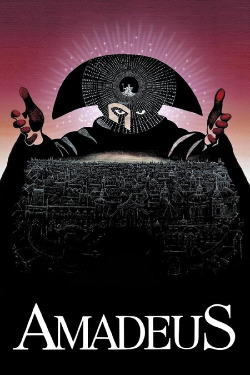
Review of Amadeus (1984) by James H — 13 Aug 2017
An Ode to Mozart.
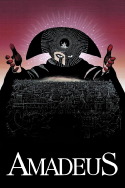
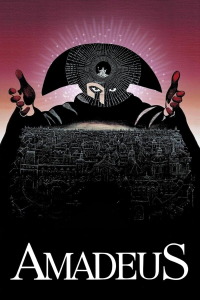
To borrow a notion of Mozart's style from respected classical musicologist Charles Rosen, Milos Foreman's motion picture of the Peter Shaffer play is full of the "violence and sensuality" characteristic of Mozart's music. In addition, by Foreman brilliantly documenting an appreciation of the "supreme expressions of suffering and terror" of the main characters in this story, we receive a philosophy of life that is "shockingly voluptuous". This movie is a mirror of human despair and delight. As Mozart's music does, so too does Foreman's ode to this exceptional musician achieve a harmony we wish would more often flow through our lives. At the same time, he delivers our compliment exuberantly fresh. This film could even turn a staunch hater of classical music or commonly glum nihilist into its most fervent recruiter.
Having cut his throat in an attempted suicide, aging former Viennese court composer Salieri (F Murray Abraham) is sent off to an insane asylum while crying out to God and the world that he is guilty of murdering composer Wolfgang Amadeus Mozart (Tom Hulce). While recovering at the asylum, a benign and sympathetic parish priest comes to take Salieri's confession. Following his usual rhetoric, the priest says, "All men are equal in God's eyes" which raises the learned composer's eyebrow and sparks the story of how Salieri came to know Mozart, why he believes all men are not equal in God's eyes, and why Salieri believes it was he who ought to be blamed for the great composer's death. After telling us about his rise from a provincial Italian town to court composer for Austrian Emperor Joseph II (Jeffery Jones), we learn about his adoration for his young contemporary. When the opportunity arises for Salieri to meet his idol, he discovers he is aghast at Mozart's complexity-how can a "giggling, dirty minded creature" compose works that are so sublime one may believe they could hear the voice of God? Split between adoration and rancor, Salieri confesses to the patient priest of his plot to learn of Mozart's secrets, of throwing every obstacle in his way, of hoping to find the opportunity to steal Mozart's last piece of music and claim it for his own-all at the cost of the life of Wolfgang Amadeus Mozart.
What truly makes this film a masterpiece is the point of view playwright and screenwriter Peter Shaffer decided on to portray Mozart-through the character of Salieri. Salieri is more like most of us than the gifted Mozart. Regular people generally believe that faith in our family, our institutions, even in our religious convictions will yield some level of greatness in our chosen field because everyone applauds our efforts. However, when we come across someone truly singular, we suddenly find ourselves covered by a dark feeling that our very purpose in life has been cast into shadow and doubt. Surviving this knock at our ego, we retaliate with envy. Naturally, we try to oppress this envy; Salieri does not. And we love him (and Abraham's portrayal) for it. Salieri plays puppet master to Mozart's pain and suffering, using every event in the great composer's life in Vienna to test his genius. For instance, after spying on Mozart's family at a masquerade, Salieri sees that Wolfgang's father wore a completely black costume. Later, while still grieving from his father's death, Salieri dons the same costume, visits Wolfgang one twilight evening, cool and solemn, to commission a "Mass for the Dead". Now almost bankrupt, needing to feed his wife and child, he accepts this request. Like Salieri, who seems to ignore his conscience, we observe Mozart's suffering without pity. We know what Salieri is doing is unethical yet by the very nature of cinema, we cannot interfere with the relationships between these all-too-true characters. As with many great films, the motivations of villain and hero are harmoniously clear and "Amadeus" sits atop this tradition.
Be warned. This is a work of fiction, loosely based on Mozart's life. The film does not document a realistic relationship between Mozart and Salieri; it does, however, illustrate the spirit of longing to be better than oneself. Salieri may not have actually been before Mozart's deathbed to transcribe the voice of God (i.e. the most perfect music), but we are all glad to experience the possibility if it could have happened. In real life, Salieri and Mozart were close enough to have even composed together a cantata for voice and piano called "Per la ricuperata salute di Ophelia". So, if anyone wondered if Salieri actually had the opportunity to co-create with Mozart, the answer is yes. However, Shaffer's "what if" scenario is much more fantastic, engaging, and rewarding.
Suitable for anytime you or your family needs to have their spirits raised...and for creative types, "Amadeus" will help let flow one's creative juices. If anyone ever wanted to watch a movie that delivered all it promises, this is the one.
This review of Amadeus (1984) was written by James H on 13 Aug 2017.
Amadeus has generally received very positive reviews.
Was this review helpful?