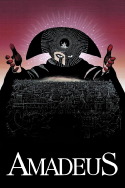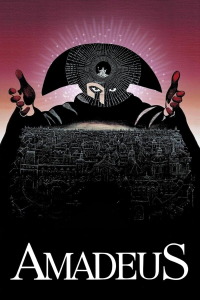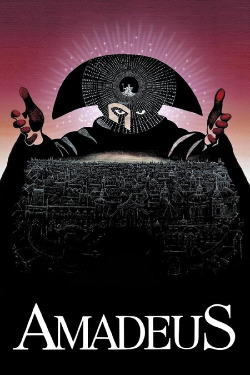
Review of Amadeus (1984) by Daniel R — 09 Jul 2011
Personal Score: 10/10.
How does one do justice? How does one speak of the greatness they see when their eyes cannot translate it in its fullness, let alone their words? This is truly a difficult task for me, reviewing the film that I consider to be the greatest of them all, but I will do so all the same.
The name Amadeus means "lover of God" or "loved by God." The title of this film is not a mere reference to the middle name of the greatest composer who ever lived. It is a reference to those two meanings, particularly the latter. For Wolfgang Amadeus Mozart was loved by God, and his music was his love of God. This is how Antonio Salieri sees it, and it is through his eyes and words that we are told this tale of jealously, pride, rivalry, obsession, madness, and music.
The film begins with the booming chorus of Mozart's "Don Giovanni," which is the central musical piece to this film, and then we hear a distant cry, "Mozart! Mozart! Forgive your assassin!" It is the cry of Antonio Salieri (F. Murray Abraham). Salieri shouts to the heavens a confession that he killed Mozart, and then his servants find him having tried to kill himself with a razor across the neck. Salieri does not die, and is committed to an asylum.
Soon a priest visits him, offering him the forgiveness of God for his confession to him. Salieri, however, is only interested in this young man's knowledge of music. He plays a song on the piano in his room, and the priest isn't familiar with it. And then another that also yields the same response. These are pieces of Salieri's work. As he tells the priest, he was the most famous composer in all of Europe, having written 40 operas. Then he plays another tune, one that we all have heard before, Eine Kleine Nachtmusik, and the priest responds more positively. "Oh that's charming!" the priest says. "I'm sorry, I didn't know you wrote that." "I didn't." says Salieri. "That was Mozart. Wolfgang...Amadeus Mozart." He looks to heaven as he says the last two parts of the name.
This telling fashion in which the film begins sets the stage so brilliantly for this film. This is not a mere piece about the greatness of Mozart or the rivalry between him and Salieri. This tale is about Salieri's rivalry with God. As Salieri tells it, he grew up knowing and idolizing Mozart, a young musical prodigy who's father trained him in all things music when Salieri was stuck with his father who scoffed at the idea of Mozart, saying he was a trained monkey. A circus freak. But Salieri wanted to be him, or like him. He prays proudly to be made into a great composer. To celebrate God's glory through music, and to be celebrated himself. To be immortalized through his work, all in exchange for Salieri's chastity.
For a while, it seems as though he may have gotten his wish. Salieri's father dies and he is moved to Vienna, the "city of musicians." He even becomes the Court Composer to Emperor Joseph of Austria (Jeffrey Jones). At this point, Salieri seems rather content with things. He seems to know that he isn't greater or equal to Mozart, but that is okay, that is until he meets him.
Mozart (Tom Hulce) comes to Vienna to play his music, and Salieri goes around looking to see if he can spot him. He has no idea what Mozart looks like, but wonders if the face of him will speak itself of the talent he possesses. His search is halted when he tries to sneak some of the food before a rich banquet, but that is also interrupted by a young couple chasing each other around and being rather deviant. The young man makes lewd jokes, laughs like a hyena, and smooches the young woman's rather large chest, which Salieri reacts to with rolling eyes and a disapproving head shake. But then we hear music, and the young man stands and says "My music. They've started without me." and Salieri's expression is changed. This obscene little man is the great Mozart? How can this be?
In a way, this is the beginning of the rivalry between Salieri and God. More and more over the course of the film we are introduced to an equal amount of Mozart's incredible musical brilliance and his childish, impish antics. Why would God choose that to be His instrument? And Salieri, dignified and respectful, is given only the eyes and ears to witness and understand the brilliance of the young man's work. Mozart even mocks Salieri and laughs that "obscene giggle" at his work. But as Salieri puts it, this isn't Mozart laughing at him, it's God. It eventually becomes too much for Salieri.
Listening to Salieri describe the music, sometimes in technical terms, sometimes in emotional ones, is just poetic. Mozart's greatness given justice by the only man who could do it justice, but all the while loathing the fact that he cannot produce the same thing. To Salieri, Mozart's music is the very voice of God, and he knows that it will live forever, while his own will fade into obscurity despite it being more popular than Mozart's at the time. In a modern sense, Salieri's work is like a summer blockbuster film, with large audiences, grand effects, and entertaining production. But Mozart's is like Citizen Kane, unappreciated in its time and well ahead of it. Too much for ears unaccustomed to take in, but soon to be seen for the marvel it is.
Salieri turns from God and says he will ruin His incarnation, that being Mozart and his music. He uses his influence to keep Mozart's work from getting too many performances, even though Salieri himself goes to each one to take in its beauty. He is obsessed with it, loves it, but hates it.
There is a scene of such beautiful irony around this time. Salieri aims to bring down Mozart's greatest work before it ever is performed, and almost does so. The subject matter of it is considered controvesial, and Mozart has to beg and plead with the Emperor for it to be heard. He is told that his talents are suited better for more "elevated themes", but Mozart scoffs and curses at the idea, drawing the ire of the men in the room. And then he speaks my favorite line of the film, "Forgive me, Majesty. I'm a vulgar man. But I assure you my music is not." This is a confession that Salieri should hear but cannot because he cannot let Mozart know he is secretly sabotaging him. It vindicates Salieri because it is the very thing he hates about Mozart, but he is not present because of his own jealous schemes.
Soon Salieri's jealousy brings him to his ultimate plan. After Mozart's father dies, Mozart's health declines. Salieri plans to take advantage of it. He decides to commission a requiem mass from Mozart, keeping his identity secret of course, and then kill Mozart. Salieri will then play this mass at Mozart's grand funeral and people will believe that Salieri will have finally been "touched by God" with this musical piece, and as Salieri puts it "God forced to listen! Powerless-..powerless to stop it!".
But as we all know, this never happened. The mass was never finished. Mozart died. No grand funeral either. The film shows the painful and disgraceful truth of Mozart's pathetic burial in an unmarked, mass grave. And no glorious coup of his work by Salieri either. As he puts it, God snatches that opportunity away by taking Mozart and leaving Salieri to live in torment, watching as his own name is forgotten and Mozart's grows, because he was Amadeus, or "loved by God." And as the film fades to black, we hear that last hyena laugh of Mozart's. But remember, Salieri told us it was God laughing at him. It is God that gets the last laugh.
When we judge a film's greatness, it is usually on two levels: its entertainment value and how artistic it is. This is the film that, to me, does both to complete perfection. When this film is funny, it is hilarious. When it is dramatic, it's breathtaking. And when the music is playing, you are swept away by it, and seeing as how the music in this is like a character, it is often. This movie has a story that is simple to follow on its surface, and also tremendously fun and interesting to plunge into to see its depth. Also the acting is amazing all around, with F. Murray Abraham taking a well-deserved Oscar for Best Actor, which he ironically won over Tom Hulce. The supporting cast is equally great, especially Jeffrey Jones as Emperor Joseph II and Elizabeth Berridge as Mozart's wife, Constanze.
If I were to make a top 25, 50, or 100 list of my favorite films, I would begin to struggle with what movie belonged where after about number 5, but since I saw Amadeus, there has never been a wonder about what is number 1. Amadeus is the most amazing film I've ever seen, and every time I watch it I love it more and more. It is the film that ignited my love for classical music, and my appreciation for the art of filmmaking. It is an utterly perfect film, and my absolute favorite.
This review of Amadeus (1984) was written by Daniel R on 09 Jul 2011.
Amadeus has generally received very positive reviews.
Was this review helpful?