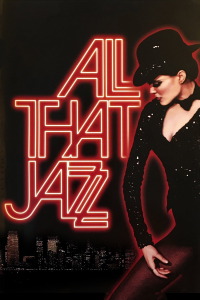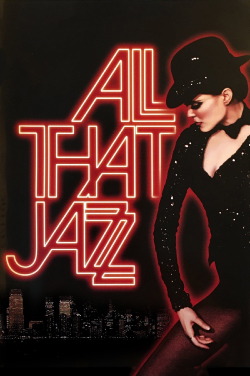
Review of All That Jazz (1979) by Kenneth L — 14 Jun 2012
This movie, which won the Palme d'Or in its year at Cannes, is a pretty curious case. Much of 1970s zeitgeist tends to go in one of two directions. On the one hand, there's gritty, unvarnished realism of the sort found in the films The French Connection, Taxi Driver, Saturday Night Fever, All The President's Men, Network, Nashville, and so on. On the other hand, there's a lot of garish, highly artificial kitsch - think of disco, Grease, or many of the TV shows of the era. This movie taps into both of these veins at once in a way I've never really seen before.
The movie was written, directed, and choreographed by Bob Fosse, the man known for choreographing the play Chicago and making the film Cabaret, among other things, and it's pretty explicitly based on his own life. Roy Scheider plays a successful choreographer with all the typical morally-dissolute-artist problems of alcohol, smoking, drugs, and infidelity. The movie (spoiler alert, kind of) basically just chronicles the events leading up to his death, with lots of flashbacks and musical numbers leading up to it.
Scheider's performance is remarkable, and pretty far from what he did in The French Connection and Jaws. Everything about his appearance and mannerisms in the film is carefully thought out, and while I haven't seen much footage of Bob Fosse himself, it seems like Scheider was probably doing a pretty good imitation. Leland Palmer manages to suggest a lot about her character's history with the main character as his ex-wife. Ann Reinking's actual character doesn't get that much development as his girlfriend, but she does have a lot of good dancing numbers. And not that they have huge parts, but both John Lithgow and Wallace Shawn are in this movie!
What's so weird about the movie is the simultaneous impulses towards flashy dance numbers, and towards brutally realistic depictions of ill health both physical and mental. The movie smartly integrates all of the musical numbers into the actual story, and the darkness of the underlying subject material often ironizes and subverts the gaudy, yet carefully choreographed, song-and-dance sequences. This is particularly true at the end of the film, when the character fantasizes several huge numbers while never actually leaving his hospital bed. And yet, for all the work the movie does in these respects, it's still kind of hard to get a sense of who this character basically is as a human being or why we should care about his problems. He pretty much seems like just the collection of his behaviors - he takes drugs, smokes, cheats, and choreographs, sure, but who is he really? Because of this failure, I was intellectually interested in what the movie was doing, but never really emotionally invested in it. Fellini's 8 1/2 was a similarly navel-gazing exercise, but that one worked better for me because we got to see Guido as a kid and understand a little bit of who he was. I'd say you check this film out if you're interested in good filmmaking or choreography technique (after all, the movie got 9 Oscar nominations and won 4), or if you're interested in the life of Bob Fosse, but it's not really the sort of movie that bowls you over emotionally with its narrative.
This review of All That Jazz (1979) was written by Kenneth L on 14 Jun 2012.
All That Jazz has generally received very positive reviews.
Was this review helpful?