Review of All Is Lost (2013) by Justin G — 08 Sep 2015
#42.
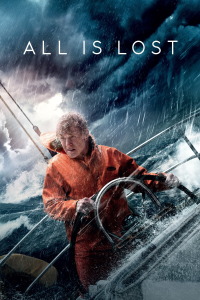
All is Lost chronicles an eight-day period in the life of a nameless protagonist who finds himself aboard a damaged vessel in the middle of the Indian Ocean. Throughout this ordeal our protagonist must weather a massive storm that forces him to abandon his sinking ship and set adrift in a life raft. In this dire situation, he once again must endure a massive storm that leaves him to the whim of fate and a tenuous reliance on his own sheer will to live or perish.
All is Lost.
J.C. Chandor gives us a visceral screen experience in the film All is Lost. From cinematography to sound design, the viewer is pulled into the singular world populated by Robert Redford aboard a doomed Cal 39 yacht, the Virginia Jean. I approached this film with a bit of trepidation after talking with a friend who is an accomplished sailor who felt the film was a bit inert with an unsatisfying ending. This middling review aside, I watched the film with the same open mind, open heart I feel is the fairest and best way to approach any work of art.
Writer/director Chandor does a fine job of presenting us with the opportunity to be the ever-watching eye and feel the mounting dread of finality within this story. After reading the screenplay, I can see that his vision of the film was very elegantly realized in the act headings; Man v. Man, Man v. Nature, Man v. Self. It seems a simplistic act structure, but also entails a very relatable and primordial struggle that speaks to the lizard brain in all of us. There were moments in the film that I appreciated the ingenuity and foresight of the main character. I found myself wondering about these instances as being purely common ocean sailing knowledge or unique to Redford's character.
One of the more compelling things about this story was to compare how I think I would've fared in this situation. By my count, I would've died about four times. In the script, Chandor addresses the main character's reliance on GPS technology as a major weakness. (Chandor 7) Redford's character, despite displaying admirable competence, also had a habit of forgetting and returning. On several occasions, he was forced to backtrack to either tie up a loose end or retrieve a vital piece of equipment. Though there was not much significance placed on these instances beyond survival in the screenplay, Redford's performance brought gravity to these situations that forced me to ponder everything from the cryptic opening image and recitation of the letter to the name of the boat. I had built in my mind an entire backstory for the reason Redford had embarked upon the trip.
The orbit and revolutions of the main character to and from the shipping container, to and from the boat, spoke to a theme of not being able to let go. The compelling moments in scenes where Redford scanned the horizon or looked back (the shipping container, the Virginia Jean, the life raft from underwater) solidified the human need for connection, for recognition and reciprocity in a hostile world. No scene embodied this more for me than the unboxing of the sextant and the near opening of the card paired with the gift. There was more meaning to the almost opening, almost re-reading of the card in light of the letter from the opening image.
What would cause a person to almost read a card? Is there a painful connection to the person or persons who gave the gift? If so, the pain is something he would have to reconcile in order to practically use the item. This was a very quick moment in the life raft, but much like the compass weight he added to the makeshift desalinization plant to guide the drinking water into the receptacle, that moment of hesitation and emotional frailty guides the viewer to return to the letter at the opening. Though the reasoning for his solitary ocean voyage is never addressed, there are plenty of obvious and subtle references to his life back on the mainland. The most glaring nod is the apologetic tone of the opening letter.
In terms of revolutions, the film makes it clear that no matter how prepared and kitted man may feel he will never be able to match the cyclical power of the tides. Throughout the film it's made abundantly clear that man does not belong in the ocean ecosystem. Still, Redford's character defies this truism and pays the price. Up until the very end, it seems that everything is aligned against things turning out for Redford. The directing job by J.C. Chandor adheres closely to his vision of the versus act headings, but thanks to Redford's performance the film is also tinged with the humanity of facing the third act in one's own life. As he struggles to survive, the dignity and pure frustration Redford portrays is mesmerizing. In the final scene during the penning of his letter in the bottle, we, as an audience are forced to revolve and try to remember what has been written.
The marriage of Chandor's words and Redford's performance created a one hundred six minute film from a thirty-one page screenplay. Reading the script after watching the film forces one to look back on the viewing and unfold scenes in chronological order. It also reinforces the idea that Redford's character has a theme of returning, looking back by giving practical reasons for a lot of the actions he takes.
This review of All Is Lost (2013) was written by Justin G on 08 Sep 2015.
All Is Lost has generally received positive reviews.
Was this review helpful?