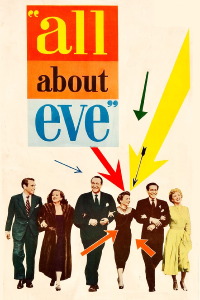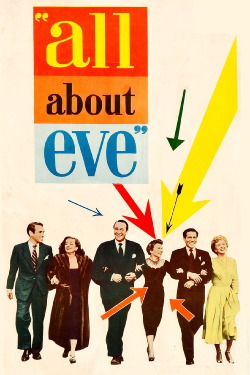
Review of All About Eve (1950) by Cameron J — 17 Aug 2014
First, Joseph L. Mankiewicz is sending "letters to three wives", and now it's all about Eve. "I have to be strong, you had to be free, 'cause it's all about Eve!" I'm symphonic prog-rockin' here, Kamelot style, and I'm supposed to be talking about a film which predates any kind of rock. I don't know what to say, because, come on, just how interesting can a drama which got nominated for 14 Oscars - scoring six, including Best Picture -, b and supposedly features a lesbian be? I can practically feel my eyes drying out, there are so many men somewhere out widening their eyes when I say that Anne Baxter is playing at least a pseudo-lesbian, but again, this film is from 1950, so that's the only thing they're painstakingly subtle about. The only kind of homosexuality that we know for certain pertains to this film is among men, because Bette Davis has quite the role in gay subculture, probably because her voice has just the right amount of depth for gay men to do impressions. It doesn't exactly hurt that this film is pretty good to begin with, and yet, as worthy as this film is of all of its praise, there are indeed aspects to shake up its intrigue.
The film's plot is so well drawn and handled that, to see the turn into the 1950s, this film is surprisingly unpredictable, but it can transcend conventions for only so long before succumbing to narrative tropes, if not moderate Hollywoodisms of the time. What distinguishes this film is its subtlety and depth as a drama of the '40s and '50s, but there are occasions of superficiality which might not be too glaring, but feel as though they are, in contrast to the subtleties, and under the pressure of the histrionics. I've heart warming of campiness, and although I hardly find cheesiness on that level, the razor-sharp dialogue occasionally gets improbably heavy-handed with its theatrical wit, while near-trite characterization thins down the depths of generally richly written and portrayed, to the point of being supplementary to a melodramatic plot. The plot is driven by melodramatics as a portrait on pursuing stardom through a companionship with, if not the overthrowing of an aging idol, and it's not entirely easy to buy in on them, partly because it seems as though they're compensating for natural shortcomings, which are obscured by inspired storytelling, but challenge one's investment even on paper. You have plenty of time to ponder upon the natural and consequential shortcomings, because among the bigger issues of the film is a length of almost 140 minutes which gets to be repetitious, maybe even aimless after a while, demanding quite a bit of patience. With entertainment value and dramatic intrigue, this film ought to firmly secure one's investment time and again, but its grip is loosened by subtle missteps whose betrayal of inspiration make it all the harder to disregard. The final product hasn't age completely with grace, but to be a film of its type and time, it's solid, and even to this day, it thoroughly compels, even in concept.
Featuring the occasional tropes, and driven by melodramatics which attempt to compensate for natural shortcomings, this story concept is not especially meaty on its own, but its thematic value is rich with intrigue, exploring the ambiguities of the intentions of an aspiring actress working with an idol she may be aiming to succeed, and the paranoia of an aging talent who fears that her best years are behind her, and that she is to be overpowered by new talent. This story, for all its histrionics and natural shortcomings, is conceptually solid, and Joseph L. Mankiewicz tells it very well, at least as a director, structuring scenes more tightly than he does as writer, to where entertainment value is kept consistent, until the slow spots come in right when they need to, and grace this film with something that was a rare gem to find during this time: subtlety. Subtlety isn't entirely there on paper, but Mankiewicz's direction is rich with taste and generally defiant of Hollywood superficialities of the time, to where it explores dramatic and thematic potential thoroughly, with the help of worthy scripted material. Mankiewicz's writing is more flawed than his direction, arguably because it might be more ambitious, - to the point of bloating plotting into repetition, maybe even a hint of cheesiness - yet even it stands out for the time, and still impresses by today's standards, with generally crackling dialogue and an effective portrayal of the artistry of and corruption within the theatre. As for the individual characters, although some of them feel like types, most all major roles are distinguished, with depths and layers that bond with the melodramatic characterization generally organically enough to augment human intrigue, which is augmented best by quite the solid cast. About as consistently impressive as anything is the acting, which is realized across the board, with anyone from the charismatic George Sanders and the relatable Celeste Holm, to the lovely, if a touch dated and sometimes unevenly used (Maybe it isn't really "all about eve") Anne Baxter - who is initially endearing as an aspiring talent and innocent young lady who slowly, but surely begins to show dark colors when she finds her dreams realized, possibly at the expense of others' - and, of course, leading lady Bette Davis, who charismatically captures the sophistication of a more grounded starlet, brutally humanized by the fear of being replaced by a fresher face, and coming to terms with her age and humanity, and how she affects her peers, both positively and negatively. Davis' effectiveness is limited by now-dated material, but her nuance and dramatics layers are relatively spot-on, driving the depths of this surprisingly subtle drama, but not alone, as there is enough realization on and off of the screen to drive the final product as consistently compelling.
"All" in "all", if you will, occasions of convention and superficiality are a little hard to ignore in the context of surprisingly tasteful storytelling, whose subtlety and grace are still challenged firmly by melodramatics which join repetitious dragging in emphasizing the natural shortcomings of this story of limited consequence, which is still rich with dramatic and thematic intrigue that is handled with enough effectiveness within the entertaining and engrossing direction, intelligent writing and strong performances which make "All About Eve" an uncommonly and rewardingly effective drama of cinema's golden era.
3/5 - Good.
This review of All About Eve (1950) was written by Cameron J on 17 Aug 2014.
All About Eve has generally received very positive reviews.
Was this review helpful?