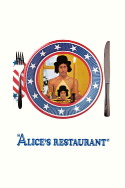
Review of Alice's Restaurant (1969) by Michael Y — 12 Dec 2012
But You Can't Have Alice.
Because my mother is older than the mothers of my friends, the first I ever knew of Arlo Guthrie was when I was in high school, and my biology class watched a special about genetic testing, which was a new concept at the time. I did know, at least in theory, about his father, Woody (here played by Joseph Boley). What was so worrying to Arlo in this special was that his father had died of Huntington's Disease, which is genetic. Arlo was having to decide whether he wanted to be tested or not, whether it was better to know for sure or to live life until he came down with the disease without the certainty that he would. Given that this was about twenty years ago, I don't now remember which he chose. However, he's still alive, so I tend to assume that he doesn't have it. He must be glad; it sounds like a pretty awful way to go.
It was 1965. Arlo (playing himself) first hoped to evade the draft by getting a college deferral. However, that doesn't go too well for him, and he heads back east, in part to see his dying father. Two of his friends, Ray (James Broderick) and Alice (Patricia Quinn) Brock, have bought a deconsecrated church in a small town in Massachusetts. Alice also starts a small restaurant. Arlo wanders about, playing his guitar at various coffee houses and so forth. He often ends up back at the church, and sometimes back at his father's deathbed. Alice and Ray take in Shelly (Michael McClanathan), a recovering heroin addict who is in love with Alice. One day, Ray invites enormous crowds of people to the church for a Thanksgiving dinner, to be cooked by Alice. Arlo and his friend, Roger Crowther (Geoff Outlaw), in an attempt to be helpful, gather up about a half-ton of garbage from in and around the church and pile it into Arlo's VW to take it to the town dump. Turns out the town dump is closed for Thanksgiving. The pair dump their trash by the side of the road, setting off the sequence of events that got the movie made.
To be honest, I've never actually heard the song. I mean, there are bits of it in the movie, but I don't think there's enough to add up to the eighteen-odd minutes of the original version, much less the up to forty-five minutes it can take in live performance. Mom was into Peter, Paul & Mary, and I recognized Pete Seeger (who, oddly, is one of three people to get billing on Netflix) from the episode of [i]Reading Rainbow[/i] he did. But Arlo Guthrie is too young to be Mom's kind of music and too old to be mine. He's only three years younger than she is, but most of the music Mom listens to is sung by people older than she is. I think that's generally the case, really; your formative music is playing when you're a kid, and when Mom was a kid, Arlo Guthrie was still just Woody's boy and no one of real consequence in his own right.
Possibly one of the things I like best about this movie is that it acknowledges some of the problems with the kind of life the characters lead. Even if Ray can't recognize it, he's hurting Alice terribly quite a lot of the time. Shelly is extremely jealous, and things aren't just going to be okay there. While there is a certain pleasure taken in the sexual freedoms the characters share, there is also awareness that it isn't all for the best. Early in the movie, Arlo meets a girl who wants to sleep with him in case he becomes famous, because that will make her somebody, too. She's fourteen and has a runny nose, but she's convinced herself that she's an adult. It's one thing to be an adult choosing a kind of bohemian lifestyle, but it's another to be exploited or an addict. There is actually a kind of sorrow here, even as we celebrate Arlo's own freedom.
This definitely makes my list of, "Okay, I don't need to watch that again." It's not a bad movie, and it has a certain charm. However, I was more interested in Alice than Arlo, and I feel that she got shortchanged. The real Alice must not have thought so, given that she's an extra in the movie in several places--including her own wedding, apparently--but I'm angry at how most of the characters seem to treat her. It's not that Roy also wants to sleep with barely legal girls; if Alice is okay with an open relationship, that's fine. Worse, to me, is that Roy takes her for granted. Her restaurant is probably the thing that's paying their bills, but he thinks she can just take off whenever she wants to and let it run itself. And on her wedding day, he assures everyone that Alice will be happy to cook them up something to eat. If I were Alice, I'd be furious about that--and it looks, in the movie, as though she is. No one seems to notice.
This review of Alice's Restaurant (1969) was written by Michael Y on 12 Dec 2012.
Alice's Restaurant has generally received positive reviews.
Was this review helpful?