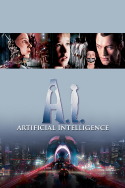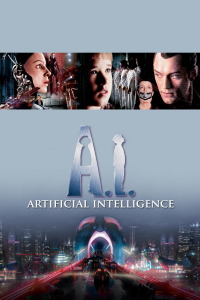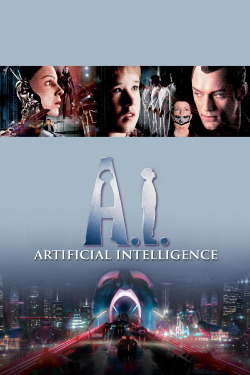
Review of A.I. Artificial Intelligence (2001) by Matt M — 25 Feb 2011
I feel spielberg misses a little here.
Kubrick films are so carefully crafted to address a main issue, not unlike Bergman films. They can almost take on the form of an essay - the film ends when all aspects of an issue have been addressed.
Spielbergâ(TM)s films are driven by a character with an extremely clear goal. Saving Private Ryan â" to save private ryan. Jaws â" to hunt down and kill a shark. AI is no different; here Spielberg riffs off of Kubrickâ(TM)s more cerebral plot and turns AI into a distinct emotional ride. Throughout the entirety of Spielbergâ(TM)s film David seeks his motherâ(TM)s love. To earn his motherâ(TM)s love David must become a real boy and so the argument here is can/when is a robot a real thinking, feeling person.
Where Kubrick would have explored the depths of this argument in an eight sequence visual essay Spielberg presents a more emotional argument. By the end of the film we as an audience feel for David and in so doing present ourselves with a sort answer. By sympathizing with David we relate with him and emotionally acknowledge that David is no different than us.
Many things get in Spielbergâ(TM)s way. First off Spielberg doesnâ(TM)t mix well with Kubrick. The contrasting Kubrick elements seem to be in direct conflict with Spielbergâ(TM)s.
Kubrickâ(TM)s more cerebral way of developing an argument often perceives characters in a cold distanced way. This allows us to view the characters and their emotions in a sort of 3rd person perspective so that we can judge and analyze them. Often Kubrickâ(TM)s characters are untrustworthy or insane and at times they scare us.
Well this approach is in direct conflict with the way Spielberg loves to sympathize with his characters. Spielberg works hard to turn characters and their conflicts into situations we can all understand and relate with so that we can feel along with the characters.
AI tries to do both. The film seems to begin more Kubrick-ish and end in Spielberg-land. The sort of philosophical arguments raised and the cold distanced approach to the characters in the beginning of the film is all but lost by the end. And the effect of this transition is confusing. Is Teddy Chucky of Jiminy Cricket. Is David Pinocchio or some mechanical terror. Is this a modern retelling of Pinocchio or is it saying something else? I feel that however interesting these contradicting perspectives can be it emotionally confuses the vast majority of the audience and overwhelms the meaning of the film.
Instead of the different sequences developing the argument of the film in greater depths David goes on an adventure that leaves the argument of his soul vastly unaddressed until the end of the picture. However clear cut Davidâ(TM)s objective is Spielberg looses focus on the main argument and instead of being enlightened by the end of the film we are merely entertained and a little confused. Somewhere along the way the film switches emphasis from the state of Davidâ(TM)s potential soul to a boy being reunited with his mother.
Other problems seem to be a rather uninventive Flesh Fair sequence, a poorly choreographed chase scene, a high contrast high saturated look and a VO narration that seems too obviously bent on provoking an emotional response -âDavid will NEVER see his mother again. IF he shakes her she will NEVER rouse.â? This is a little heavy handed for a director who so skillfully brings everyone to tears in his other films.
This review of A.I. Artificial Intelligence (2001) was written by Matt M on 25 Feb 2011.
A.I. Artificial Intelligence has generally received positive reviews.
Was this review helpful?