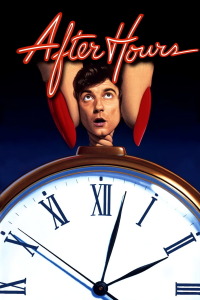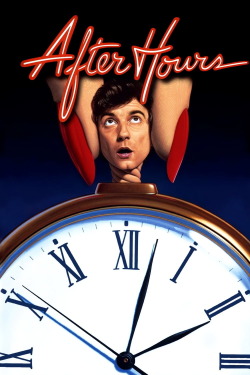
Review of After Hours (1985) by Robben M — 20 Sep 2009
Martin Scorsese does Kafka! Or better yet, a Kafka story set in NEW YORK. More specifically, SoHo, but that doesn't really matter.
AFTER HOURS is the incredibly surreal and disturbing, yet amusing, tale of Paul Hackett, a relatively normal man who works a dull day job at a typing place. It's never specified, and it's not important.
In any case, he's rather bored, but one night he meets a nice young lady and it seems that things are going well.
The girl is Marcy, and she welcomes Paul to her loft, where she's staying with a sculptor named Kiki.
Then, Paul's first bout of misfortune hits: he loses all his cab fare money. The driver is furious and Paul is effectively stuck in the Soho area. He meets with Marcy anyway, and meets Kiki, the totally bizarro sculptor who likes to make plaster bagel-shaped paperweights (...).
She also is working on what resembles a three-dimensional version of Edward Munch's THE SCREAM. Paul gets the name wrong, much to Kiki's amusement.
It seems like Paul is attracted to Marcy, but he stumbles across a strange collection of photos in her possession. What's inside is too horrifying (we see flash cuts of the pictures, some of which resemble terrible burn injuries) and Paul's increasing disgust as he looks at each picture increases.
From then on, all bets are off. Paul determines he's had enough of this evening, but it's just getting started.
Before he ends up back at work the next morning, he will discover that at midnight, the subway fare suddenly jumps up in price, just enough so he doesn't have enough change, meet a psychotic and neurotic ice cream truck driver who likes to place mousetraps in a circle around her bed, Marcy's corpse, who turns out to be the girlfriend of a jealous bar-keep, Kiki and her friend playing games reminiscient of S&M and bondage, Cheech and Chong stealing the three-dimensional scream, an angry homosexual mob out for his blood (along with the ice cream truck driver, complete with ice cream truck music), a homosexual man who is willing to listen to his woes of the night, a punk night club where he almost mohawked, a murder going on in the next room (for which he non-chalantly believes he'll get blamed for anyway), and then his transformation into a statue, at which point it takes the story full-circle, finally ending up at his work-place.
In short, it's the worst evening ever.
Besides the incredibly amusing turn of events, what really separates the film from run of mill prat-falls and pranks is the sheer sinister tone of the picture.
Strange events and almost surreal coincidences conspire against Paul, who's constant attempts at understanding and excuses end up getting him into more trouble, some situations even becoming life-threatening.
Scorsese never lets the tone veer from darkness, and, in some ways, AFTER HOURS stops being a simple comedy of madness in New York and ends up going off into disturbing and macabre territory. Marcy's mysterious murder and her book of "photos", while oddly hilarious, are still scary.
Scorsese never tries to subjectify a scene or anything. Every vignette is played for what it is, and whatever feelings or vibes given off, you take along for the ride.
In this way, the film is completely disjointed, and for some, it's off-putting. I don't think it could work any other way BUT disjointed. The way Paul is thrown from what worse situation to the next really adds to the theme of the movie; that is, the theme of escalation.
Everything escalates to one thing and another, and everything is strangely interconnected, without every trying hard to do so.
The reason for the Kafka comparison is apt. Everything happens because there's no rhyme of reason. Everyone is mad. Paul is the only sane man, though stupid, for assuming the best in everyone, and at the very end, you get the feeling that he's more amused by this not-so-startling revelation.
But even without any of this, one can enjoy AFTER HOURS for its simple bravura. It's tightly constructed, and never stops moving. The camera seems to fly about, capturing the night streets in an unearhtly manner. This is more to do with the glow of lights on the street, but in any case, everything is dream-like, and never gritty in a stereotypical sense.
The editing of the film is almost delirious, often jumping from one object to the next, in close detail, to wide proximity. The aforementioned "photos" scene is particuarly memorable for its strangeness, and it's but one of many set-pieces.
Perhaps Kafka is not the best example, as there's no great mourning of sanity or oppressive state of mind. Rather, it's reminiscent of Beckett. The whole sequence of events are just so absurd that by the end, you don't know what to particularly make of the film.
The struggles of trying to get home and the incresingly insane odds seem all too familiar with the theater of the absurd.
A funny back-story on the production is that Scorsese didn't know how to end the film. Michael Powell, one of the legendary filmmakers, hung around the production, offering his comments. He said that the story must end at the beginning, though no one really knew how to do that.
Other endings were drawn up and written, some normal, some magical, and some downright disturbing. One of the most memorable scrapped endings is where Paul, desperate for a hiding place, meets an older woman in the bar. She offers to show him the hiding place, but then he's confused when she leads him to a basement.
She looks at him seductively and points to her nethers, saying that he can hide in there. At first he's shocked, but then obeys. He crawls inside her.
Then, on an empty highway at night, she gives "birth" to Paul, and he crawls out, slimy and wet, and continues to walk off into the night horizon.
I'm not entirely sure what they were thinking with that ending, but talk about unforgettable.
AFTER HOURS is another one of Scorsese's underrated films, much like the spectacular NEW YORK NEW YORK and GANGS OF NEW YORK, both underappreciated gems because of Scorsese's stereotype as a niche filmmaker (of the gangster picture, which is simply one genre for him. He can move about as freely as he wants).
In some ways, it's a natural expression of the madness and savagery which permeates Scorsese's body of work, however subdued, or rather, not subdued, it is.
This review of After Hours (1985) was written by Robben M on 20 Sep 2009.
After Hours has generally received very positive reviews.
Was this review helpful?