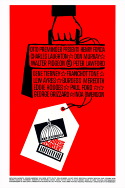
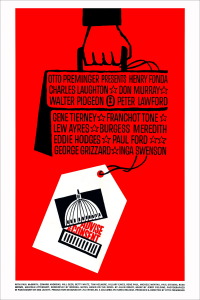
Review of Advise & Consent (1962) by Paul Z — 17 Aug 2010
Henry Fonda has a way of playing the kind of man I would vote for. In 12 Angry Men, he's the only one of a dozen who's willing to consider every uncertain facet of circumstance, and succeeds in persuading the other eleven to do so. In Fail-Safe, he's an American president so painstakingly objective and diplomatic that he simply cannot escape the cataclysmically horrific facts of his situation. I'm unsure of whether or not it's just coincidence that Sidney Lumet's two masterpieces and Otto Preminger's Advise & Consent are all three phenomenal marvels of American cinema, but a pattern is clearly developed. What makes Advise & Consent intriguing, however, is that Fonda's on screen for less than half of the film. What Fonda says to defend his position as a nominee for Secretary of State is of astonishing insignificance compared to what's done behind his back, and what he does behind other backs, to approve or deny his appointment as head of foreign affairs.
Another parallel more pertinent to Preminger's film as a whole is Network. Decades after its release, no matter how iconic or influential it's become in American culture, not only has its unsettling, paradigm-shifting conveyance been completely overlooked, but the very reverse it warns against has happened. In Advise & Consent's case, we continually take for granted that the President is responsible for every single bill, law, regulation, deregulation that's put into practice, as if he waves a wand or pushes a button, rather than if we were to just watch this story. Watch, realize in its mesmerizing realism a chronicle of just how little power a president has. The president has the last word, says whether he likes something or not, but he's nothing more than a glorified bureaucrat. He has his vision, views, ideas, but what of the hundreds upon hundreds of officials he must answer to, wait for, consider the visions and views of, before something's actually done? Otto Preminger, one of the edgiest, darkest filmmakers of the studio era, gives us a political chronicle wherein the President is known simply asâ?¦the President. We never catch his name. Even in 1962, Preminger, original novelist Allen Drury and screenwriter Wendell Mayes, could see clearly that after all those yard signs, banners, campaign ads, the lionized images of men who seemingly lead us in all our decisions, acts and deeds as a people mean very little. What does mean something? Our own acts and deeds. Our own standards. What are we willing to accept? How much of us are willing to accept it while the rest of us stay behind wallowing in tradition and fear? Those more vulnerable than those like Charles Laughton's Seabright Cooley, who's so eloquent and confident in his robust figure and white suit that we're hardly aware or even expectant to see Franchot Tone's President.
The film seems to culminate into a focus on rookie Senator Brigham Anderson, played by Don Murray, who has a past, or an identity, that a Barney Frank or Gerry Studds couldn't have been so open about in 1962. Again, Preminger was an extraordinary filmmaker not simply because of his capacity for deliberately, subtly, beautifully constructed compositions and the architecture of tension that could de-vein a shrimp---all penetratingly evident here---but his penchant for bringing things to the screen that would deliver a well-deserved kick in Hays' balls. Things that opened doors and minds for the generations beholding it in theaters at the time, whether they were prepared or not. What should he have done? Waited till they were prepared to see heroin addiction, grisly consequences of rape, the repression of homosexuality? HAHAHAHAHA! When would that have been? Now?! Phffft! Good ole Rose Nylund has a bit part as a female Senator, for instance. In the close confines of the Senate floor, it's accepted. There's the abstract feeling that the masses outside of it would've been more surprised at her sex. But don't get me wrong. Advise & Consent is not just a masterpiece in my eyes purely because it's some sort of liberal parable. It isn't. Indeed, Wyoming Senator Fred Van Ackerman, played with unabashed unscrupulousness by George Grizzard, is apparently a liberal, which is educational for me, a young 2010 man who has never seen liberalism as oppressive, much less the sort who would want Fonda's nomination withdrawn, to the extent that blackmail of a closet homosexual would seem justified. Advise & Consent is not a politically radical chestnut but a docudrama of what happens behind the voters' backs. What Liberal and Conservative mean now bear little direct context with what they meant in 1962.
But what they meant then is certainly frightening: Preminger's not only extremely clever in his casting, but publicly vindictive in it. Burgess Meredith, who was blacklisted in the 1950s, here plays a witness who testifies that Fonda has a Communist past. Perhaps now in a less fascist time in our country it's clearer that whether or not Fonda does is beside the point. Walter Pidgeon's perfect for the strongest ally of the President. He's perfect for the strongest ally of anybody! Look at the unaffectedness of this man. No matter what role, what film, he's as natural as dust in the wind. And he befits the age and weather-beaten disposition of his character, named Bob Munson: There couldn't be a more perfect name for this character. And Preminger actually casts Gene Tierney as a person this time. As a student filmmaker with attractive female friends, I know how he feels, frankly. You try to cast them according to their talent but it's difficult to see past astonishing curves. Nevertheless, we get from her one of the most relatable scenes I've ever seen, prudish affluent American women, grown, socially active, trying to get straight what the functions of Congress actually are.
This review of Advise & Consent (1962) was written by Paul Z on 17 Aug 2010.
Advise & Consent has generally received very positive reviews.
Was this review helpful?