Review of A Very Long Engagement (2004) by Tom B — 25 Jun 2011
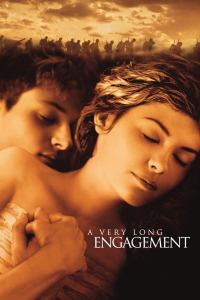
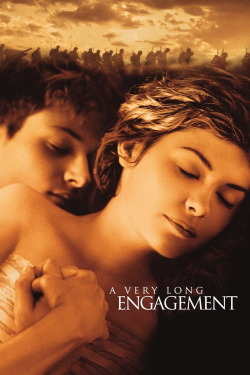
Another in Jean-Pierre Jeunet's series of films in which Audrey Tautou walks around forlorn for a couple of hours, hopelessly in love and unable to do anything about it. Or maybe that's redundant, since the inability to do anything about it might be implied in the hopelessness. These French films can be tough to figure, so I won't rule out that possibility too soon.
Jeunet shoots the film in ways that feel familiar. He has the flat light and colors of his earliest work; these permeate the many battlefield scenes. He has the saturated colors, low camera setups, and pastoral light for country scenes; these come straight from Amelie. He has Audrey Tautou venturing from an idyllic countryside lifestyle to the confusions of the urban setting--this is also from Amelie. Except that here, her venture is even less voluntary than the one she took in the earlier film.
There are many overhead tracking shots. Jeunet must own a crane rental company that maintains a separate billing relationship with his films' producers. He puts everything under a lifted camera. In Amelie the overhead setups often made you look differently at everyday events, giving the proceedings a dizzying cleverness. In AVLE, the overhead stuff seems misplaced, too jaunty for even the happy scenes, and feels more like a stylistic affectation or addiction on Jeunet's part. Serious moments feel less serious for being trundled and spun under the Hi-Lift.
We also get the matter-of-fact voiceover that, as in Amelie, seems intended to make light of silly habits we all have in common by pointing them out as an announcer in a newsreel would. There, it gave the filmmakers a way to breathe some air into some fairly conventional genre material. Here, we remind ourselves that we're supposed to feel touched, because the tricks keep us out of the moment, like Jeunet would rather remind us that it's all make-believe than he would show us a new perspective on events.
After all, his great skill is to make very weird things feel progressively more and more personal to each of us as we learn more about them. But he skips around so much in the tone of how he handles each moment that we can never remember how much like us we're supposed to think the characters are. We end up wondering why a story that's probably just as good as Amelie's ends up feeling scattered and banal, despite being much weightier and more tragically fraught.
To be sure, though, the visuals are the usual panoply of delights you would expect from Jeunet. He's fully embraced a steampunk style with this film, scattering Edwardian fashion against a backdrop of crystal palace architecture and glittering mechanical works. The urban scenes are lit halfway between the halcyon saturation of home and the sulfuric miasma of the battlefield, a moody shadow world where people can still be fully human but maybe can't quite completely leave themselves vulnerable to experience, as they can back home at the seaside where the flowers bloom and the albatross glides. And Audrey Tautou plays the tuba.
What playing the tuba has to do with the seaside is known only to Jeunet, but the voiceover made some pretty strong poetic accusations about its being an aesthetically valid and creatively borne form of distress call, or some such. Which is why she drags a chair out to the lighthouse to practice, evidently. To warn ships on clear sunny days that hers is a lighthouse shining a beacon of heartbreak. Whatever. If they had showed her playing that damn tuba one more time I was ready to throw wet sand in it. And rocks. Oh, they showed it again. Fortunately my tv made it through in no worse shape than when it started.
And another thing. Why did Mathilde (Tautou's character) feel inspired to drag a chair so far from the house to practice...given that her legs were stunted by polio? Jonas Salk was just a schoolboy in the times when this movie was set, so she sometimes used a chair, sometimes limped across the frame. Her chair does figure in the plot at one point, but, thankfully, not due to her being stuck on the tracks in front of an oncoming train or something corny like that. It actually gives her an advantage instead--whew. But, judging from the tuba shots, it's a kitchen chair (not a wheelchair) she's dragged out to the shore to play one note over and over to the wind and the waves. This is music for people who are intimidated by all that snooty, high-falutin' stuff played by people like Kenny G.
We see some stylish actors making strong choices with material of varying interest. Dominique Pinon is back, making great noises (literally) in his scenes at the dining table, of which there are many (everyone loves to eat in this film, like many of Jeunet's others). Ticky Holgado twirls a dandy moustache--maybe the dandiest in a film quite overrun with them.
Jodie Foster speaks some french in a role that kind of makes you feel bad for her, and Marion Cotillard is distractingly beautiful in a role that's an interesting framework for her amazing face--we focus on her features in many still shots where crazy things happen right around her, sometimes to her, sometimes by her.
Urbain Cancelier is cast seemingly to erase the memory of the bombast he showed as Callignon in Amelie; here he's a sweet and kindly priest who does nothing more brutish than unsuccessfully attempt to shush choir practice so he can hear the telephone (the telephone in this film, being always connected by landline since it's 1917, is a symbol of connectedness to the real world...and, you know, sometimes you can't hear the real world over the sound of the angels calling you home. GET IT?).
It's a tricky decision that Jeunet does not ultimately see fit to make. Is he making another bittersweet (but mostly sweet) Audrey Tautou in love movie? Or a sinister, maybe even macabre meditation on man's inhumanity to man? Recorded history certainly boasts few greater venues for showcasing human beastliness than the trenches in Flanders in 1917. French and German troops hunker down close enough to yell at each other for months on end, dying by the tens of thousands in the hope of gaining a few yards of territory. We see plainly from the postwar scenes in the film that it was all for nothing, no one gained or celebrated a thing when all was said and done. Flemish farmers were just left to worry about their animals stepping on landmines. Everything else returned to a pre-war state.
In fact, one of the few people kind enough to step in voluntarily and help Mathilde try to make sense of what happened in the war is a fellow war wife...from Germany. They meet by chance via some strategic eavesdropping in a Flemish cafe; they compare notes by sneaking off to the loo at the same time, lest they agitate the men at their tables with their shared confidences. Though French and Germans sup amicably at adjacent tables, hard wartime feelings naturally would persist.
Not long before this clandestine exchange of information, Mathilde and her aunt comment fairly good-naturedly that men never really grow up. This seems like a hopeless overgeneralization to use as an arrow to fire against militarism, but hopelessness is kind of the name of the game in this movie, so it's another log of subtext thrown on the pacifist fire. Probably not unfairly, either, given that this is WW1 we're talking about, not WW2.
This was at the time the biggest war in history, the most mechanized. But it turned out to be the all-time stalemate, and maybe the all-time meatgrinding horror show for combat troops. If a sweet, innocent heart should be tragically destroyed by the horrors of mans inhumanity to man, where better than in these trenches? And who better than Audrey Tautou to pine away for the loss of that sweet heart? While playing a tuba? In a kitchen chair? By a lighthouse? Wait...was this originally a Monty Python sketch?
This review of A Very Long Engagement (2004) was written by Tom B on 25 Jun 2011.
A Very Long Engagement has generally received very positive reviews.
Was this review helpful?