Review of A Serious Man (2009) by Nathaniel M — 12 Jun 2013
3 Stars out of 4.
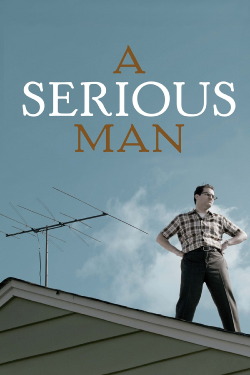
It has taken me two viewings of A Serious Man to like it. The first time was a dull expedition into the absurd naturalism of Jewish culture. The Coen Brothers' were really playing to themselves here and I found it as a very distancing experience. It turns out there is a way (if you are not Jewish) to enjoy A Serious Man: admire the Coens' bravura, their timely quirky characters, and the sharp dialogue. To an extent this a comedy, to another extent this is relentless drama. A Serious Man, like many other Coen films, captures the motions of life in a particular society. This is not quite a screwball film because there is a deeper complexity to these characters than just dismissing them as fatuous. These are characters living tragic lives, controlled by the dynamics of their society. Here we find a comedy of manners where the characters's choice reflect them and their decreasing integrity. They have religion, they have family, but they are never truly happy.
A Serious Man begins as a fable -- dimly lit, 20th century setting, and archaic characters. A husband and wife believe a rabbi to be dead but he comes knocking at their door, very much alive. The opening acts almost biblical: we are not here to laugh, but to take in some kind of message. Something the Coen's love to explore. Professor Larry Gopnik (the terrific Michael Stuhlberg) is in a pickle. His wife wants to leave him for the care-giving and benign Sy Abelman (Fred Melamed). It is unusually funny, every time Larry tells someone of his misfortunes (quite insecurely I might add) the immediate response is a shocked gasp of: Sy Abelman!? Larry is constantly demoralized throughout the film, but Stuhlberg plays it smart. He makes you care about the character, but Larry is not totally self-aware with his sadness. You'll find him funny when he anguishes but you'll also find this peculiar sympathy.
Even Larry's son Danny (a great first-time performance by Aaron Wolff) is in trouble. But for reckless, purely teen purposes. He loses his walkman while listening to Jefferson Airplane and he owes money to a school drug dealer. This is the '50s when kids smoked pot as much as they enjoyed ice cream. Danny is completely out of it, completely stoned. He deals with his boring, midwestern life by singing Hebrew songs and maintaining a decent high. Larry was never exposed to that. He is tied down to morals. He refuses to pass a failing student who needs the mark for university purposes, he is tempted by his voluptuous lady neighbour, and hesitant to judge his redneck other neighbours. Larry is trying to be a serious man but the mental conflict that inhabits him reduces him to a frivolous being.
This film is more for the Jewish folk irrefutably. The Coen's jokes can fly past you without you realizing it and the era is so subtly composed that it would take great scrutiny to immerse yourself in it. The language in the script, though it is well-written, has the Hebrew dialectic that can drown out some of the jokes that are much funnier than they sound.
But the Coen's know how to set up terrific set pieces. They craft peculiar side stories to stimulate these character's afflicting lives. You would be a mere fool to turn down the story of the Three Rabbis which moves at a more anticipating pace than traveling down the Yellow Brick Road. Who is that third rabbi and why is he always 'busy'? O, that is right, he's thinking. Or care to indulge the convoluted story of the dentist trying to decipher a Hebrew code found behind a man's teeth? The joke is that the Coen's build all this tension for nothing. Larry asks the second rabbi what happens in the end and he replies that it does not really matter. It is just so fascinating.
The second half does become too serious; Larry becomes concerned with his loss of humanity. He's given up on himself and that sombre attitude he is trying to develop. The process is intriguing as drama, but the Coen's lose hold of the gag -- we should still be laughing at these characters.
But the second viewing of A Serious Man was a worthy one. The Coen's endure a absurd yet realistic approach to the fall of one man, caught up in his faith and crumbling substance as an important adult. No one can treat him seriously anymore and neither can he. And please, do not despise the ending to A Serious Man, but it keeps the message wide open. Think like that second rabbi and ask if a true answer is really important. In the end, all these characters were looking for was somebody to love. Do they ever? Not really, neither do they gain redemption, but the influential beat of the Jefferson Airplane song "Somebody to Love" interprets the film with this psychedelic and bitter-sweet gloom. Because when the truth is found to be lies, all the joy within you will die (as they wrote). And that is what The Airplane and A Serious Man taught us -- the truth is a distorted revelation.
I SAY--See It.
This review of A Serious Man (2009) was written by Nathaniel M on 12 Jun 2013.
A Serious Man has generally received positive reviews.
Was this review helpful?