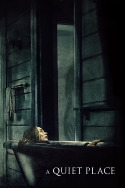
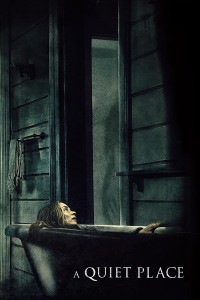
Review of A Quiet Place (2018) by Kevin F — 09 May 2018
We shout out loud with gratitude in the face of an archaic cinema facet revivified by post-modern suspense genre: Silence.
Who'd have ever thought one of the most beloved and recognized men of the American comedy television is the one who is giving a turn of 180 degrees to mainstream horror-thriller genre? Directed, co-written and starring Mr. John Krasinski, this serendipity is an untamed and stealthy cinematic beast, which doesn't spin out of control in the three genres it is composed, delivering a juicy masterclass on how to build excellent drama and tension sequences using as a vehicle an idea that breathes coherence, forwardness and originality. Unfortunately, we cannot call it as a modern classic or an indispensable game-changer because of obvious and detrimental flaws that weaken the enormous possibilities it got. Clearly, it bolsters the sprightly revival of the genre, allowing the spectator to experience a basic-structure-but-complex-development storyline, with an intermittent but intense pace, with aggressive and powerful images; a delightful cocktail of emotions where wisdom and quality easily dissipate the problems detected only by a severely objective and critical mind, a mind excited to bump into the new "Don't Breathe," a mind that left the theater pleased but confused and sincerely dissatisfied.
Keeping the viewers on the edge of their seat for more than one hour is unthinkably complicated; popcorn, phone calls, text messages, a noisy - and bothersome - individual who doesn't be quiet or, if the worst comes to the worst, a succession of on-screen images failing to correctly capture attention are factors that drastically affect the correct cinematographic experience the spectator must have, for this reason, each filmmaker must safeguard effectiveness and dynamics on its project, regardless of the genre or the director's vision, should always have the mind of the spectator on the move; The big and endless problem is that many get it through high-sounding hollow set-pieces that in most cases are mere incorporations alien to the needs of the story. For that reason, it's a pleasant surprise and a huge pride to observe how an entire theatre is in a fascinating state of alert, either by interest or discomfort, turning my head and glimpsing in the darkness a notable number of people with anguished faces as an immediate response is a kind of unspeakable satisfaction, however, what is certainly impressive and mind-boggling is that this great achievement was got by a story in which voice dialogues are conspicuously absent- well, except for certain explicitly required interventions, - accentuating the complexity of this enviable feat, without a doubt, doing this isn't easy, and this film breathes mastery in this field.
What was the last time you watched a nearly-silent suspense film made by a major Hollywood studio? It seems that this question has no answer. The main originality builder here is its ability to evolve in a particular not-talking film, that's already a bombshell. With an over limited use of dialogues and an intrepid skill in conceiving an irrefutably captivating story with coherence and vigor, it seems impossible to make a movie without the actor's voice, for many artists is a requirement for storytelling understandability, since the characters are the link to the viewer, they make the connection, but, not all the stories take this kind of paths. From page one of the script what writers Scott Beck and Bryan Woods wanted was to stick a plot in absolute silence, because precisely this was the thematic thread around the story would derive, its almost complete leading and its unbelievable results become the film into a must-see, because in addition to the pictures, it profits from the unbeatable performances and incredible cinematographic tricks to replace the imperceptible emptiness of any human noise. Broadly speaking, this kinematic tool seems to be the engine of the idea, however, dissecting my own experience and some spectators' opinions, such a factor didn't work in top form. We agree that the first two halves of the film, despite determined exceptional moments, fall abruptly, losing the constancy of its sporadically dynamic, frenetic pace, causing sadly distraction or disconnection in the public with the flick. But these are eventual failures and flaws, quickly saved by the aforementioned sequences, which share authenticity, beauty and horror in comparable conditions.
The second wise move is, of course, the story. Divided into daily chapters, the settling of a not-too-distant utopia sets the plot as a rich center of ambitious possibilities, which knows how to use very well. Around orange woods, a beautiful river and a country house adorned by cornfields, the story puts its eye on an American family that is severely affected by a literally unexplained human extinction, which, in a kind of modern twist to George A. Romero's masterpiece, was aggressively reduced by some annihilating creatures, very similar to Ridley Scott's alien, that possess an overdeveloped sense of hearing, oxide beasts that have imposed just one rule on people who wants to survive: zero sounds. With this setting, the family will undertake a hard survival path to hell in a land where nothing is seen, but everything is heard. Although cinema has often shown humanity as an endangered species- of course, most in YA film adaptations, -a horror story had never used it in such a clever and impressive way, here monumental destructions are not of metropolis or nations, the powerful destructions are the plot twists and the consequences these horrific rust animals stir up. Likewise, the script allows each of the characters to develop in an organic, emotional and cohesive way, as the actions of one member have an impact on the other, thus forming a complex chain in which each character is vital to the other. The twists are perfect, unexpected and painful. Heartbreaking, they're simply afflictive as these are the ones that make to weep many silent viewers, extremely well-achieved tear-jerking moments, a film rich in worries. Nonetheless, many resolutions fall into commonplaces, verbi gratia, putting a major character in jeopardy, at first glance, seems risky, indeed, very few take seriously that something is going wrong, and it's a shame because the incredible tension given to the last act is undermined, but beware, don't trust yourself, because there are surprises, awesome surprises.
It's worth highlighting an underlying social and political character in the script, subjects with a chance of controversy and debate. Placing the first minutes of the movie precisely in the year in which a new American president was elected and scattering enigmatic and renowned newspapers on walls and paths attribute a latent denotation of political nature, perhaps, putting an emphasis on the big role that the United States has inside this annihilation. The origin or purpose of the instinctive creatures is never clearly revealed, but it could attributable some responsibility to some kind of authoritarian rule; a fiction not too distant from our reality.
Dreaming is priceless, so I find myself in the middle of the dividing line between those who support and who don't the theory that Krasinski's film would have fit like a glove into J. J. Abrams' ever-expanding franchise, "Cloverfield". Relating it to the suspense and thriller of Dan Trachtenberg's claustrophobic psychological horror hit seems more logical and accurate than to Matt Reeves' or Julius Onah's films. If one compares them in detail, it's possible to detect several similarities such as the disappearance of any human salvation, annihilations at the hands of unknown entities - possibly of extraterrestrial descent - chary brainy characters, breathtaking tension sequences builders, dynamic and dramatic developments on the characters and an unusual and sharply daring taste to give a twist to the storyline. Perhaps, when the same production studio of the franchise offered the writers this alternative what mainly stopped them in accepting to adhere it to its universe was the extreme resemblance of this movie to Trachtenberg's flick, not in essence, in figure, concluding that, despite the bravery and originality of the idea as an independent work, wouldn't fit into the moderately-related pattern because they would feel quite close, and according to Bad Robot's creative minds, they will weave their unusual cinematic universe by dissimilar genres and themes that, in due course, are compacted into a coherent whole, a kind of Marvel Studios idea; and all in all, this is one of the few studios that have successfully achieved a real impact with its shared universe. Likewise, analyzing the nature of the proposal, the central axis of the film would violate the rules of the franchise, since 2008 with the inaugural work was established the appearance of a beast of colossal proportions, that is, the creatures that terrorize the characters as soon as a sound reaches their ears could not appear as explicitly as they do in the film, it would be counterproductive, so it was insane to install it both for the development of the script and for the coherence of the universe and its even inexplicable monster.
Only seven characters on screen, three of them are single-use narrative gears, but the story keeps above water in large part due to the refulgent, strong performances. Assuredly the broad recognition of the Hollywood-stars couple helped in the global reach of the film and the feeling of each moment, possibly because father and mother are husband and wife in real life. After eight years of marriage, the new- with full respect - 'Brangelina' manage to portray a fictional relationship as sentimental, human and tangible as they possess, the spark and authenticity of emotions are perceptible, since they shine together and separately. According to the players, the real reason why that achievement was possible was their own children. It's difficult to say if they play main or supporting roles, however, it can be concluded that each of them is key throughout the hour and a half of footage. No hesitation, Krasinski is who leads his own film. Portraying an austere, terrified but constantly prepared, protective father, the American actor sweats fear and love with an overflowing force, he stands out every time he appears on the scene and certainly manages to dissipate, even for a few minutes, his renowned TV-star name. Neck and neck, his wife Emily Blunt also knows how to steal the show; her acting power glimpsed in her gaze, the defenselessness and maternal ferocity are palpable in her role as Evelyn Abbott, she's smart, self-sacrificing and sympathetic; she embodies what a mother is with so much sweetness and credibility that we pains even her slightest scratch, both physical and emotional; another big role to file in the huge catalogue of the actress, who makes her first foray into horror cinema. The young girl Millicent Simmonds, leading in the latest film of Todd Haynes "Wonderstruck", is the dourest and rebellious character, it's fantastic that such a role has been given to a 15-year-old actress. There are no hurdles in the way to convey what she feels, we believe her frustration and guilt, we know she doesn't do the right thing and we do the impossible to be aware of her mistakes; a great announcement and a new addition for an unusually long acting newcomers list. Last, but not least, Noah Jupe, who with his charisma and inherent tenderness becomes the most vulnerable character and, as a consequence, by whom the audience suffers most, he has an important role in the development of the idea, this ends up being his official presentation after small opportunities in "Wonder" and "Suburbicon." Of course, sign language is universal in the movie and is executed by all the actors, which increases the difficulty and therefore the results of each interpretation, further improving their incorrigible performances.
There's no complaint as for the artistic field, indeed, here is where the film shows some of its best bets. Mainly, the clever camera movements leading the film because they encompass the essence of the moments; dolly moves, zooms and blurs and some hand-held camera shots behind or in front of the characters produce insecurity and discomfort. Likewise, the angles chosen by the filmmaker/actor are coupled with the meaning of each scene, the picture gets narrative power, necessary due to the absence of constant dialogues. The cinematography of Charlotte Bruus Christensen, who had previously worked in "Molly's Game", "Fences" and "The Girl On The Train", achieves an unparalleled, threatening and alarming imagery all the runtime, the viewers never feel confident, much less relaxed, among the foliage of the forest or the dense corn crops. Leaning on a numerous production crew, the film mutates into a kind of test in which the slightest error (crunch) leads to the worst final, there are marks on the ground indicating where they can and cannot step on, noisy elements are eliminated, nobody wears footwear and all the paths are delimited by white sand that looks more sinister than it should, even a newborn's whining aren't allowed in a world that must remain forever in mute.
Christopher Tellefsen deserves personalized recognition thanks to his decision of reducing as much as possible the length, synthesizing the crucial parts and discarding what doesn't contribute, focusing the core of an entertaining genre film. Time flies by as situations are located in the right place, carefully beneficial choices. After the screening, I found four memorable scenes, dark dreams coming true thanks to a set of artistic and creative components to achieve such level of effectiveness and unbeatable naturalness: The first one takes place at the beginning, just before the main titles make their appearance as vanishing powder; the second one is an incident inside a creepy silo; The third one is a painful sacrifice demanding a few wipes and the fourth one, exhibited in the last act, is starring Emily Blunt in a bathtub and the danger lurking, certainly brutal and the best of all the movie by far.
The sound section is good, but that isn't enough. Despite pictures had to execute the narrative function the dialogues could not, the accompaniment was to be exceptional, as original as the ideas of the script and terribly disturbing as it should be in a horror film. Two Oscar nominations, but Marco Beltrami's soundtrack doesn't have much to highlight because it complies with simple emotional, atmospheric compositions and loudly cheap high-sounding sounds when the creatures make their entrance, it's quite common and unimaginative in a manner of speaking. A huge dissatisfaction with such powerful references, however, the biggest disappointment was the sound editing work, which plays its role half-heartedly, it doesn't use an important feature in the way it should, a terrible flaw. While on several occasions a good frightening impact is achieved by breaking the silence with an accidental sound, all the alternatives the story had are not explored.
With his third work as a director, John Krasinski burst into as an inventive and original voice for suspense genre. His film is a tension construction class, as well as a visual delight thanks to a sensible and exciting perspective on a story that isn't wasted. It's amazing to see how he understands the function of each camera movement, knows how to keep an exquisite timing between the characters and sets up vicious sequences that leave the spectator petrified. We place a value on the prioritization of the coherence and storytelling sharpness, bringing the characters in the foreground, not relegating efficient jump-scares with oppressive atmospheres leading to a breathtaking climax. Like hotcakes on the tables of the major studios, he announces himself as one of the most innovative Hollywood filmmakers and screenwriters at the expense of this spectacular debut that took everyone by surpri.
This review of A Quiet Place (2018) was written by Kevin F on 09 May 2018.
A Quiet Place has generally received very positive reviews.
Was this review helpful?