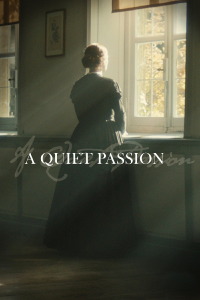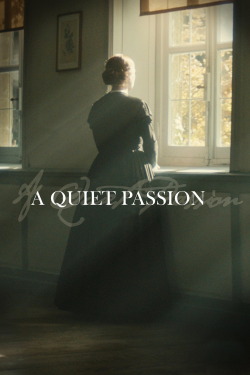
Review of A Quiet Passion (2016) by Travis W — 08 Jan 2018
Very little is quiet in Terence Davies' A Quiet Passion. The young Emily Dickinson, played by Emma Bell, spends her time in the company of her family and walking the Amherst gardens with friends and neighbors. Clever repartee and smarting retorts characterize these engagements, with witticisms volleyed back and forth at such speed it would make Whit Stillman blush. Still, beneath all this pedantry trembles something even louder.
Davies teases the skulking menace during a typical evening at the Dickinson home. The young Emily looks up from her reading, a flash of epiphany settling across her face. She recites in voice-over:
The Heart asks Pleasure -- first --.
And then -- Excuse from Pain --.
And then -- those little Anodynes.
That deaden suffering --.
And then -- to go to sleep --.
And then -- if it should be.
The will of its Inquisitor.
The privilege to die -.
Under her words, the camera takes a slow turn around the candlelit room: an aunt dozing, a father reading, a sister sewing, a mother staring distractedly at the fire. In full rotation, the camera comes back to rest on Dickinson's face, aghast at the abyss she has just borne witness to. In the previous scene, she exclaims, "Poems are my solace for the eternity which surrounds us all." At this darkened hour, she has glimpsed that eternity hunting the paltry anodynes of the drawing room, the Inquisitor taking its inventory. Her mother, in ignorance, breaks Emily from her horror and asks her to entertain with "one of the old hymn-tunes" on the piano. Emily acquiesces.
Eventually, though, all this agreeableness ends, and the subterranean trembling of the first half of the film turns to the unclositered rage and sorrow of the latter portions. Upon losing friends and family members in quick succession, Dickinson, played in older age by Cynthia Nixon, forsakes all such passing pleasures the world of society has to offer, not the least so because they have seemed to pass on her. Receiving as little attention from suitors as her poems receive from publishers, Dickinson internalizes rejection in both person and soul.
Soon the body works its own rejection, debilitating her with seizures brought on by Bright's disease. In the solitude of her seclusion and suffering, the stuff of her poetry, that thin veil between living and eternity takes hold of the screen. The passion stalks from a source outside, elsewhere to the fragile humanity at stake. Until finally, it stops for her.
This review of A Quiet Passion (2016) was written by Travis W on 08 Jan 2018.
A Quiet Passion has generally received positive reviews.
Was this review helpful?