Review of A Prairie Home Companion (2006) by Wade B — 22 Dec 2008
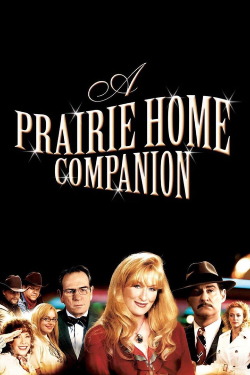
The films of revered director Robert Altman are something of an acquired taste: while certainly not epic on the scale of huge costume dramas or blockbusters, the worlds that Altman spins into life onscreen are invariably sprawling and complex, as his characters confront in extraordinary ways the very ordinary facts of life. In 2001's class-conscious [i]Gosford Park[/i], he looked at the universal themes and ideas of death, prestige and family through the prism of a drawing-room murder mystery. With [b]A Prairie Home Companion[/b], a tribute to the real-life, long-running live radio show starring Garrison Keillor, Altman wants to invite us into a world on the verge of collapsing beneath the weight of modernity: there is little room left, the film is saying, for these small-town stars and values of yesteryear.
Keillor, who wrote the film, stars as a broadly fictionalised version of himself: he does indeed helm the titular radio show, just as it's about to be shut down by the sinister Axeman (Tommy Lee Jones), who is never referred to as such in the movie but doesn't get a more humanising name either. He represents The End of the quiet, simple hometown life and values that these radio stars have peddled for years: whether it's the singing Johnson sisters, dotty Yolanda (Meryl Streep) and earthy Rhonda (Lily Tomlin); yodelling cowboys Dusty (Woody Harrelson) and Lefty (John C Reilly); or even those who help and hang around backstage: pregnant stage manager Molly (Maya Rudolph), or Yolanda's death-obsessed teenage daughter Lola (Lindsay Lohan). All security man Guy Noir (Kevin Kline) can do is hang around backstage as he recognises another harbinger of doom sharing the same corridors and walkways as the oblivious radio stars: the white-clad, ethereal Dangerous Woman (Virginia Madsen) - not so much woman as angel of death and endings.
If it isn't clear enough by now, [b]APHC[/b] is very far from being a linear, literal kind of film. There's the straightforward entertainment part of it, as movie celebrities take to the stage to sing the kind of sweet, down-home country ballads that are a hallmark of Keillor's programme. So you have Streep and Tomlin belting out [i]My Minnesota Home[/i], or Reilly and Harrelson goofing their way through [i]Bad Jokes[/i] galore - through all of this is looped the bare bones of a plotline: Yolanda is Garrison's erstwhile girlfriend, still trying to figure out why their relationship didn't work out; Lola wants the dying show and the death of a member of their troupe to be given the eulogies they deserve; the Axeman and Dangerous Woman close in on each other - each bringing their own brand of ending, one artificial and one natural... but who's to say which is better?
This is the point, if point there be, to Keillor's script: [b]APHC [/b]is a film about goodbyes, the kind that eventually, inevitably come even if fate intervenes, the kind you cannot avoid. Of course, it's at this point that the literal shades into the metaphorical, for it's difficult to understand the role of Madsen's white-cloaked character - she flits through scenes,for the most part unnoticed, an icy, blonde and yet not malevolent presence. She seems to be Fate rather than Death, and it's interesting that few of the characters in the film recognise her for who she must be, beyond the most hyper-stylised, artificial character, Guy Noir - himself an arch creation one first sees emerging from a diner into a flickering orange wash of lamplight in the pitch-black night.
The problem with the film is that Altman never quite seems able to blend the simple mundanities confronted by his characters with this almost painfully indulgent battle between Fate and Humanity. Of course the film is a fake, elaborate construct - the tribute to a radio show that, in real life, is still broadcasting to this day - and to some extent comes across as if it's holding itself at a distance from the audience. This, however, can be appreciated intellectually and yet fail, as I feel this film ultimately does, at making a visceral impact. Its deliberate, mannered symbolism is indulgent to the point that it falls flat, causing puzzlement rather than lending insight.
[b]APHC[/b]'s saving grace is, as always, the remarkable cast that tends to flock to Altman projects. The thrill of Altman's trademark scripted improvisation clearly has its raw appeal. All the stars are clearly delighting in the trademark overlapping dialogue peppered throughout (most memorably and brilliantly sent up by Streep and Tomlin themselves at the Oscars honouring Altman that year), itself almost a character in the film as, for instance, Yolanda and Rhonda bicker and reminisce and trade barbs the way you feel they have all their lives. Tomlin, as always, is a comic delight, winningly deadpan in a way only she can be, while Lohan surprises with her ability to create a real, believable teenage girl free of the neuroses one has come to associate with the actress' public persona. Keillor, meanwhile, lends a certain folksy charm to... his interpretation of himself.
The real standout here, however, is Streep. It's fun enough as is to watch Streep so thoroughly inhabit a character who is clearly less intelligent than herself, a rare occurrence in Streep's career. It certainly doesn't hurt that Streep boasts the best set of pipes on the show, belting her numbers live with a confidence and charm born of the years and experience Yolanda has gathered behind her. But the real treat is to watch Streep subtly, unobtrusively turn Yolanda into the film's shining light: Yolanda's insistence on [i]living[/i] her life in the face of a predetermined ending, as she frets at Garrison for dumping her, somehow becomes the clarion call for the rest of the film. She's the slightly befuddled character who never quite knows what's going on around her, but who muddles on anyway: life, [i]living[/i], in the face of death and fate.
[b]APHC[/b] has its interesting points: the characters are finely drawn for all the improv, the ideas intriguing albeit not fully fleshed-out. If Keillor's intent to draw parallels through symbolism more literal than subtle falls a little short of its mark, there's still enough to appreciate in the performances of the stellar cast Altman has assembled. If nothing else, you can watch the film as a concert... or as a showcase for a set of actors clearly thrilled to be working in each other's company.
This review of A Prairie Home Companion (2006) was written by Wade B on 22 Dec 2008.
A Prairie Home Companion has generally received positive reviews.
Was this review helpful?