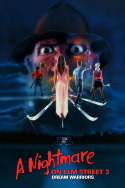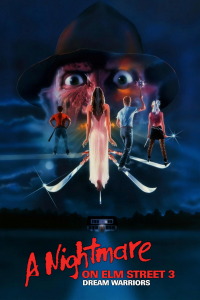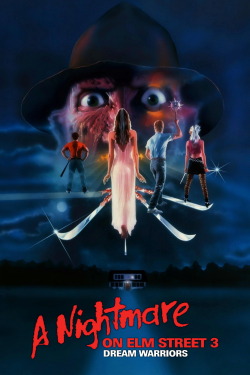
Review of A Nightmare on Elm Street 3: Dream Warriors (1987) by Tom W — 25 Jun 2012
Wes Craven may have been the one to bring Freddy Krueger to life, but it was Chuck Russell who, for better or worse, transformed him into a mainstream icon.
A Nightmare on Elm Street 3 is one of the best of the Elm Street franchise-- probably my third favorite overall (after the first one and New Nightmare)-- and while it could be faulted for talking the films in the comedic direction that would ultimately destroy them, it's hard not to enjoy the strange mix of humor and horror that this movie has going for it. After the second Elm Street movie was panned for being the nonsensical, unintentionally homoerotic disappointment that it was, New Line actually got Wes Craven to come back and write a script for part three; unfortunately, Craven's draft was a little too dark and way too out there for the fledgling studio, who now saw Freddy as a potential franchise cash-cow. Enter Russell (who would later go on to direct The Mask, among other things) and his co-writer Frank Darabont (Shawshank Redemption, natch), who busted out a rewrite that emphasized the imaginative aspects of the dream world and incorporated more spectacular surreal imagery into the film, all while keeping the rules of the dream world relatively clear... not to mention turning Freddy into a bit of a wise-ass. The result? A movie that made more than the first two films combined, and a villain rendered so likable that he became a pop-culture icon in his own right, spawning T.V. spin-offs, books, a 900 number (seriously), and even a plethora of children's toys-- not to mention being probably the most popular Halloween costume in the history of ever. But even ignoring all the things that would come afterward, Dream Warriors serves as a pretty awesome conclusion to the Elm Street "trilogy", if you will, resolving lingering questions and character arcs that go back to the first film and bringing the story to a logical, satisfying end (one that, of course, wound up ignored and undone at the start of the inevitable sequel). Looking back, it stands as the creative apex of the original franchise, finding that happy medium between being a straight-up terrifying ghost story and a toothless self-referential chucklefest.
Wisely ignoring the events of the second film (which, because of its jump-scare twist ending, didn't have any real effect on the Elm Street mythos anyway), Dream Warriors revisits the few surviving characters from the first film, integrating them with a new cast of fresh faces in an interesting and appropriate new environment-- in other words, it manages to nail every single thing you can get right in a horror sequel. The film opens with Kristen, a young, blond teen girl (uh-oh) having a vivid nightmare about a dilapidated house and a certain fedora-sporting burn victim before being discovered with a slit wrist and a razor (since in this film Freddy likes to frame his victims as suicides). She gets shipped off to Westin Hills, a psychiatric hospital, where she meets a motley group of misfits and outcasts who all share the same recurring nightmare-- a nightmare the hospital staff writes off as the byproducts of the Freudian subconscious, despite the fact that the kids are dropping faster than fat people running a marathon (and in increasingly spectacular ways, at that). Things seem bleak until a new hotshot doctor shows up ready to listen to what they have to say... said hotshot being none other than Nancy Thompson, rookie psychiatrist and heroine of the first film. She convinces the head psychiatrist, Dr. Neil Gordon, to hear the kids out (by sleeping with him, of course); together, they discover that the Westin Hills kids are the last of the Elm Street children, and that the only reason that they've survived this long is because they each possess a unique dream power-- making them more formidable than the usual slasher-film fodder. It doesn't take long, though, before the shit hits the fan: Nancy and Neil are fired, Kristen is placed in isolation and sedated, and Freddy takes one of the kids hostage in the dream world, daring the others to come in after him. Banding together one last time, Nancy and the kids go back into the dream world to save their friend, while Neil, with the help of Nancy's father, seeks out Freddy's hidden remains in the hopes that a proper burial will lay his twisted soul to rest... in HELL!!!
Unlike pretty much every other horror film I've seen, Nightmare 3 has a real ensemble cast, not just one made up of a bunch of people waiting to get turned into shish kebab. Leading the charge is Heather Langenkamp as Elm Street survivor Nancy Thompson, now all grown up and with hair three times the size of her head. Nancy makes a transition from heroine survivor to mentor figure in this film, her experience guiding the last few kids left from Elm Street as they make a final stand against Krueger with their bitchin' dream powers. This leaves the virginal heroine spot open, though, so we are introduced to Patricia Arquette (in her first-ever role) as Kristen Parker, a young teenage girl with the miraculous ability to pull other people into her dreams. Arquette isn't acting so much as coasting on her natural charm, but one thing I'll give the girl: she can scream with the best of 'em. Then, of course, there's the band of teens being stalked by Freddy: Ken Sagoes as Roland Kincaid, a sizable tough guy with a foul mouth and bit of a temper; Ira Heiden as Will, a young man in a wheelchair with a fondness for Dungeons and Dragons; Jennifer Rubin as Taryn, a former junkie and wannabe punk rocker; and Rodney Eastman as Joey, a mute kid with a weakness for the ladies (his nurse in particular). These kids are surprisingly well-developed for horror movie victims, and some of them prove so likable that they actually survive 'til the end of the film! Watching over them are Dr. Neil Goldman (played by Craig Wasson), a somewhat bland nice-guy who falls for Nancy and starts to believe that something fishy is going on, and Dr. Elizabeth Simms (Priscilla Pointer), the head of the department who predictably thinks the kids are making sh*t up and almost gets everybody killed. (And for some reason, a young Lawrence Fishburne is there, too, as Max the orderly.) John Saxon makes a welcome return as Nancy's father Donald Thompson, who's lapsed into alcoholism after the events of the first film. Finally, it wouldn't be a Nightmare on Elm Street movie without Freddy Krueger, and Robert Englund is back once again to haunt the dreams of the "last" Elm Street kids. Englund really hit his stride with this entry, which gave him a chance to develop Freddy's sense of gallows humor while still allowing him to be frightening; it was a difficult balance to strike, and none of the sequels would manage it quite as well as Dream Warriors.
Dream Warriors is a far more imaginative and visually outlandish film than either of its predecessors, and that's largely due to Chuck Russell's work as writer and director. The script takes the idea of a tangible dream world and plays around with it, screwing up physics in interesting ways and granting characters dream abilities based on their personalities; it also delves into the psychology of the dream attacks more, as Freddy resorts to exploiting personal weaknesses in the protagonists to get at them (a first for the franchise that would go on to become its trademark). Visually, the film sets a clear divide between the bland, flat palette of the real world and the brightly-colored dreamscape; once the characters find themselves in the heart of the dream world, the film builds towards surreal sequences set in lavishly-detailed nightmare sets-- you can tell that the production designer must have had a ball putting together some of these funhouse-like soundstages. Since this was Chuck Russell's first film, it's not too surprising that the direction is a bit amateurish, with flat compositions and minimal camera movement, but the sets and the fantastic lighting make up for much of it. The special effects and make-up effects are more extensive than in either of the previous films, and, with the possible exception of the Ray Harryhausen-esq Freddy skeleton at the end of the movie, they all hold up pretty well today (they may not be realistic, but they are effective). Finally, I have to mention the score by Angelo Badalamenti. Now, I know that horror films aren't typically known for their big orchestral scores, but good God, the score for this movie sounds like it was recorded off of someone's Casio. This is one of the least impressive film scores I have EVER heard... which might be why there's so much rock music in the film ("Dream Warriors" by Dokken, incidentally, is a classic).
The third Nightmare transformed the Elm Street films from a flash-in-the-pan into a genuine franchise. Granted, it's not as genuinely frightening as the first film was, but it manages just the right mix of humor and horror to pull you in and keep you there. And of course, this is the movie in which Freddy crystallized into a pop culture icon, exploding into the public consciousness in a way that proved tremendously lucrative (I can just imagine the marketing guys talking with New Line: "Freddy dolls! Lunch boxes! 900 number! These are all perfectly logical licensing opportunities for a movie about a child murderer, right?"), but also ultimately destroyed the character when subsequent sequels watered him down and turned him into a wise-cracking anti-hero rather than a figure of terror. At the time, however, the approach proved fresh, new, and invigorating for a franchise that was almost torpedoed by its second outing; of all the non-Craven Nightmare outings, Dream Warriors is the most coherent, the most imaginative, and by far the most entertaining. If you want to see the iconic Freddy Krueger at his absolute best, this is it.
This review of A Nightmare on Elm Street 3: Dream Warriors (1987) was written by Tom W on 25 Jun 2012.
A Nightmare on Elm Street 3: Dream Warriors has generally received positive reviews.
Was this review helpful?