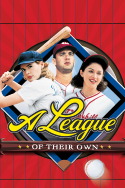
Review of A League of Their Own (1992) by Edith N — 11 Aug 2010
How Baseball Movies Are Different When They're From Women.
In its way, this movie really does use every sports cliché in the book. I mean, after all, we're dealing with an entire team of plucky newcomers, except for the one washed up old has-been going for one last chance. On the other hand, I'm not sure it tells you half the time whether they actually win the games. Oh, there are a few where we know, because it is actually relevant to the story once or twice. However, tehre isn't that perpetual need to know that there is with most sports movies. Honestly, I'm pretty sure they're having a winning season the whole time, and the worrisome thing is not making the playoffs so much as it is still having playoffs to make. In a very real sense, the plucky newcomer is the league itself, and in that same sense, whether any individual game is won or lost is essentially irrelevant, so long as the sport is made interesting enough to keep the league running.
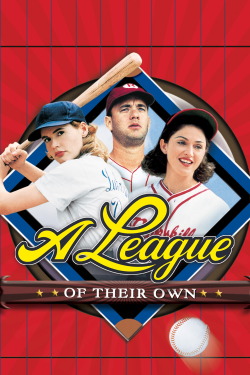
It is World War II. The men have gone to war, and women are having to fill in for them in all industries. This includes baseball. Ernie Capadino (Jon Lovitz) comes scouting through the country, and in Oregon, he encounters Dottie Hinson (Geena Davis) and her sister, Kit Keller (Lori Petty). They're working in a diary, Dottie mostly while she waits for her husband, Bob (Bill Pullman), to come home from the war. However, they go with Capadino to try out for the All American Girls Professional Baseball League. They try out together, and they both make it to the Rockford Peaches. There, they meet a wide range of quirky women, from the skanky Mae Mordabito (Madonna) to the plain and shy Marla Hooch (Megan Cavanagh). There is also their surly, drunken coach, Jimmy Dugan (Tom Hanks, still seeming very nice), himself a former baseball legend now fallen on hard times due to the increasing decrepitude of his knees. Naturally, there is bonding to go with the baseball.
The film is actually cognizant of some of the differences between men and women, or anyway how they're perceived. Remember, one of the first things the women discover once they make it onto the teams is that they will be wearing short, short skirts. Now, that's great for Mae, because it's less for her to take off. However, her best friend Doris Murphy (Rosie O'Donnell) doesn't quite have her legs. Alice Gaspers (Renée Coleman) slides (not Leaps) so forcefully that she gets a pretty scary bruise over most of her thigh. I mean, these were real athletes, but no one took them seriously at it. At the outset, they're pretty much just filling in until the men get back, and everyone knows it. Heck, it almost seems as though Dottie's whole life is just filler until her husband gets back, and the film is uncertain about how much credit to give her for that. She loves her husband more than the sport, but it also makes it seem as though she loves her husband more than herself, which it decidedly does not encourage.
In more ways than one, this is a movie crystallized in time. It portrays events at a very specific time in history. People today have no fear of the Western Union man, having never gotten a telegram in their lives. Few enough people die in the military now that they send someone to your door in person to break the news. In another sense, though, there is a strong hint of early-'90s-ness to the film. There is, after all, Madonna, with the appearance of yet another Oscar winner in her video for the movie's theme. (Quick, name the other two!) There is Rosie O'Donnell, back when I had any interest in watching Rosie O'Donnell. Heck, look at Jon Lovitz. It's Jon Lovitz! Penny Marshall has a generic enough directing style so that a lot of the movie could be made by practically anyone, which is probably what keeps it as timeless as it is. While the music is performed by Carole King, James Taylor, and the Manhattan Transfer, it is still period music.
The thing which always kind of amuses me is that, at the end, that poor man (Mark Holton) still gets called Stillwell Angel. It has to be said that it's one more aspect of life on the road which doesn't get mentioned much in movies about, you know, male athletes. Evelyn Gardner (Bitty Schram) has to take that evil little brat (Justin Scheller) on the road with her. A male athlete would be able to, well, leave the kid at home with the mother. The women aren't supposed to smoke or drink. I mean, they have a chaperon in their boardinghouse. Heck, they all live together in a boardinghouse. Even Dottie, who's married. Either way, though, the end of the movie shows how memory works. After all, Dottie was able to identify a now-confident Marla with just a gesture. Mae and Doris are having arguments fifty years old. I imagine that, when Stillwell walks into that room full of women who knew him when he was a child, he suddenly is one again.
This review of A League of Their Own (1992) was written by Edith N on 11 Aug 2010.
A League of Their Own has generally received very positive reviews.
Was this review helpful?