Review of '71 (2014) by Ola G — 15 Mar 2015
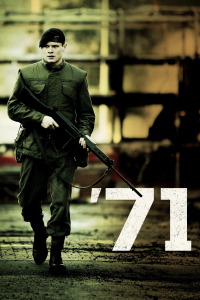
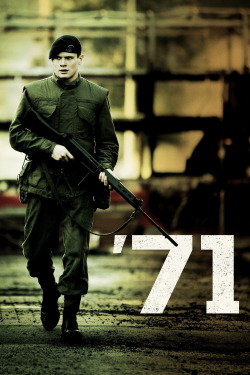
The young British soldier Gary Hook (Jack O'Connell) is accidentally abandoned by his unit following a terrifying riot on the streets of Belfast in 1971. Unable to tell friend from foe, the raw recruit must survive the night alone and find his way to safety through a disorienting, alien and deadly landscape...
Writing for the Los Angeles Times, Kenneth Turan called ?'?71 "a tense thriller from Britain that so adroitly joins physical intensity, emotional authenticity and political acuity that you may find yourself forgetting to take a breath." Manohla Dargis of The New York Times singled out Jack O'Connell for praise, saying, "Mr. O'Connell runs away with ?'?71, in which his character's every emotional, psychological and physical hurdle makes for kinetic cinema." '?71 won Best Director at the 2014 British Independent Film Awards, after receiving nine nominations.'71 is powerful, intense, gripping, emotional and well crafted. You can feel the tension through the screen, smell the fire and gunpowder as the film shows atrocities from both sides of the conflict. The direction is fantastic from Yann Demange, this being his directorial film debut, for which he received the British Independent Film Award for Best Director. Well deserved in my eyes. Jack O'Connell is great as well in the leading role and he manages to portray everything that might go through you in such a difficult situation. The historic turn of events, the Troubles, which is the backdrop of the movie is truly tragic and a dark spot on Ireland. Belfast has been the capital of Northern Ireland since its establishment in 1921 following the Government of Ireland Act 1920. It had been the scene of various episodes of sectarian conflict between its Catholic and Protestant populations. These opposing groups in this conflict are now often termed republican and loyalist respectively, although they are also referred to as 'nationalist' and 'unionist'. The most recent example of this conflict was known as the Troubles - a civil conflict that raged from around 1969 to 1998. Belfast saw some of the worst of the Troubles in Northern Ireland, particularly in the 1970s, with rival paramilitary groups formed on both sides. Bombing, assassination and street violence formed a backdrop to life throughout the Troubles. The Provisional IRA detonated 22 bombs within the confines of Belfast city centre in 1972, on what is known as "Bloody Friday", killing eleven people. Loyalist paramilitaries including the Ulster Volunteer Force (UVF) and the Ulster Defence Association (UDA) claimed that the killings they carried out were in retaliation for the IRA campaign. Most of their victims were Catholics with no links to the Provisional IRA. A particularly notorious group, based on the Shankill Road in the mid-1970s, became known as the Shankill Butchers. In all, over 1,600 people were killed in political violence in the city between 1969 and 2001. Sporadic violent events continued as of 2014, although not supported by the antagonists who reconciled in 1998.
This review of '71 (2014) was written by Ola G on 15 Mar 2015.
'71 has generally received very positive reviews.
Was this review helpful?