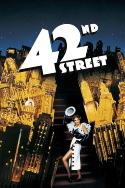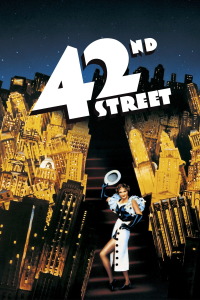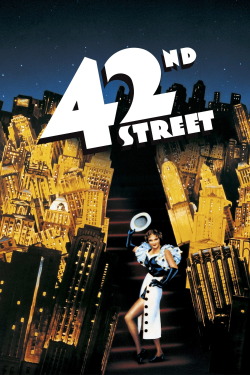
Review of 42nd Street (1933) by Jake R — 20 Aug 2009
When talkies mercilessly killed off the silent movie, producers struck gold with the bright idea to fill their primitive movies with lots of pretty faces, glamorous design and brash song and dance numbers to detract from the banality of the dialogue, the uncomfortably wooden performances and the general lack of unoriginality of the entire film; needless to say, somethings never change in Hollywood. But once the stifling sound technology relaxed a little and the camera could move more freely as it had done in the silents, movies could become moulded into higher class entertainment again. Armed with a bright, new army of stars and with film making talent now used to the changed climate the '30s went on to became on of the greatest decades for movies in cinema history.
The musical itself was somewhat the flagship of the early talkie era, a totally fabricated piece of entertainment existing solely for the pleasures of watching it on screen. With theatre or songs you could branch over enormous ground and come back for more, as you used to with silents, but talkies were cheap money machines that merely exploited a novelty and disappeared when the next curiosity came along; basically the cinematic equivalent of pop music, and it did well to show the inferior nature the talkies had brought the film industry into. But this cheap entertainment became phenominally popular because of the disaster in the real world, with the Great Depression making audiences desperate for something light and fluffy to make them forget about their own hard lives. Thus, the musical became increasingly a genre of wish-fulfilment, pandering to the most basic of audiences needs: sexy girls, catchy tunes and pretty dances. Because of this rudimentary mind-set most musicals of the period have aged even worse than silent movies, but '42nd Street' was one of the real greats that managed to bypass its generic limitations to become something quite timeless.
From the word go the film doesn't prance about, spouting an energetic montage of sounds and sights to capture the giddy spirit of the genre. The story unfolds in the most archetypal way, that of a spectacular show hampered by a prissy leading lady, only for that frumpy chorus girl to jump in at the last moment and save the day. It's only one of the literally dozens of elements in the movie that have been copied ad infitum in cinema ever since, to that point that even regarding this as the first (which it probably wasn't) is difficult, the sense of familiarity a little too strong to be as fully enraptured as the humble theatre-goers of 1933 were.
But the film's overwhelming sense of fun is inescapable. There's an astonishing amount of maturity concerning some characters, and the desperation to accomplish a show is convincing, but it's not the pure fantasy most of its contemporaries were. The threadbare atmosphere of the early '30s is felt poignantly, the women's fashion crystallised as that almost-pathetic fusion of late '20s flapper with garish design to cover the cheapness. Aside from Daniels no one in the film looks particularly glamorous, and the brilliance of the cast can't disguise that unique attitude of frustrated weariness most of the world at the time was feeling. There's a gentle sensitivity to Julian Marsh's stressful handling of a petulant theatre company, and, most importantly, there's a real group spirit and feeling of friendship amongst the cast. It doesn't quite have a bitterness or sourness one might expect from a backstage musical, but then, people in 1933 didn't want to a see a film that would depress them.
It would've ruined the movie's honest enjoyment anyway. This is a film more about finding joy in unexpected places, and making it yourself instead of just waiting for it to happen. It's about not letting your friends down, and not feeling unimportant just because there's a lot of you in the group. Again, these are things that have been covered countless times in the 75 years since, but when seen without an unpleasant sting in the tail it feels almost nakedly innocent and refreshing.
The cast as much as anything are what makes the picture succeed. Wonderful supporting turns, particularly a classy role for an aspiring Ginger Rogers, add chucklesome barbs to the wobbly proceedings and that energy shown in the opening scene is echoed constantly by the rapid-fire delivery, but there's a trio of masterful performances are what elevates this movie into a fantastic cinematic experience. First, Dick Powell is warm and loveable as the male chorine not quite up to standard but still devoted to having a good time and making others happy as if he was. Warner Baxter lends a leathery weight as the long-suffering Julian Marsh, his staccato vocal style a little irritating, but perhaps symbolic of the exhaustion and bluntness his character's profession erodes. It's Baxter, not the bright-eyed Powell, who delivers the film's, and the genre's, most famous and definitive line, and at the end it's his visible relaxation after the tension of the opening night that lets the film finish on such a deft and sophisticated note. But if the film lacks a glossy sheen elsewhere it's more than made up by Bebe Daniels. A veteran of the silent era, her subtle body language and facial expression create a truly brilliant performance. There's something about her wide eyes that are unavoidably captivating, the way they glisten with a burning luminosity all the time, that makes her a lasting symbol of the romantic elegance of silent movie stars, a kind of glamour that comes as natural as breathing, something long lost in cinema since.
The film's real coup d'etat is that fact that for a musical there's not much singing and dancing. It's more concerned with the minuitae of backstage life and the tiring process of rehearsal, but you don't really care because the cast and details are so engrossing. Only after half way do the number creep in, first diguised as rehearsal routines, then they flower into the dazzling entertainments legendary choreographer Busby Berkeley is famous for. From the story-within-a-story 'Shuffle Off to Buffalo', to the classic geometric waltz of 'Young and Healthy', to the epic title number, with a near-wordless bridge portion that surely inspired 'Singin' in the Rain's extended 'Broadway Melody' sequence, the numbers aren't show-stoppers but they're wonderfully warm and witty and do provide some striking sights.
If anything, '42nd Street' is one of those film's where all the tropes of the genre are there, but they're done in such a unique and vibrant way that it matters less who sings what than simply following these characters in their grippingly human lives. It still ranks high up on movie lists because of its realness, and its conviction of working to make people feel good by making them feel good about themselves. How often do you come across a film like that these days?
This review of 42nd Street (1933) was written by Jake R on 20 Aug 2009.
42nd Street has generally received positive reviews.
Was this review helpful?