Review of 4 Months, 3 Weeks and 2 Days (2007) by Dean T — 03 Apr 2011
Some Laws Will Always Be Broken.
The first thing to understand going in is that the Romanian laws against abortion had nothing whatsoever to do with morality. The Ceauşescu regime was not noted for following any morality other than "you should do what we, personally, think is right." No, the concern here was directly related to the Ceaușescu family as well. In that they should rule over a lot of people. The population rate in Romania was on the decline, largely because people couldn't afford to have kids, and the Ceauşescus decided that this was because abortion was legal. Oh, and birth control. While this is broadly true, it doesn't address why people weren't choosing to have children, because Nicolae Ceauşescu was not a master of psychological subtleties. At any rate, the government's policies, designed to make Romania look better without actually increasing the standard of living, also created a bumper crop of AIDS babies from ill-advised blood transfusion policies.
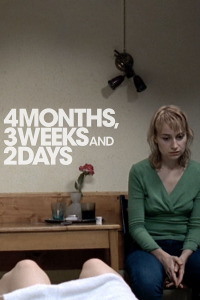
It is in 1987, the last few years of the Ceauşescu regime, that Gabriela "Găbiţa" Dragut (Laura Vasiliu) has become pregnant. The father is never made much of an issue, because she gets her roommate, Otilia Mihartescu (Anamaria Marinca), to make all the arrangements. The two of them manage to do just about everything wrong, including getting a room at the wrong hotel; the abortionist, Viarel Bebe (Vlad Ivanov), knows which hotels he can slip in and out of without leaving a record, and the one they go to isn't one of them. He is also supposed to meet with Găbiţa in advance, and she sends Otilia. Găbiţa has also lied about how pregnant she is, claiming at first that it's only two months and then three. Bebe reminds her that, after four months, they could go to prison for murder. However, he agrees to perform the abortion, but not for the 3000 lei they've gathered. His price . . . well, he knows Găbiţa isn't going to have his child, anyway.
The long-suffering Otilia should have just made Găbiţa deal with the consequences. Somehow, everything becomes her problem, and when she asks why Găbiţa didn't do it, the answer is, "It was hard for me!" As if it were a walk in the park for Otilia. Then again, this all goes to show that Găbiţa is exactly the kind of person you don't want to have responsibility for a baby, and leaving the child in a Romanian orphanage in 1987 was just a slow death sentence. By the time she takes Bebe to the hotel, it's too late for Otilia to back out. Maybe it was from the moment she agreed to help--from the moment she found out Găbiţa was pregnant. They're roommates in college. They were friends before. It seems probable that Otilia was taking care of Găbiţa's dolls for her when they were children. And it strikes me that Găbiţa was never going to grow up as long as there was Otilia there to take care of her. Probably she wouldn't anyway; probably she would be one of those people who finds someone. But Otilia should have found out.
And then there's Adi Radu (Alexandru Potocean), Otilia's boyfriend. He doesn't need taking care of in quite the same way. What he needs is not someone taking care of him overtly but someone who will pretend that she is letting him take care of her. Yet one rather gets the impression that Otilia will still end up being the one doing all the work. She's that kind of person. One of the most effective scenes in the movie has nothing to do, at least in theory, with the main story. Adi has basically given Otilia an ultimatum to force her to attend a family birthday party for his mother (Luminita Gheorgiu). She has other things to worry about, and then he yells at her for not bringing his mother flowers. She had thought she'd just stop by, but there she sits at dinner, surrounded by Adi's parents' friends. Who are all doctors, who could have done something for Găbiţa, but who among other things accuse her of disrespect for accepting an offered cigarette in front of her boyfriends' parents. As if she weren't treated as rude for trying to refuse.
Most of the time, the camera is still, just sitting and capturing the movements of the people in and out of frame. (Roger says there's only one shot per scene, but I think he's wrong. I'm not sure enough to look it up, though.) There is a disorienting scene where Otilia is running, afraid that something has gone horribly wrong with Găbiţa, which isn't even Steadicam. By definition, Steadicam doesn't jostle the camera that way. It is also the one shot which doesn't feel as though it belongs in the movie. I've complained about static shots in the past--the interminable [i]Jeanne Dielman[/i]--but the scene just before you realize Bebe is actually a horrible person is more effective in its stillness. Yes, he's talking down to Găbiţa, but she deserves it. He does things a certain way for certain reasons, and she thinks "sorry" will make up for everything. His calm voice and the still camera lull us into trusting him. The still camera seems like Otilia's facade; it's still on the outside to hide the savageness underneath.
This review of 4 Months, 3 Weeks and 2 Days (2007) was written by Dean T on 03 Apr 2011.
4 Months, 3 Weeks and 2 Days has generally received very positive reviews.
Was this review helpful?