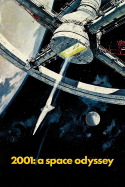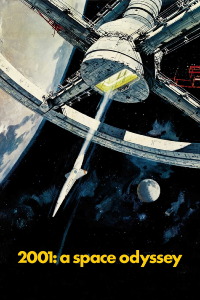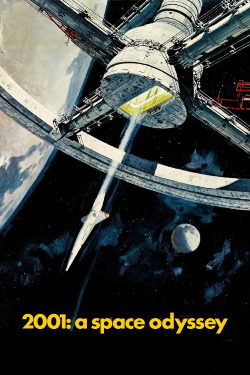
Review of 2001: A Space Odyssey (1968) by Christian A — 30 Aug 2016
You often see 2001: A Space Odyssey on many "greatest movies of all time lists". But does it in fact belong there?
2001 begins at the very dawn of man, and we witness our humble beginnings. Herbivore hominids eating alongside tapirs, contending with a lack of water, food, another hominid group and as we witness first hand, predators such as leopards. Our ancestors appear weak and at odds against everything.
One morning, the struggling clan of hominids wake to find an out of place structure outside of their cave. The Monolith. They are afraid, confused and frantic, until their leader, Moonwatcher, approaches the Monolith and touches it. Soon, the entire clan begin to examine the Monolith. Soon after the encounter with the Monolith, the man-apes learn how to use bones as tools. They begin to hunt the tapirs, and now know the taste of meat.
The confident group of man-apes go and assert their claim on a watering hole previously taken by a rival clan. Moonwatcher uses the bone as weapon and kills the rival clan's leader. A victorious Moonwatcher throws his bone in the air and this leads to one of the greatest match cuts in history as a bone-tool cuts to a nuclear space station. Showing just how far we have come.
We see Haywood Floyd aboard a Pan Am spaceship heading towards a gigantic space station, where he will then fly to the moon to visit the American Clavius Base on the moon. Something has been found on the moon, something that must be kept secret.
Haywood lands on the moon base and congratulates the leaders of the base on their finding and their discretion while keeping it secret. Haywood and members of the moon base travel towards their mysterious finding.
The suspense builds, and we see the moon base has uncovered a monolith, identical to the one found by our ancestors all those years ago. The team is deafened by a loud and ominous radio signal emitting from the Monolith, towards Jupiter.
We cut to the spacecraft, Discovery One, on a mission bound for Jupiter. Aboard is Dr. David Bowman, (Keir Dullea) Dr. Frank Poole (Gary Lockwood), a HAL 9000 (Douglas Rain) super computer and multiple other crewmembers in hibernation for the journey. Frank and David sit down and watch a news interview which they are a part of. We learn Hal controls all aspects of the ship and he is very enthusiastic about the mission. David also talks about how HAL appears to have real emotions, but he doesn't know if that's just the way he is programmed or not.
Later on, HAL is talking to David about the secrecy around the mission, before being alerted to the definite failure of the ships main antenna. David retrieves the antenna component during an Eva mission and brings it inside the Discovery One.
Frank and David can't find anything wrong with the antenna however, and mission control also concludes that nothing is wrong, and that HAL may be malfunctioning, even though the failure rate for the HAL 9000 computers is 0%.
Frank and David talk about disconnecting HAL, as it may be dangerous to allow him to stay activated. Frank and David try and be private about this conversation, however HAL reads their lips and discovers their plan.
Frank and David decide to replace the antenna, and see if it fails, knowing that if it does, nothing is wrong with HAL at all. During the EVA mission to replace the antenna, Frank's oxygen tube is cut and he is sent through space, slowly dying.
David hastily rushes into a space pod and leaves the Discovery One to rescue is friend. David retrieves Frank and attempts to get back into the ship. However, when David arrives HAL informs him that he knew what David and Frank were planning, and he couldn't let them disconnect him. HAL then tell David that he is not allowed in back into the ship.
David comes back into the ship through the emergency airlock and makes his way to HAL's main frame, where he will disconnect HAL. HAL pleads for his life and then begins to sing Daisy Bell as David shuts him down.
David continues the mission, finally arriving at Jupiter. He discovers a Monolith orbiting Jupiter, awestruck, he leaves the Discovery One in a space pod and investigates the mysterious object. What happens next is magical, but I won't spoil it.
There are three main character throughout the film. This would be David Bowman played by Keir Dullea, Frank Poole played by Gary Lockwood and HAL, played by Douglas rain.
David Bowman is the protagonist of the film and a crew member aboard the Discovery One. We don't know much about David, other than is drive to complete the mission, shown how even after all the incidents on the Discovery One he still pushes forward. We don't know if he does so simply because it's his mission of if he has an irresistible need to go where no man has gone before.
Frank Poole is another crew member on the Discovery One and David's companion. Frank and Dave were the only crew members that boarded the Discovery One not already in hibernation. Frank is plans with David to put down HAL. Frank is (presumably) killed by HAL while on an EVA mission and is left adrift in space.
HAL is the "central nervous system" of the Discovery One and considered by David and Frank another member of the crew. Even though HAL is a machine, he still shows signs of emotions such as pride and fear. HAL is the antagonist of the film and successfully kills off the entire crew except for David Bowman in an attempt to "save" the mission.
Stanley Kubrick often made controversial films that didn't exactly fit the classic Hollywood Narrative Style. And we can see this in 2001: A Space Odyssey. The shots are long and drawn out, there is little dialogue and there isn't even an end goal that the characters are trying to achieve in the film. 2001 is not just a movie, but a journey. A journey that everybody will look at differently. Some may love it, others may hate it, some may think they understand and other won't have a clue. This film doesn't ask much you, Stanley Kubrick simply wants you to sit down, watch, listen and use your imagination while watching this film. Stanley Kubrick holds these long shots so you can use that time to think and reflect on what is going on in the film. I imagine being a 10 year old and watching 2001 in the theatre. I would be awe struck, completely mesmerized at what was going on in the film. I think people often forget that this movie was made before we went to the moon, and Stanley Kubrick, or anyone for that matter, didn't really know what it was actually like in space. Kubrick took something relatively unknown and presented it in an amazing and engaging way for his audience.
Stanley Kubrick is known for his meticulous film making, take "Barry Lyndon (1975)" for example, filmed using all natural lighting to give the movie an oil painting feel to it. 2001 is no exception to this level of perfection. One example of Kubrick's attention to detail is the Discovery One's fuselage. When I first watched the film I was very intrigued so I watched the documentary Stanley Kubrick: A Life in Pictures (2001) and did some research into it. Stanley Kubrick actually designed the fuselage to act like a huge spinning hamster wheel. So whenever David or Frank were walking all that was really happening was a crew was rotating the set and the actors would stay in place. His sometimes meant the actors had to be strapped in as they rotated with the wheel. That is some simple, yet awesome thinking. There is also no sound when we our point of view is from space, this is accurate because realistically, there is no sound in space, however, even in modern times directors still include sound in space. This is most likely done to keep things exciting I imagine. Along with depicting artificial gravity well, Stanley Kubrick also very accurately displayed zero gravity during the space scenes and emergency airlock scene. During the airlock scene, Kubrick actually filmed it vertically and attacker Keir Dullea to cords that members of the film crew would then loosen or pull on to accurately display zero gravity. Another brilliant scene using simple, innovative thinking.
As I explained earlier, the match cut between our ancestors first tool, the bone/weapon/tool, that transitions to a nuclear missile launching satalite orbiting earth is probably one of the most famous edits in film history. This cut is there to show our far we have advanced, and our continued reliance on weapons.
The music is perhaps one of the most interesting things about the film. Because Stanley Kubrick didn't focus on dialogue to drive the story, he needed to incorporate strong visual and sound elements. Which he certainly accomplished. Kubrick actually commissioned a soundtrack to be composed by Alex North, who worked with Kubrick on Spartacus and Dr. Strangelove. However, Stanley Kurbrick grew fond of the stand in music he was using and decided that was the most optimal route to go. In an interview, Kubrick explained it like this.
"However good our best film composers may be, they are not a Beethoven, a Mozart or a Brahms. Why use music which is less good when there is such a multitude of great orchestral music available from the past and from our own time? When you are editing a film, it's very helpful to be able to try out different pieces of music to see how they work with the scene...Well, with a little more care and thought, these temporary tracks can become the final score.".
2001: A Space Odyssey is a science fiction film to the core. Stanley Kubrick takes full advantage of the genre to show us mesmerizing imagery of space, technology and planets in our solar system. I always say science fiction is my favourite film genre because directors can show us wonderful ideas that we still have questions about. Stanley Kubrick does this and delivers it all through perfect filmmaking.
This movie filled me with a sense of wonder and unknown. I can't help but wonder what this film would be like for a 10 year old seeing it for the first time. This film is impactful and transcendent and it is no surprise it is such an influence to people even to this day. It's not often film makes one feel so many different emotions but 2001 is one of those films.
2001: A Space Odyssey has been loved by all for the last 46 years. I expect it to continue to be loved as it goes down in history as one of the most influential and greatest films of all time.
This review of 2001: A Space Odyssey (1968) was written by Christian A on 30 Aug 2016.
2001: A Space Odyssey has generally received very positive reviews.
Was this review helpful?