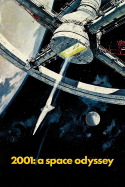
Review of 2001: A Space Odyssey (1968) by Da Z — 29 Nov 2014
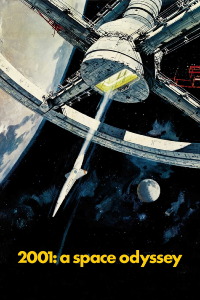
It is undeniable that Stanley Kubrick's 2001: A Space Odyssey is a cinematic classic. It is a hallucinatory and philosophically thought-provoking experience unlike any other, and it remains to be as relevant as any modern film could be, though was released in '68. This is not a film that, by any means, could be watched every day, or one would be driven to existential insanity. Still, 2001 is a film that deserves-almost pleads-to be watched every so often. If there is an opportunity to catch it on the big screen, there is no doubt you should be there. First-time watchers and avid fans alike will be awed by 2001: A Space Odyssey. It is impossible not to. Furthermore, the film marks a moment in cinematic history that is as iconic as it is entertainingly lucid.
Let me start off my saying that I am tackling 2001: A Space Odyssey as a half-review, half-analysis. If that gets annoying, I'm sorry, but hey, at least I've taught you some cool philosophy stuff! I promise not to get too wordy. Anyway, here we go. As promised, in the year 2001, we are taken on a journey through space, though in an entirely unconventional manner. We see the spherical horizon of the Moon and the Earth as the film begins-that is, after three minutes of darkness and a viscerally intense score that'll make you itch all over. It is soon evident there is a very surreal nature to this film and it lies wholly in its manner of presentation. 2001 is comprised of four segments, each telling a story concerning animalism, humanism, artificiality, and morality. Furthermore, the film depicts the consequences of attempting to understand what we perceive to be "the truth," or in other words, "the secret of life." Is there an afterlife? Is there a reason for our existence? 2001's astounding execution of questions such as these are strikingly brought to life in the four-part film, each providing their own importance to the film's central theme. The theme itself, however, is something for each person to interpret for himself or herself. There is no right or wrong when it comes to 2001: A Space Odyssey.
So begins the first segment: The Dawn of Man. This segment depicts the early stages of animalistic life, and ultimately, it sets up the animalism vs. morality theme of the whole film. We first see apes interact in a savage and territorial manner, full of rage and dominance. Upon waking one morning, the apes discover a large, rectangular, black monolith on their land, and are afraid and apprehensive to approach and touch it. When they all eventually do, they begin to understand causes and effects and perform higher cognitive functions as rational beings. It is a depiction of evolution, sharply framed as an ape grabbing a bone and smashing a skull open. From one frame to the next, we see apes transform in both physical figure and cognition. They learn weapons exist, as does death. This develops into the concept that we have an animalistic nature due to our evolutionary core. It is also important to note that the black monolith is a highly important aspect of the film as a whole. It is presented here first and exists as a symbol of morality and higher intelligence in the film.
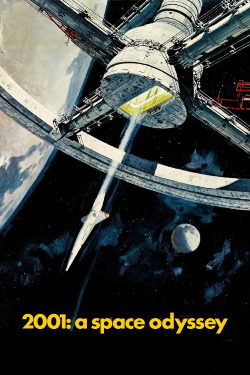
The second segment, entitled TMA-1, follows a man named Floyd as he enters a space station orbiting Earth to attend a meeting concerning something "he is not at liberty to discuss." We are clearly no longer in the prehistoric ages anymore. The cinematography in this segment is cosmically breathtaking as we see people, such as Floyd and other passengers and crew, walk in all directions-such as making full 360 degree turns, thanks to velcro shoes! With gravity (and hence, other objects) always remaining at zero, this effect may be dizzying but is a beautiful spectacle. Neon lights cover the spaceship and detailed moon craters cover the ground. Upon attending the meeting, Floyd is told of a mysterious black monolith that has appeared on the Moon-identical to the one in the first segment, of course. As he goes on a mission to see the monolith, its eerie sound and almost menacing presence is as much a bewilderment to the astronauts and himself as it was to the apes.
2001 jumps precisely eighteen months into the future in its following segment, entitled Jupiter Mission. It can be said that here we encounter the two central characters of the film, or rather, for the remainder of the film. We meet the intelligent and handsome Dr. David Bowman on a mission to Jupiter with several other scientists, who remained in cryogenic hibernation until arriving close to the planet. (Hey, sci-fi flicks have used this from Alien to Interstellar!) The mission itself, however, came in the name of an intelligence machine that is "absolutely fullproof" named HAL 9000. This machine interacts with humor, sarcasm, and a highly cognitive form of intellect and inquiry, as seen in its discussions with the astronauts in this segment. However, the mission itself remains a secret only HAL can know, and the astronauts remain entirely on the whim of just how foolproof HAL can be-particularly when it comes to the "necessary success" of the mission's completion. These scenes range from satirical and to piercingly philosophical in terms of human communication and rationality. It is obvious HAL could not possibly have a morality complex such as human beings, therefore clouding its judgment. Or rather, is it possible that it could? Could a machine possibly interpret our morals and methods of rationalization, in turn mimicking human behavior? This becomes a thoughtful concept to consider as the film swings into a frenzy of suspense and uneasiness. The ideas are bold, as are its intense final seconds.
The final segment of the film, entitled Jupiter and Beyond the Infinite, continues with Dr. Bowman surrounded by the cinematic beauty of the planetary universe en route to Jupiter. This segment is without a doubt the most mind-boggling and philosophically dense part of the film-largely due to its manner of closing. Bowman discovered that the Jupiter Mission was conducted due to a black monolith found on the Moon (of course, again) transmitting powerful radio emissions toward Jupiter. His descent into Jupiter is a profoundly eloquent experience, and the reason I call it a descent rather than a journey is due to its hallucinatory and metaphorical nature. Bowman discovers another black monolith as he enters Jupiter and is immediately flung into a kaleidoscopic vortex. He sees translucent walls, waves, and shapes of all colors, possibly being a depiction of the Big Bang or cell reproduction or alien life. Bowman is eventually left standing in a room. This is the finale of the film and its progression is confounding. Therefore, it is best seen and deciphered by one's own interpretation and personal perspective. As previously stated, 2001 demands multiple viewing, and this is because every watch brings something new in the form of one making sense of the scientific and philosophical proposals made in this sci-fi tale. If you haven't caught on yet, 2001 is one of my all-time favorites and I could clearly discuss it for ages. It is truly a spectacle that remains highly regarded in all of cinema and with good reason-it is gripping, thoughtful, and relentless as an analysis of evolutionary and morality. There is absolutely nothing like it, and is therefore a must-watch for all.
This review of 2001: A Space Odyssey (1968) was written by Da Z on 29 Nov 2014.
2001: A Space Odyssey has generally received very positive reviews.
Was this review helpful?