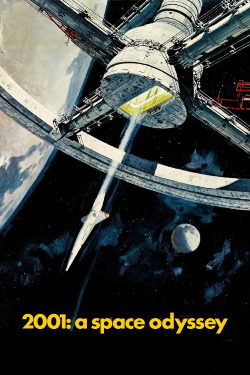
Review of 2001: A Space Odyssey (1968) by Cameron H — 22 May 2015
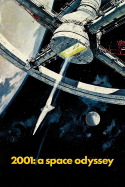
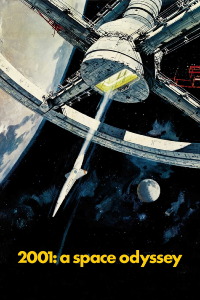
(This is a revised review, as I decided to watch the film again.) In the first couple of viewings of 2001: A Space Odyssey, I questioned its legacy as one of the greatest sci-fi films of all time. I barked at director Stanley Kubrick's "failed attempt to be artsy fartsy," and felt that the colourful, spacey, and wildly impressive music video parts should have been separated from the isolated and intense man-versus-machine story into separate films. There are three distinct sections --- The Dawn of Man, where we see a monkey clan discover how to use objects/technology as weapons; the space travel, which takes up most of the movie's running time and features the unnerving OS, HAL 9000; and the landing on Jupiter, the "music video" section. I had trouble connecting everything, beyond the big black monolith that appears in each section, and I saw 2001 as pretentious and lazy. My frustrations were surely unjust. When it comes to Kubrick, nothing is lazy. As for pretentious, I have seen the light.
2001 has always amazed me as a spectacle and thinker's film. HAL 9000, the computer system that runs one spaceship on a NASA-like mission to Jupiter, is one of the greatest movie villains, and a surefire inspiration for Portal's GLaDoS. HAL has evolved so perfectly that it has freewill, prioritizing its own survival over the safety of the astronauts in the ship. This is a classic example of what might happen, if A.I. could overpower humans. And what's more fascinating is how helpless the humans are, due to how dependent they are on modern technology. Keir Dullea, who plays the lead character/astronaut David, shows a great understanding of this situation, never opting for anger towards the emotionless computer. Similar to an early part of the section, when David was happy to test his wits against HAL in a game of chess (and lose), David aims to disconnect himself from technology altogether for the sake of his own survival. And though the film has very famous uses of classical pieces, I was equally provoked and, frankly, got the chills in the moments of space's dead silence.
I am sure that I would have always loved 2001, if it were just this section alone, but I liked the other sections too, for very different reasons. The opening and closing scenes of the entire movie are dialogue-free space shots, set to Richard Strauss' "Thus Spoke Zoroaster." The sparse sunlight that shines upon Earth and the bubble baby brings out the beauty of life, in a universe mostly full of darkness. Not that there is anything evil about darkness, but it signals absence. And so, I address the monolith, whose theme song is the shaky Ligeti choral piece, "Lux Aeterna." It is as black as space, and looks almost as though a rectangular chunk of the air breaths in no light. It appears throughout each section, and is connected with development of humanoids. Rival monkey clans were fighting over a water pool, the monolith stood over one clan, that clan used bones as weapons, and won the water pool. Problem solved. David has computer problems, lands on Jupiter, confronts the monolith, and becomes a new being that no longer must rely on computers. Problem solved. While I still feel that the parts are greater than the sum, I can finally connect the movie and develop a fair opinion on it. The recurring monumental imagery and music, the pace that drifts as slowly as the spaceship (relative to the distance between Earth and Jupiter, that is), the typical science-fiction themes mastered atypically. I wish I took a cinema class to be able to address how pristine and unique the cinematography is, but there's that too. Arthur C. Clarke, the screenwriter, is what I needed to understand, while Stanley Kubrick is what I already understood. I love everything about the film as one tour de force.
This review of 2001: A Space Odyssey (1968) was written by Cameron H on 22 May 2015.
2001: A Space Odyssey has generally received very positive reviews.
Was this review helpful?