Review of 2001: A Space Odyssey (1968) by Joshua H — 05 Mar 2015
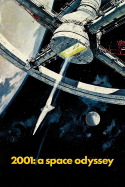
2001 is a landmark not just for science fiction, but for filmmaking in general. What I mean by that is 2001 redefined what science fiction films could accomplish in terms of effects, as well as in their message. 2001: A Space Odyssey has quite the plot, basically about the discovery and understanding of a strange structure known as the monolith. This of course unfolds over the course of human history, spawning from mankind's origins and well into the future.
Stanley Kubrick, one of the 20th century's most visionary directors (Full Metal Jacket, The Shining), helms the film and directs with precision and true love for science fiction. 2001 is beautifully shot and well acted, churning out some wonderful performances from the cast. The film is set in what appears to be the outside of a Utopic society, which has perfected space travel and understands all the precautions behind such a complex task. The only real glimpse the audience has of Earth is at the beginning with the now-famous "Dawn of Man" sequence, in which the monolith gives early man the ability to understand how to make weapons and tools - this is the film's explanation for the birth of technology.
The monolith really serves as the film's central focal point - the film isn't truly implying that all things good and evil come from a mysterious, large, rectangular prism but that, all things do come from somewhere. So, where does sin come from? Spiritually, the Christian understands the sin comes from within us; it is a nature that we have when we are born - so beyond that, where does it stem? It all goes back to that fateful day in the garden as Genesis tells us...
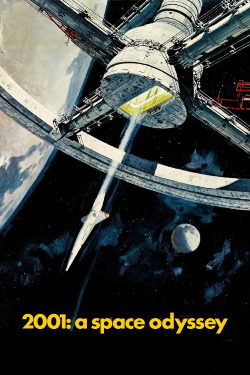
The characters here are not fleshed out to greatly; many of them are only there to further the plot, and unlike Blade Runner and District 9, which are really character pieces with the backdrop of a huge science fiction world - 2001 is a film about theme, and astonishment. A big drawback for contemporary audiences is that 2001 is a slow movie - I mean slow - and at first it may seem pretty pointless to have the film run along (or drag along I should say) at a snail's pace. But back when this film was released, there was no Star Wars, or Jurassic Park, and special effects were not the extravagant spectacles that we are desensitized with today. Kubrick gives the audience the complete opposite of brief glimpses, filling his reels with scene after scene which in no way develop the story, but showcase the wonderful special effects of the spaceships and world that Kubrick's special effects team created. But some of the more effective features in the film, were done very simply, with little to no special effects at all, requiring a panel with a red light and someone to deliver truly chilling lines of monotone dialogue.
If the film has any true antagonist, it has to be HAL 9000. HAL is a super computer, one of two prototypes. HAL has been installed on the spaceship taking two astronauts to Jupiter, where man has uncovered from a crater what is later revealed to be the monolith. He is a unique antagonist, more so than Blade Runner Replicants and District 9's military. HAL, unlike a human protagonist, is omniscient in the ship. He controls everything, and is everywhere. There is nowhere that the astronauts can hide from him. Even when they try to talk in a place where they can't be heard, HAL can still see them and read their lips. HAL is wonderful, and such an enjoyable villain to watch on screen, because all you have for his personification is a red "eye", many of which are scattered throughout the ship. His voice is monotone, and expresses no emotion; he is a computer after all. This is rather haunting after thinking about it, and HAL is perhaps my favorite antagonistic character explored in a long while.
I find it fitting that in looking for the film's essential protagonist, there really isn't one - yes, you could argue that it is the astronaut that HAL torments, but as the film begins and develops in it's story, there are many moments in which the audience assumes that he/she is watching the protagonist, and right as we become comfortable with a character, the film switches to another point of view - in some way, to me this only thickens Kubrick's message about the astonishing being that is mankind and is search for a higher power. It allows us to relate in some way to the film, because there are so many characters that we can latch on to. So, the protagonist is not a Richard Dekker type, it is not a Christopher Johnson; it is not even a team of space explorers who have the mission of going where no man has gone before. 2001 turns the table by making all of mankind the central force for good and understanding, in a vast and mysterious universe.
As for the ending of the film, it is open to interpretation. The last scene of the film, which shows us the iconic image of the film, the embryonic "Starchild" as it's been called, is left open to interpretation. Similar to Ridley Scott's direction of Blade Runner, Kubrick leaves 2001 open to the viewer's interpretation. Like a painting one might find in a museum, the ending of the film is quite ambiguous, and is not directly answered. The question of where the monolith came from and why it is has any significance isn't explained. Some who are in need of an answer often latch onto the novel of the same name, which was produced the same time as the film, as it sort-of explains a little bit more clearly what exactly the monolith is, and the purpose of the "Starchild", among a few other things.
The explanation of what the film truly means is something I've always wondered, and in my research I found an interview Kubrick did for Rolling Stone. In the interview, Kubrick states:
"On the deepest psychological level the film's plot symbolizes the search for God, and it finally postulates what is little less than a scientific definition of God...The film revolves around this metaphysical conception, and the realistic hardware and the documentary feelings about everything were necessary in order to undermine your built-in resistance to the poetical concept.".
For me, based on the director's own words, 2001 is at it's core a poetical search for God. It finds a way to metaphysically represent him and his power through the monolith, and images like the "Starchild".
Overall, 2001: A Space Odyssey is powerful, and a landmark in science fiction. In 2001, to be human is to be flawed, but not without the ability to discover and understand. Personally, that's a wonderful concept that I as a Christian can latch on to, understanding that God reveals many things to us in this life and the next. Kubrick's vision is that of spectacle, wonder, and encouragement. It begs us to go beyond the normal limits and expand our understanding of ourselves, humans, the most valuable asset in God's Creation.
This review of 2001: A Space Odyssey (1968) was written by Joshua H on 05 Mar 2015.
2001: A Space Odyssey has generally received very positive reviews.
Was this review helpful?