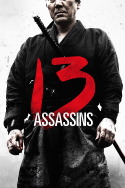
Review of 13 Assassins (2010) by Daniel K — 25 Sep 2011
4: Funny, I wouldn't have predicted this would be one of those films that I drastically undervalue the first time around (much like Zodiac and Let the Right One In, which I believe have both transitioned from 3.
5 to 4.5 stars). I've altered my rating from 3 to 4 stars after a second viewing. It really seems as if Miike has taken Seven Samurai and updated it for a modern audience, except we have 13 heroes and the fight against a sadistic prince has taken on national significance.
Basically, whenever I criticize the film below, believe that my opinion is now the opposite. For instance, the geography of the town was more comprehensible this time around, the characters are more memorable, and it was immersive and somewhat overwhelming in its virtuosity.
This was my original review: Given the plethora of gushing reviews, I was actually expecting more. I've definitely enjoyed much of Miike's ultra-violent and purposefully shocking work, but I wouldn't call myself a fan and 13 Assassins sadly did not change my mind.
I was more than willing to rush into the picture and embrace it, both because it was the last Monday night Bear Tooth theatre film I'm ever likely to watch along with the now obligatory pitcher of Moose's Tooth hard Apple Ale, and because it is a modern take on the samurai genre (aka the Western).
While it is appropriate to compare it to numerous recent and not-so-recent Western and/or War pictures, the picture I found myself thinking back to most often was certainly Seven Samurai. This is both a testament to the power and ambition of the film and of its failure: few films are likely to be worthy of favorable comparison to this masterpiece of masterpieces.
Just as Kurosawa took his time getting around to the fighting, so does Miike (the first two acts are devoted to political strategy and preparing for and travelling to battle, respectively). However, Kurosawa delicately balances the acts against one another and leaves the viewer begging for more.
Miike does not do the same. The physical landscape of the town in Kurosawa's masterpiece is entirely comprehensible to the viewer, whereas this town is a bit of a mystery. In other words, the viewer is not intimately immersed in the environment to the point of utter familiarity.
Each of Kurosawa's characters are indelibly etched onto one's consciousness and completely unforgettable. We grieve when they perish; not so here, at least not to so poignant an extent. Most of the characters blur together and are anything but memorable.
There are of course significant exceptions, but these are only the lead characters. They are indeed thoroughly engaging though. The cinematography and framing is extremely well done. I can't help but wish we were able to see what Kurosawa could have made given the lighting, processing, lenses, and film stock available today.
Just as contemporary Westerns seem to be from another world, so did Miike's version of the Samurai picture. The main strength of the film for me was its examination of violence. I couldn't help but feel that every image was placed before the viewer simply to elicit an emotional and intellectual response and make them consider just what their role in the entire process was.
We take sadistic pleasure in the violence, the rape, the maiming, the amputation, the cruelty, the murder, etc, just as the antagonist and villain in the picture does. He doesn't quite seem to understand his fascination, but do we as the audience? We want him to be brutally slaughtered and punished for his transgressions, so are we any different? We grit our teeth and wait with baited breath for the battle to commence and the slaughter to proceed.
Additionally, Miike seems to be commenting on the viability and reasonableness of the samurai code (just as Kurosawa and so many others have). The head of the antagonists army seems to advocate loyalty above all else, even though he knows he is serving a monster bent on destroying the peace of the empire.
He is following his code. This is a philosophical point that can be related to numerous other examples, both historical and contemporary (government and corporate whistleblowers for instance). It was a fascinating, thought provoking picture, but in the end I found it a bit of a disappointment and less than immersively overwhelming.
This review of 13 Assassins (2010) was written by Daniel K on 25 Sep 2011.
13 Assassins has generally received very positive reviews.
Was this review helpful?