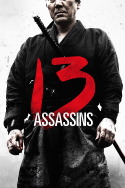
Review of 13 Assassins (2010) by Thefilmdoctor — 22 Mar 2016
Takashi Miike is in top slashtastic form with this samurai drama.
Set around 1844, when the feudal Shogunate still ruled Japan, the action starts with an attention-grabbing sequence showing a nobleman (Masaaki Uchino) committing hara-kari. It’s explained that his ritual suicide was sparked by shame over fact that his daughter was raped and murdered by Lord Naritsugu Matsudaira (smoothly heinous Goro Inagaki), the current Shogun’s brother, whose bloodlust — and just plain lust — seems to know no bounds.
Deciding that enough’s enough, high-ranking Shogun official Sir Doi (Mikijiro Hira) hires respected samurai Shinzaemon Shimada (Koji Yakusho, a local household name better known offshore for “Babel” and “Memoirs of a Geisha”) to assassinate Naritsugu.
Slightly draggy middle act focuses on Shinzaemon preparing a team of, natch, 13 assassins to slay the baddie and his retinue — which means the avengers will come up against Shinzaemon’s old friend, now Naritsugu’s right-hand samurai, Hanbei Kitou (Masachika Ichimura).
Some of Shinzaemon’s band of brothers are given more prominence than others, like his gambling-addicted nephew, Shinrokuro (Takayuki Yamada), and his sturdy, fiercely loyal apprentice, Hirayama (Tsuyoshi Ihara). There’s also scruffy oldster Sahara (Arata Furuta), who asks for payment upfront (if you mapped the cast of “Ocean’s Eleven” on this, he’d be Elliott Gould), and rangy non-samurai Koyata (Takayuki Yamada, providing comic relief), who couldn’t give a damn about honor but is up for a good scrap.
Pic’s last 45 minutes or so basically offers one long battle scene as Shinzaemon and Naritsugu’s posses square off in a town loaded with booby traps set by Shinzaemon’s crew to even the 200-13 odds. Heads literally roll, but considering Miike’s reputation for extreme gore, the violence is largely restrained. Swordplay throughout is gracefully executed, with Miike and editor Kenji **** striking a judicious balance between closeups and long shots. Indeed, the film’s staging makes consistent logical sense, providing a clear idea of what’s going on where and who’s who.
Most welcome of all, Miike proves here he can play it straight when he wants to, and while there’s just enough humor to leaven the proceedings (especially when things are at their grimmest, often courtesy of the deliciously, near-satanically evil Naritsugu), there’s no winking at the audience or any attempt to subvert the genre. That said, the script interjects a contempo sensibility by raising issue with the strict samurai code that calls for unconditional obedience to masters, even at the cost of what’s best for the nation. There are obvious nods to Kurosawa, but also to more contempo genre fare. Offshore auds may struggle somewhat to keep up with the earlier reels’ copious discussions of propriety and allegiance, which play such a major role in shaping events.
Terrific, character-defining costumes by Kazuhiro Sawataishi; a rousing, propulsive score by regular Miike-collaborator Koji Endo; and great, vivid sound work, especially from the pic’s Foley artists to suggest the sound of sliced flesh, round out a tip-top tech package. The version to be released in Japan will be 20 minutes longer, nearly all of it set in a bordello that’s visited the night before the battle; producers apparently felt this slowed the pic down too much, and cut it for the international version shown in Venice.
This review of 13 Assassins (2010) was written by Thefilmdoctor on 22 Mar 2016.
13 Assassins has generally received very positive reviews.
Was this review helpful?