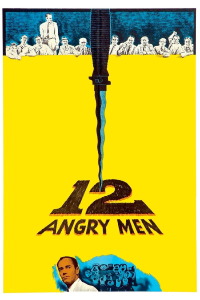
Review of 12 Angry Men (1957) by Blake P — 09 Jun 2014
?12 Angry Men? is so essential in the world of film it proves to be a nearly impossible task to praise it too highly.
It isn?t keen on changing setting ? it?s more drawn to pulling the viewer in simply through its story, its actors. Sometimes, we forget that the best of films are the ones that don?t pull a bunch of stunts to spark our interest, and ?12 Angry Men? is an example of one. Jury duty is a job that most groan at, as it calls for hours upon hours of sitting in restlessness, waiting with anxiety as to when the case will finally end. The jurors in the film have this mindset stuck in their head like a catchy pop song ? yet, unexpectedly, they are thrown a biscuit that proves too difficult to eat in just one bite. They must chew it slowly, enjoying the flavor.
The case portrayed in ?12 Angry Men? at first seems like a clean-cut one. A young man is on trial for allegedly stabbing his father to death. There are witnesses. The defendant has a criminal background. He must be guilty, right? What gives the film the light to the dynamite is Juror #8, played by Henry Fonda with a heroic cape shrouded in an everyman façade. He is the only one who votes not guilty ? he feels that the case has hardly been discussed, and a young man?s life is on the line. He deserves a chance to live, not be thrown away with the daily trash.
#8?s rejection of the status quo slowly but surely reveals the true natures of the men around him. Some are like-minded and intellectual in their thinking; but others turn towards old-school values for judgement. The defendant is a minority, and while people like #8 base their opinion on the case in its essence, the biggest of scoundrels, such as the intolerant Juror #10 (Ed Begley), look towards more personal reasons in their judgement. The film is only 95 minutes long, but it invites in emotional impact and intensity with the force of a meteor.
It?s important to remember that 1957 was a time of change for America ? the Civil Rights Movement was beginning; women were inching their way towards equality. To have a defendant who happens to be a minority would not cause any difference today, but in the ?50s, it could go in any direction. Juror #8 represents the changing U.S., the people with open minds that weren?t bent on the age old racism that was pushing American back rather than forward. Juror #10 shows the nasty side that we often choose to ignore when it comes to history, the population that was more concerned with making their grandfathers proud than doing what was right. Witnessing the two parties in one film is quite fascinating, as we know which side would eventually conquer all.
Sidney Lumet, who is now considered to be one of the finest directors of all-time, is able to produce verity with touches of cinema to make everything a tad bit more dramatic while still keeping things away from contrivance. The film is set on the hottest day of the year, and in return, the men are doused in sweat, mirroring the white hot tension that burns in the room. Lumet puts the camera at eye level with a wide-lens, giving us claustrophobia that is unshakably uncomfortable. These sprinklings of filmmaking prowess is what gives ?12 Angry Men? its artistic flair ? it is able to showcase the actors while still giving the setting a chance to complement them.
?12 Angry Men? is a classic in the truest sense of the word ? a marvel in cinema that can scarcely be recreated today. The acting, the screenplay, the direction, is all so flawless that it has not aged.
This review of 12 Angry Men (1957) was written by Blake P on 09 Jun 2014.
12 Angry Men has generally received very positive reviews.
Was this review helpful?