Review of 12 Angry Men (1957) by John R — 24 Aug 2014
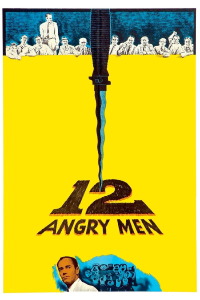
This summer, I was supposed to be part of a jury. For what case, I have no idea. I was not needed and won't receive another summons for, at least, six years. I feel bittersweet about this. People tend to complain about jury duty, but it would have been a new experience for me. 12 Angry Men is the closest I can get to the real thing, listening to each juror's reasoning, backgrounds, etc. The case is that an 18-year-old Puerto Rican boy is on trial for allegedly killing his father, and the entire movie is the twelve white male jurors in the waiting room, deciding the boy's fate. If he is found guilty, he will be executed. This case is probably far more interesting than one I could have participated in. There are no scenes in the courtroom, but when it is revealed that the verdict is not unanimous (11-1, in favour of guilty), the jurors reflect on what was said in the courtroom versus what else was possible. Why would you want to sit through a film in a jury room? Because it's not just a matter of convincing you whether or not the boy is guilty, beyond reasonable doubt. 12 Angry Men, or one angry man Henry Fonda, the lone "non guilty" juror, also exposes injustices against Puerto Rican youths, be it from the jurors, the witnesses, or even the boy's lawyer. The whole system seems quite corrupted, on the basis of this trial alone. After listening to each man explain his reasoning for a vote, sometimes a change in vote, I already feel sharper about interpreting evidence and such.
"Still," you say, "Why would I want to watch a jury room drama? It's bad enough in real life!" Well, you non-believer, if the drama is not enough for you, watch this for the characters and their relationship with one another. Every single juror has at least one moment where he speaks his mind and indirectly reveals conflicting characteristics. All twelve actors perform impeccably, particularly Henry Fonda and the stubborn Lee J Cobb. Out of the twelve moments to shine, however, my favourite comes from Ed Begley, who is so sure that the boy is guilty because, "that's what they're all like." He is so clearly racist that all other jurors can't stand to listen to him speak, some of whom seem to realize that they might have been biased themselves. Begley still continues to speak, until no one is listening to, or even looking at, him. Credit to director Sidney Lumet for that one. Most credit for this marvelous work should go to screenwriter Reginald Rose, whose script was so strong that it would take effort to ruin its material.
This review of 12 Angry Men (1957) was written by John R on 24 Aug 2014.
12 Angry Men has generally received very positive reviews.
Was this review helpful?