Review of Yojimbo (1961) by Ricardo O — 25 Mar 2010
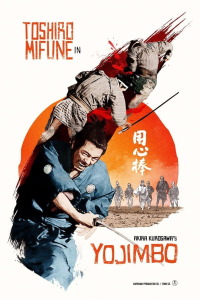
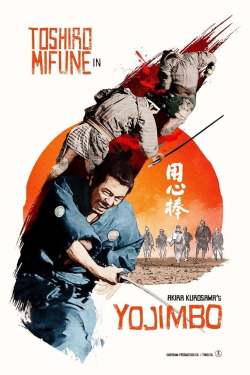
A lone samurai drifter, unemployed after the collapse of the Tokugawa Dynasty, arriving at a crossroads, throwing a stick in the air and walking in the direction it points. This brings him to a small town where two clans constantly battling each other. One of the first things he sees is a dog with a human hand in its mouth. The town almost seems deserted until a little man comes running out and offers to act as an employment service to give him a job as a yojimbo - a bodyguard. The samurai named Sanjuro, played Toshiro Mifune, listens but does not commit just yet and requests for sake and something to eat. After displaying his great swordsmanship before both clans in a brawl, Sanjuro offers his services to the highest bidder. When Sanjuro overhears the employer's wife telling him, "We'd save the whole 50 ryo if we killed him after he wins," the clever warrior switches to the other side. His goal is to trick the two parties into killing each other because neither one of these clans are good in any way and he feels they should both be exterminated for the greater good of the townspeople. Sanjuro's plan gets a wrench thrown in, however, when the brother of one of the leaders, comes to town with a modern weapon: a gun. The brother named Unosuke, played by Tatsuya Nakadai, is a sneaky kind of self-confident person, and he produces the weapon smugly from time to time. Occasionally, he kills people in cold blood, just to prove that he can. Possibly the only two people that are actually good in the whole town, a farmer and his wife are kidnapped. While employed by the party that has done the kidnapping, Sanjuro kills the six guards, frees them, and tears up the house so that it could look like a fierce struggle and then blames it all on the other side. Sanjuro is then beaten and imprisoned but is able to escape with the help of the old man and the coffin-maker. Sometime after, the old man is taken prisoner and this enrages Sanjuro. He then goes back into the town and challenges Unosuke to a final showdown, where the old world samurai is pitted against the new world progress, and must use hit wits and his physical prowess to survive. With both sides now defeated, the ronin then moves on to the next town he may encounter.
Yojimbo is one of the most influential films ever made. It's influence includes movies especially Sergio Leone's first western A Fistful Of Dollars. The most overtly comic film in Kurosawa's whole canon is full of moments such as the words Sanjuro exchanges with the thugs in the beginning of the film as well as when he tells the coffin-maker "Two coffins. Noon, maybe three." Another scene is when the injured Sanjuro is smuggled away in a large barrel and when his bearers take a pause in the middle of the street, the samurai tilts up the lid of the barrel to provide a humorous commentary on the progress of the hunt for him. One of Kurosawa's finest films, Yojimbo is a classic example of the kind of craft that goes into the making of his films. Mifune's perfect performance is one of the finest ever put on screen. Mifune's outstanding performance, combined with Kurosawa's expert direction and Kazuo Miyagawa's beautifull photography, makes for one of the greatest, and funniest, films in Japanese cinema. This is a must see film for fans of Westerns and fans of Kurosawa to watch. 10/10.
This review of Yojimbo (1961) was written by Ricardo O on 25 Mar 2010.
Yojimbo has generally received very positive reviews.
Was this review helpful?